
















Copyright: ©Author(s) 2026.
World J Gastroenterol. Jan 21, 2027; 33(3): 123339
Published online Jan 21, 2027. doi: 10.3748/wjg.123339
Published online Jan 21, 2027. doi: 10.3748/wjg.123339
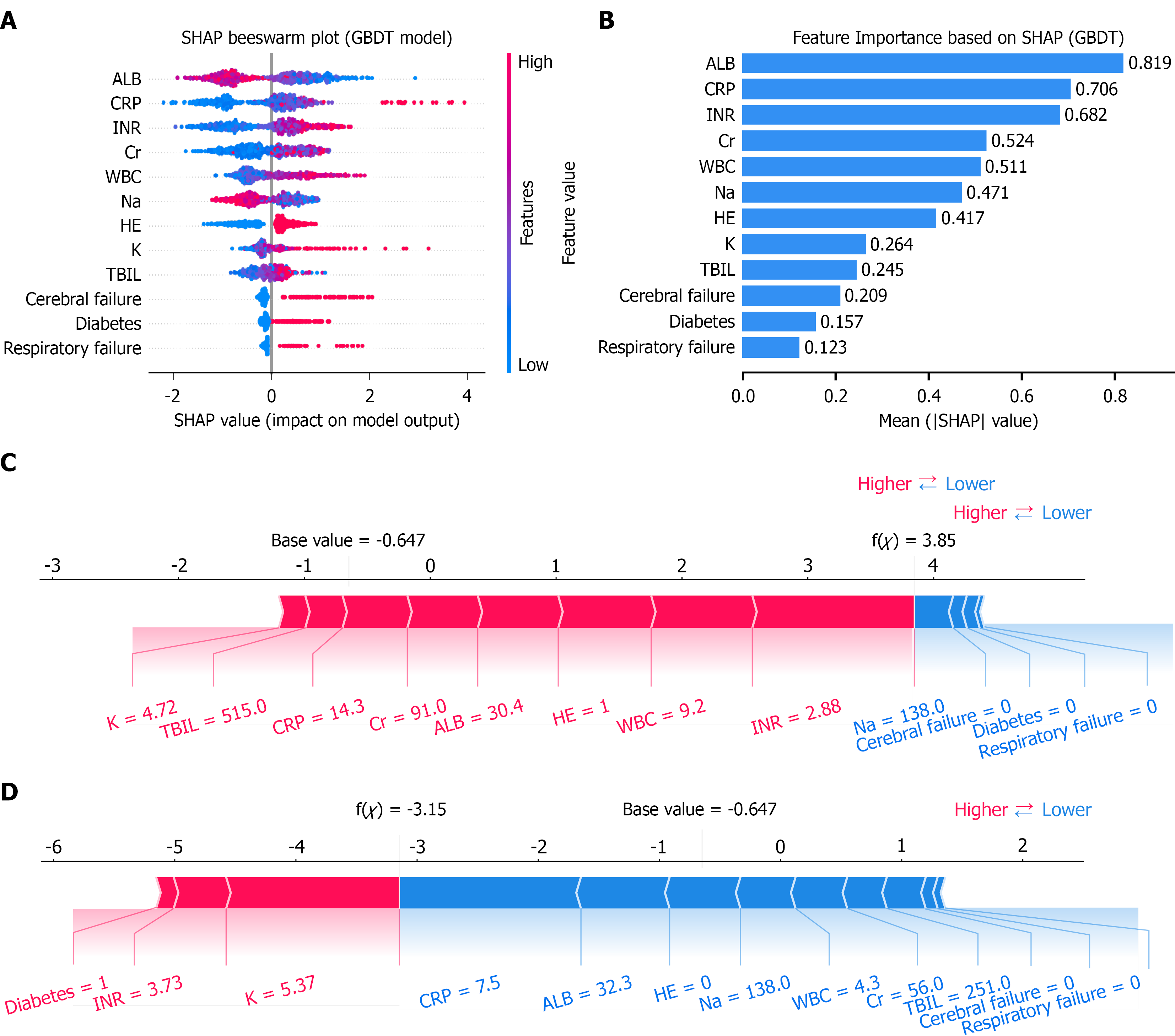
Figure 6 SHapley Additive exPlanations analysis of the final 12-feature Gradient Boosting Decision Tree model.
A: SHapley Additive exPlanations (SHAP) summary plot showing the distribution of SHAP values for each feature. Each dot represents one patient; red indicates a higher feature value and blue indicates a lower feature value; B: SHAP bar plot ranking feature importance in the final model; C: Local SHAP explanation for a representative patient with hospital-acquired (HA) bacterial infection; D: Local SHAP explanation for a representative patient without HA bacterial infection. In panels C and D, the SHAP value indicates the contribution of each feature to the model prediction for an individual patient. The base value represents the average model output, and f(x) represents the final log-odds prediction for the individual patient. Arrow length reflects the magnitude of each feature’s contribution. ALB: Albumin; CRP: C-reactive protein; INR: International normalized ratio; Cr: Creatinine; WBC: White blood cell count; Na: Sodium; K: Potassium; HE: Hepatic encephalopathy; TBIL: Total bilirubin; GBDT: Gradient Boosting Decision Tree; SHAP: SHapley Additive exPlanations.
- Citation: Chen JY, Chen XY, Xie YW, Chen YW, Shi XW, Lin N, Huang CJ, Luo R, Lu XQ, Chen XX, Wu J, Huang HJ, Zhu Q, Li LJ, Yu J, Cao HC. Development and validation of a machine learning model for hospital-acquired bacterial infection prediction in acute-on-chronic liver failure. World J Gastroenterol 2027; 33(3): 123339
- URL: https://www.wjgnet.com/1007-9327/full/v33/i3/123339.htm
- DOI: https://dx.doi.org/10.3748/wjg.123339