
















©Author(s) (or their employer(s)) 2026.
World J Gastroenterol. Mar 7, 2026; 32(9): 114207
Published online Mar 7, 2026. doi: 10.3748/wjg.v32.i9.114207
Published online Mar 7, 2026. doi: 10.3748/wjg.v32.i9.114207
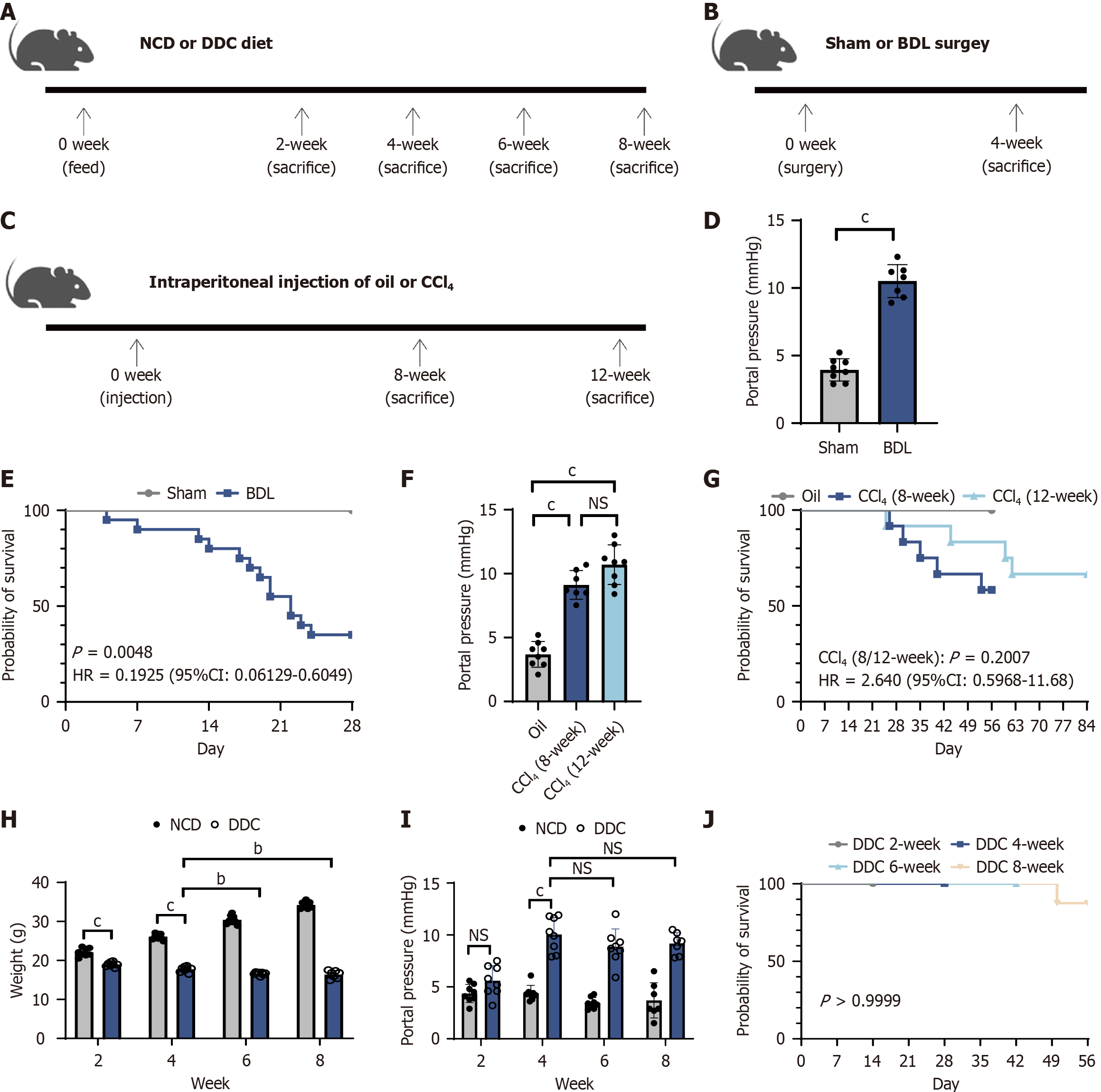
Figure 1 The 3,5-diethoxycarbonyl-1,4-dihydrocollidine diet mouse model (4 weeks) exhibited portal pressure comparable to bile duct ligation and carbon tetrachloride mouse models.
A-C: Schematics of the modeling procedures and timelines for 3,5-diethoxycarbonyl-1,4-dihydrocollidine (DDC) diet (A), bile duct ligation (BDL) (B), and carbon tetrachloride (CCl4) mouse models (C), respectively; D and E: Portal pressure measurements and survival curve of sham (n = 8) and BDL (n = 7) groups; F and G: Portal pressure and survival curve in oil (n = 8), 8-week CCl4 (n = 7), and 12-week CCl4 (n = 8) groups; H-J: Longitudinal comparisons of body weight, portal pressure, and survival curve between normal chow diet and DDC groups at 2 (n = 5), 4 (n = 5), 6 (n = 5), and 8 (n = 4) weeks post-modeling. aP < 0.05. bP < 0.01. cP < 0.001. NCD: Normal chow diet; DDC: 3,5-diethoxycarbonyl-1,4-dihydrocollidine; BDL: Bile duct ligation; CCl4: Carbon tetrachloride; HR: Hazard ratio; CI: Confidence interval; NS: No significant.
- Citation: Zhao JB, Wu ZH, Lin JY, Luo GQ, Zhang CH, Wu GB, Fan Q, Qi XL, Huo HZ, Yu JW, Li HJ, Zheng L, Luo M. Evaluation of a 3,5-diethoxycarbonyl-1,4-dihydrocollidine diet-induced mouse model in a comparative experimental study of portal hypertension. World J Gastroenterol 2026; 32(9): 114207
- URL: https://www.wjgnet.com/1007-9327/full/v32/i9/114207.htm
- DOI: https://dx.doi.org/10.3748/wjg.v32.i9.114207