
















©The Author(s) 2026.
World J Gastroenterol. Feb 28, 2026; 32(8): 115333
Published online Feb 28, 2026. doi: 10.3748/wjg.v32.i8.115333
Published online Feb 28, 2026. doi: 10.3748/wjg.v32.i8.115333
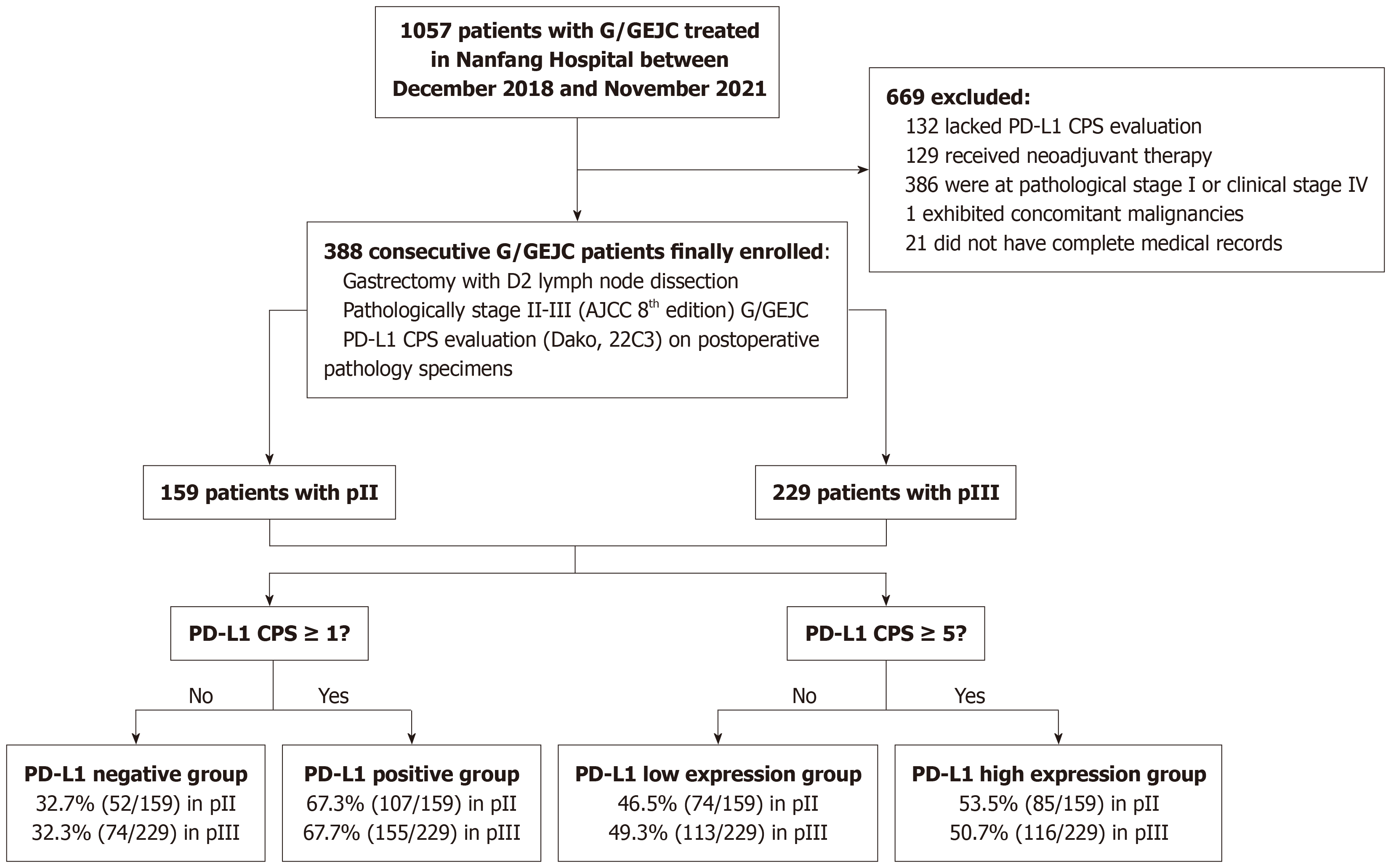
Figure 1 Study flow diagram.
A total of 1057 patients with gastric or gastroesophageal junction cancer (G/GEJC) were recorded in our database. Of these, 669 patients were excluded owing to the absence of a programmed death ligand-1 (PD-L1) combined positive score (CPS) assessment (n = 132), receipt of preoperative neoadjuvant therapy (n = 129), stage I or IV disease (n = 386), multiple primary malignancies (n = 1), or incomplete medical records (n = 21). The remaining 388 consecutive patients did not receive neoadjuvant therapy and were histologically confirmed as pathological stage II (pII) or pathological stage III (pIII) after gastrectomy. Among them, 159 patients were pII and 229 were pIII G/GEJC. In pII G/GEJC, 107 (67.3%) patients were PD-L1-positive (CPS ≥ 1) and 85 (53.5%) had high PD-L1 expression (CPS ≥ 5). In pIII G/GEJC, 155 (67.7%) patients were PD-L1-positive and 116 (50.7%) had high PD-L1 expression. G/GEJC: Gastric or gastroesophageal junction cancer; AJCC: American Joint Committee on Cancer; PD-L1: Programmed death ligand-1; CPS: Combined positive score; pII: Pathological stage II; pIII: Pathological stage III.
- Citation: Zhang HM, Li FP, Zhang HY, Liu XR, Chen XH, Liang HY, Yan X, Xie Q, Zhong R, Lai M, Zhong XF, Liu H, Zhao LY. High PD-L1 expression as a negative prognostic factor in stage III but not in stage II gastric cancer. World J Gastroenterol 2026; 32(8): 115333
- URL: https://www.wjgnet.com/1007-9327/full/v32/i8/115333.htm
- DOI: https://dx.doi.org/10.3748/wjg.v32.i8.115333