











BPG is committed to discovery and dissemination of knowledge
Minireviews
©The Author(s) 2026.
World J Gastroenterol. Feb 7, 2026; 32(5): 115009
Published online Feb 7, 2026. doi: 10.3748/wjg.v32.i5.115009
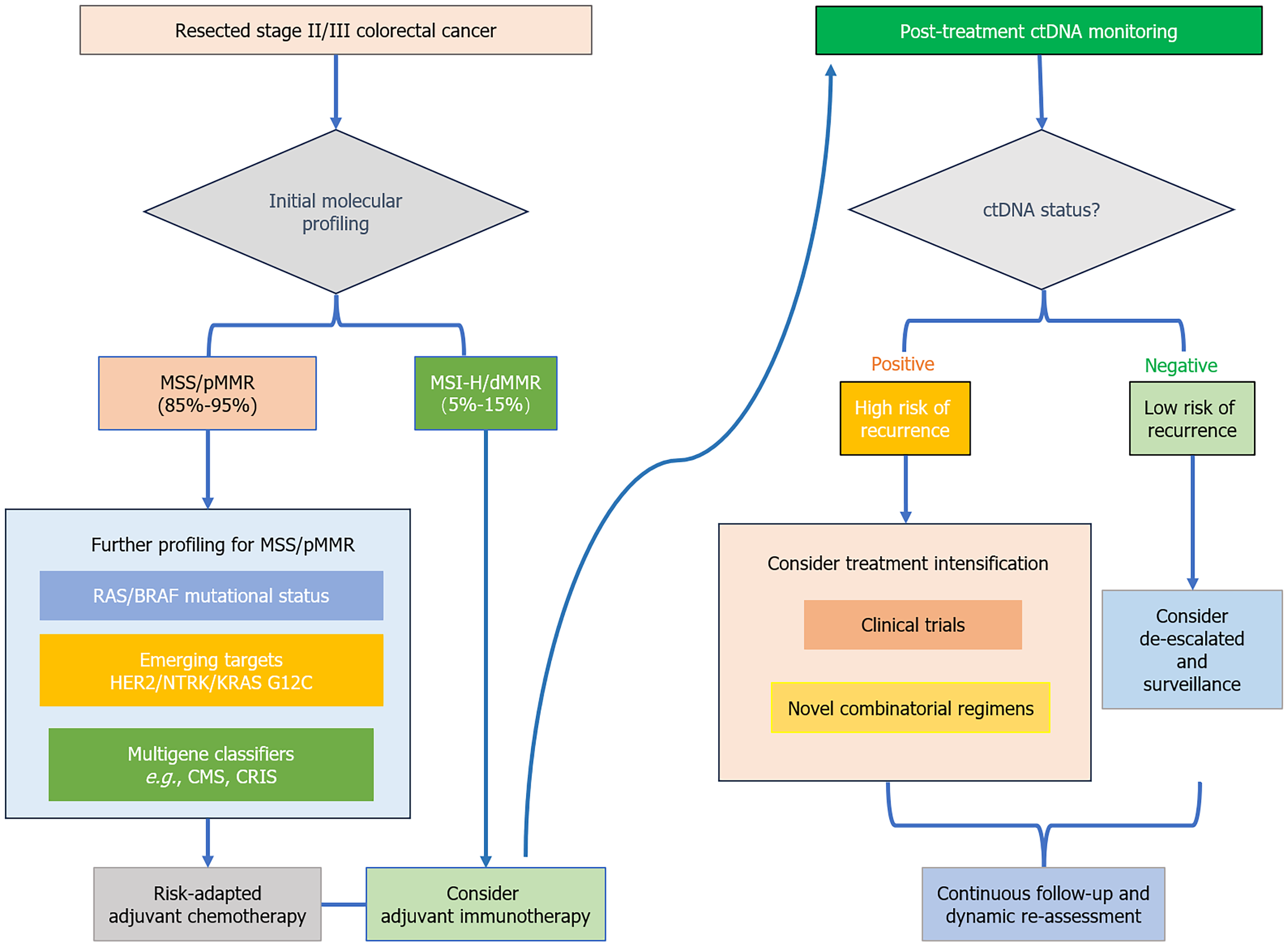
Figure 1
Figure 1 Molecular profiling-guided decision-making in the adjuvant therapy of stage II/III colorectal cancer. This algorithm illustrates the personalized management pathway following surgical resection. Initial molecular profiling by mismatch repair status segregates patients into microsatellite instability-high/mismatch repair deficient (representing a candidate for clinical trials evaluating adjuvant immunotherapy) and microsatellite stability/proficient mismatch repair streams. For the majority microsatellite stability/proficient mismatch repair cohort, further profiling (e.g., rat sarcoma viral oncogene homolog/B-rapidly accelerated fibrosarcoma, multigene classifiers) informs risk-adapted chemotherapy. For all patients, post-treatment circulating tumor DNA (ctDNA) monitoring dynamically stratifies recurrence risk, guiding subsequent decisions on treatment intensification (for ctDNA-positive) or de-escalated surveillance (for ctDNA-negative). MSS: Microsatellite stability; pMMR: Proficient mismatch repair; MSI-H: Microsatellite instability-high; dMMR: Mismatch repair deficient; RAS: Rat sarcoma viral oncogene homolog; BRAF: B-rapidly accelerated fibrosarcoma; HER2: Human epidermal growth factor receptor 2; NTRK: Neurotrophic tyrosine receptor kinase; KRAS: Kirsten rat sarcoma viral oncogene homolog; CMS: Consensus molecular subtype; CRIS: Colorectal cancer intrinsic subtype; ctDNA: Circulating tumor DNA.


Write to the Help Desk