
















©The Author(s) 2026.
World J Gastroenterol. Feb 7, 2026; 32(5): 114752
Published online Feb 7, 2026. doi: 10.3748/wjg.v32.i5.114752
Published online Feb 7, 2026. doi: 10.3748/wjg.v32.i5.114752
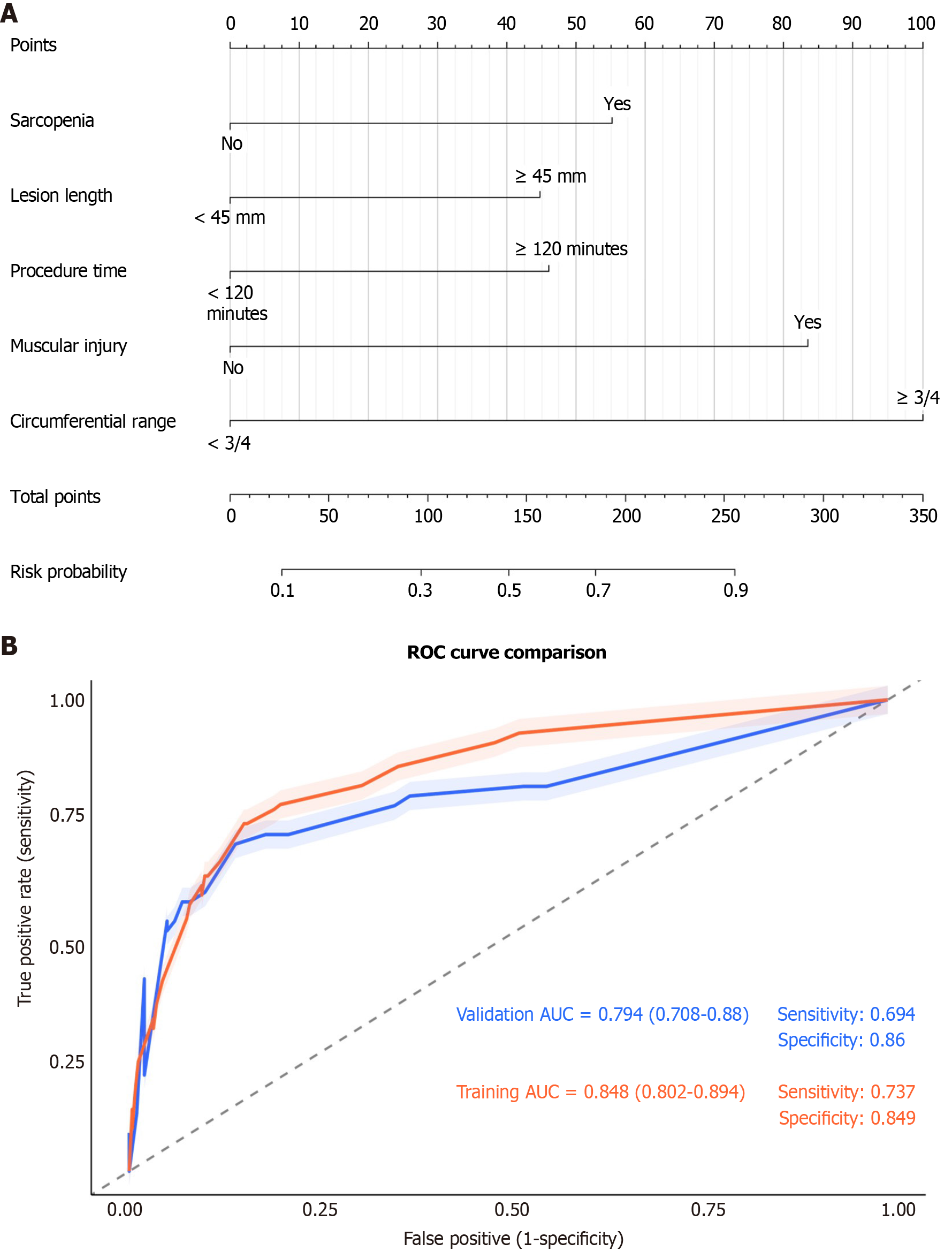
Figure 6 Development and validation of a predictive nomogram for post-endoscopic submucosal dissection stenosis.
A: The nomogram is used to calculate an individual patient's risk of postoperative stenosis. For each predictor (including sarcopenia, lesion length, procedure time, and circumferential range), a vertical line is drawn upward to the 'Points' axis to determine the corresponding score. The sum of these scores is located on the 'Total Points' axis, and a line drawn downward to the 'Risk Probability' axis indicates the personalized stenosis risk; B: Receiver operating characteristic curves demonstrate the discriminative ability of the model. The area under the curve was 0.848 (95% confidence interval: 0.802-0.894) in the training cohort and 0.794 (95% confidence interval: 0.708-0.88) in the validation cohort, indicating good and consistent predictive performance. ROC: Receiver operating characteristic; AUC: Area under the curve.
- Citation: Yang KZ, Chen L, Xu L, Xu BX, Li MY, Wang Z, Lu Q. Correlation between sarcopenia and esophageal stenosis following endoscopic submucosal dissection and construction of a postoperative stenosis risk model. World J Gastroenterol 2026; 32(5): 114752
- URL: https://www.wjgnet.com/1007-9327/full/v32/i5/114752.htm
- DOI: https://dx.doi.org/10.3748/wjg.v32.i5.114752