
















Copyright: ©Author(s) 2026.
World J Gastroenterol. Dec 28, 2026; 32(48): 119352
Published online Dec 28, 2026. doi: 10.3748/wjg.119352
Published online Dec 28, 2026. doi: 10.3748/wjg.119352
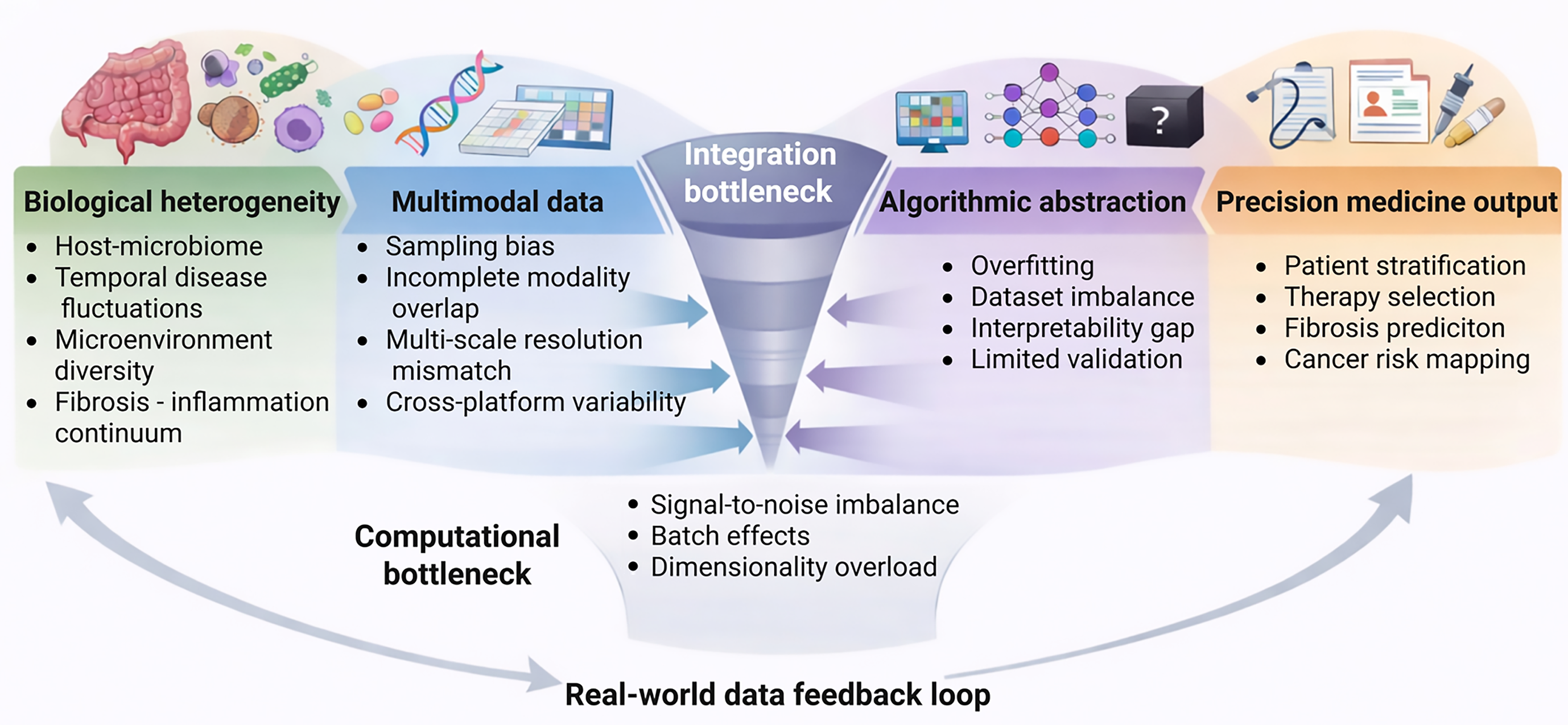
Figure 2 Schematic representation of the challenges that limit the translation of omics discoveries into clinically actionable precision medicine in inflammatory bowel disease.
Biological heterogeneity forms the foundational layer of complexity. Multimodal data acquisition introduces additional challenges, including sampling bias, incomplete modality overlap, cross-platform variability, and multi-scale resolution mismatches. Integration of high-dimensional datasets creates a computational bottleneck driven by dimensionality overload and signal-to-noise imbalance. Artificial intelligence models face challenges related to overfitting, limited validation, and interpretability. Together, these challenges delay the realization of precision medicine outputs such as patient stratification, therapy selection, fibrosis prediction, and cancer risk mapping. A real-world data feedback loop, incorporating prospective validation and iterative recalibration, is essential to overcome some translational constraints.
- Citation: Shirima CA, Sabuholo GA, Bubulac L, Patel P, Pircalabioru GG. Application of spatial omics, multi-omics, and artificial intelligence in inflammatory bowel disease: Current applications and emerging opportunities. World J Gastroenterol 2026; 32(48): 119352
- URL: https://www.wjgnet.com/1007-9327/full/v32/i48/119352.htm
- DOI: https://dx.doi.org/10.3748/wjg.119352