
















Copyright: ©Author(s) 2026.
World J Gastroenterol. Dec 7, 2026; 32(45): 121641
Published online Dec 7, 2026. doi: 10.3748/wjg.121641
Published online Dec 7, 2026. doi: 10.3748/wjg.121641
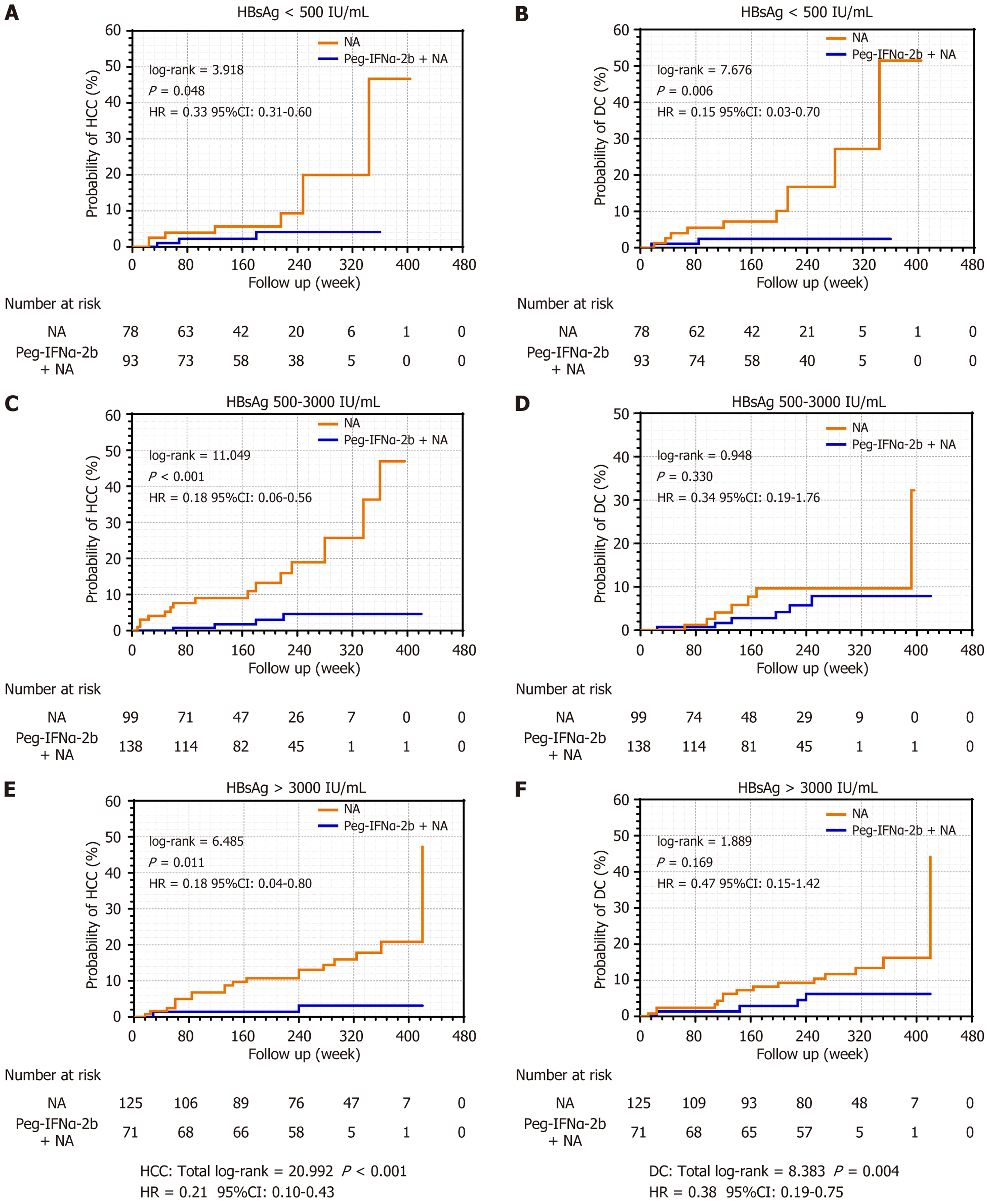
Figure 2 Survival analysis stratified by baseline serum hepatitis b surface antigen levels: Nucleos(t)ide analogue monotherapy vs pegylated interferon α-2b combined with nucleos(t)ide analogues.
A: Patients with hepatitis B surface antigen (HBsAg) < 500 IU/mL, endpoint: Hepatocellular carcinoma (HCC); B: Patients with HBsAg < 500 IU/mL, endpoint: Decompensated cirrhosis (DC); C: Patients with HBsAg 500-3000 IU/mL, endpoint: HCC; D: Patients with HBsAg 500-3000 IU/mL, Endpoint: DC; E: Patients with HBsAg > 3000 IU/mL, endpoint: HCC; F: Patients with HBsAg > 3000 IU/mL, endpoint: DC. HCC: Hepatocellular carcinoma; DC: Decompensated cirrhosis; HR: Hazard ratio; NA: Nucleos(t)ide analogue; Peg-IFNα-2b: Pegylated interferon α-2b.
- Citation: Li XY, Huang JT, Liu T, Li YY, Zhe L, Cao H, Lin BL. Pegylated interferon α-2b add-on to nucleos(t)ide analogues reduces hepatocellular carcinoma and decompensation in advanced fibrotic chronic hepatitis B. World J Gastroenterol 2026; 32(45): 121641
- URL: https://www.wjgnet.com/1007-9327/full/v32/i45/121641.htm
- DOI: https://dx.doi.org/10.3748/wjg.121641