
















Copyright: ©Author(s) 2026.
World J Gastroenterol. Dec 7, 2026; 32(45): 121242
Published online Dec 7, 2026. doi: 10.3748/wjg.121242
Published online Dec 7, 2026. doi: 10.3748/wjg.121242
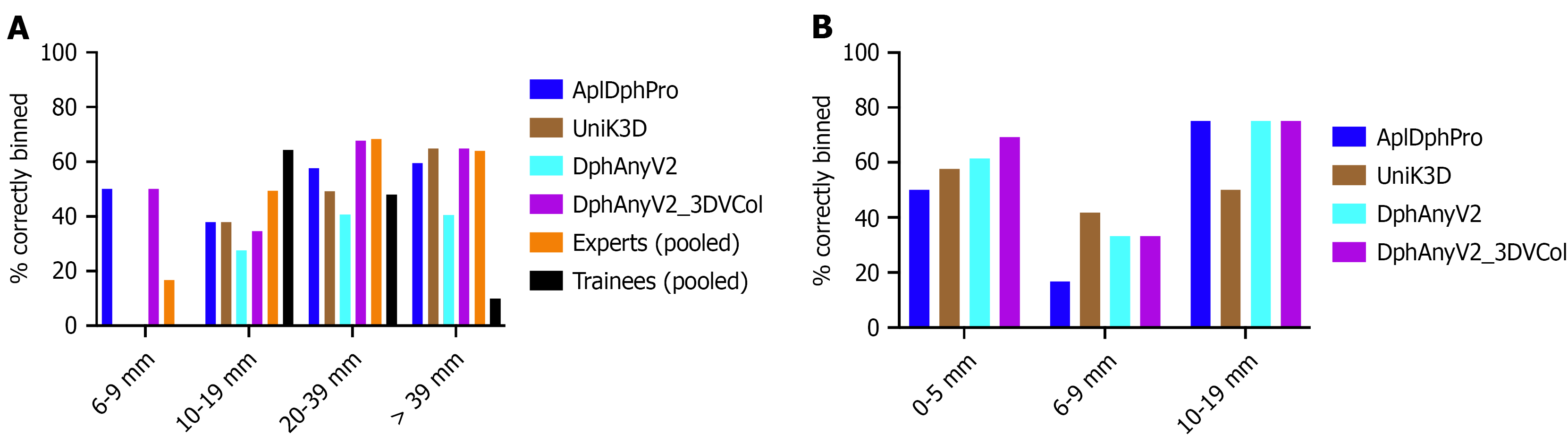
Figure 4 Percentage of correctly binned size predictions per size category for four artificial intelligence models (AplDepthPro, UniK3D, DphAnyV2, DphAnyV2_3DVCol).
A: Percentage of correctly binned size predictions per size category for four artificial intelligence (AI) models (AplDphPro, UniK3D, DphAnyV2, DphAnyV2_3DVCol), pooled experts, and pooled trainees. Measurements were classified into five bins (≤ 5 mm, 6-9 mm, 10-19 mm, 20-39 mm, > 39 mm). Across the three well-populated bins, experts showed the most consistent accuracy (49%-68%), while trainees performed well for smaller sizes (Bin 3: 64%) but markedly declined for larger measurements (Bin 5: 10%). Among AI models, DphAnyV2_3DVCol achieved the highest accuracy in the larger size ranges; B: Percentage of correctly binned size predictions per size category for four AI models (AplDepthPro, UniK3D, DphAnyV2, DphAnyV2_3DVCol) in a dataset restricted to smaller measurements. All models performed best in Bin 3, with three of four reaching 75% accuracy. Performance was notably weaker in Bin 2 across all models, with AplDepthPro achieving the lowest accuracy (17%).
- Citation: Schulz D, Ebigbo A, Holley E, Nagl S, Nichiporyk O, Probst A, Scheppach MW, Römmele C, Roser D, Zellmer S, Messmann H. Domain specific training with three-dimensional virtual colonoscopy images improves artificial intelligence based automated size prediction for large lesions. World J Gastroenterol 2026; 32(45): 121242
- URL: https://www.wjgnet.com/1007-9327/full/v32/i45/121242.htm
- DOI: https://dx.doi.org/10.3748/wjg.121242