
















Copyright: ©Author(s) 2026.
World J Gastroenterol. Nov 28, 2026; 32(44): 117819
Published online Nov 28, 2026. doi: 10.3748/wjg.117819
Published online Nov 28, 2026. doi: 10.3748/wjg.117819
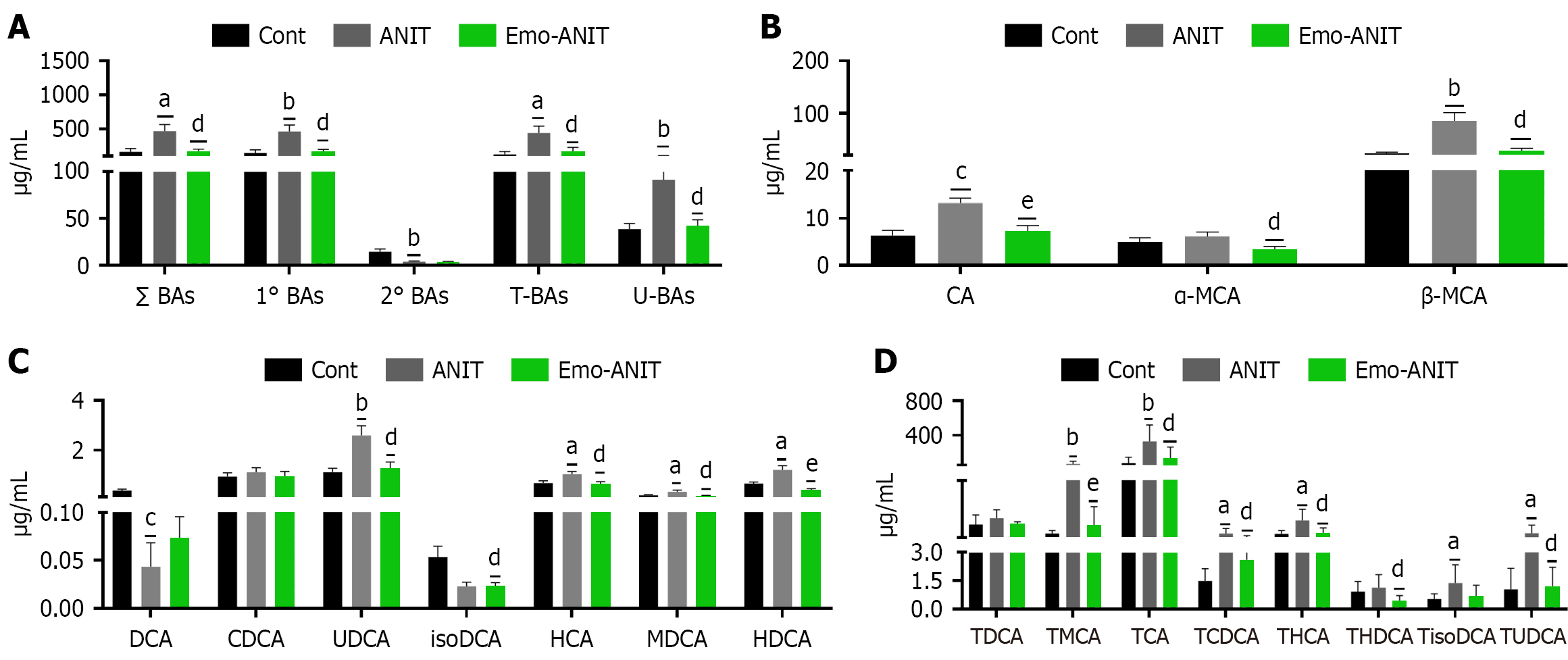
Figure 6 Effect of emodin on liver bile acids in mice with α-naphthylisothiocyanate-induced cholestatic liver injury.
A: Changes of total bile acids (BAs), primary BAs, secondary BAs, taurine-conjugated BAs and unconjugated BAs (U-BAs); B: Changes of U-BAs with high content; C: Changes of U-BAs with low content; D: Changes of taurine-conjugated BAs. Data were analyzed via two-tailed Student’s t-test, n = 8. aP < 0.05 vs control group, bP < 0.01 vs control group, cP < 0.001 vs control group, dP < 0.05 vs α-naphthylisothiocyanate group, and eP < 0.01 vs α-naphthylisothiocyanate group. Cont: Control; Emo: Emodin; ANIT: Α-naphthylisothiocyanate; Σ BAs: Total bile acids; 1° BAs: Primary bile acids; 2° BAs: Secondary bile acids; T-BAs: Taurine-conjugated bile acids; U-BAs: Unconjugated bile acids; CA: Cholic acid; MCA: Muricholic acid; DCA: Deoxycholic acid; CDCA: Chenodeoxycholic acid; UDCA: Ursodeoxycholic acid; HCA: Hyocholic acid; MDCA: Murideoxycholic acid; HDCA: Hyodesoxycholic acid; TDCA: Taurodeoxycholic acid; TMCA: Tauro-β-muricholic acid; TCA: Taurocholic acid; TCDCA: Taurochenodeoxycholic acid; THCA: Taurohyocholic acid; THDCA: Taurochenodeoxycholic acid; TUDCA: Tauroursodeoxycholic acid.
- Citation: Wang CX, Wang LM, Fu ZF, Zhao X, Han LF, Lou YF. Emodin ameliorates cholestatic liver injury by regulating bile acid metabolism and gut microbiota in mice. World J Gastroenterol 2026; 32(44): 117819
- URL: https://www.wjgnet.com/1007-9327/full/v32/i44/117819.htm
- DOI: https://dx.doi.org/10.3748/wjg.117819