
















Copyright: ©Author(s) 2026.
World J Gastroenterol. Nov 14, 2026; 32(42): 121690
Published online Nov 14, 2026. doi: 10.3748/wjg.121690
Published online Nov 14, 2026. doi: 10.3748/wjg.121690
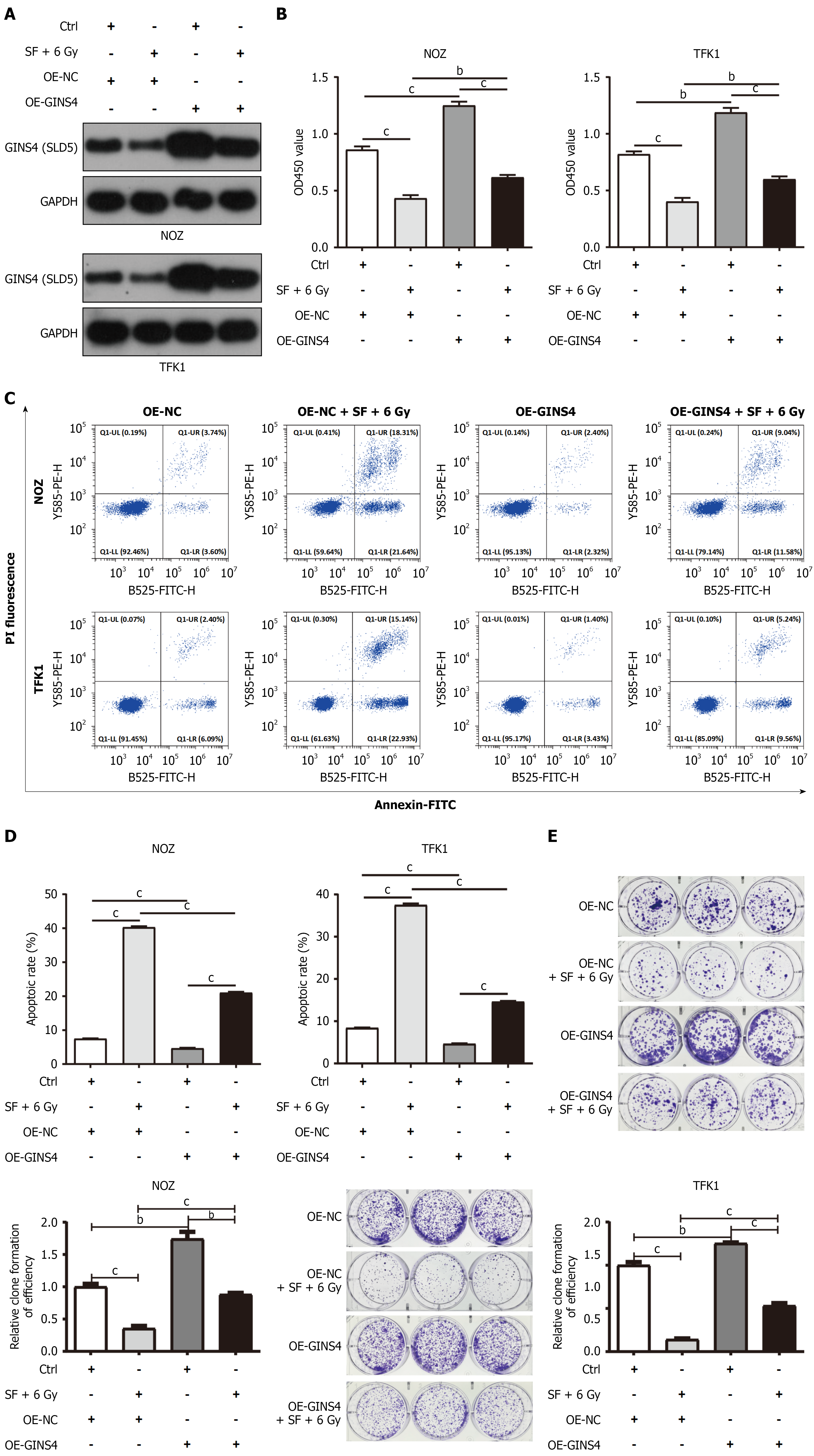
Figure 4 Overexpression of GINS4 promotes tumor proliferation and inhibits apoptosis, while surufatinib suppresses GINS4 expression and is associated with radiosensitization.
A: The pLenti-GINS4 (OE-GINS4) construct was generated using standard molecular biology techniques. Western blot analysis was performed to detect GINS4 expression levels among different treatment groups in NOZ and TFK-1 cells; control = empty vector control; B: Under conditions of GINS4 overexpression, cell viability was assessed across various treatment groups; C and D: Flow cytometry was employed to evaluate apoptosis in NOZ and TFK-1 cells in OE-GINS4 compared to control cells, with or without SF + 6 Gy treatment. Quantitative analysis of apoptosis rates among different treatment groups is presented in D; E: Clonogenic assays were conducted to assess the proliferative capacity of OE-GINS4 and control cells, with or without SF + 6 Gy treatment. Representative images of colony formation and quantitative analysis of colony counts for different treatment groups in NOZ and TFK-1 cells are shown in E, respectively. All data are presented as mean ± SEM from three independent experiments. bP < 0.01, cP < 0.001. SF: Surufatinib.
- Citation: Huang A, Cao Y, Li B, Xiao J, Zhan SD, Wang NY, Mei XP, Zhao SZ, Han J, Xiao Y, Wang LF, Ma H. Surufatinib achieves radiosensitivity in cholangiocarcinoma by suppressing GINS4 expression to induce Ca2+/cAMP signaling activation. World J Gastroenterol 2026; 32(42): 121690
- URL: https://www.wjgnet.com/1007-9327/full/v32/i42/121690.htm
- DOI: https://dx.doi.org/10.3748/wjg.121690