
















Copyright: ©Author(s) 2026.
World J Gastroenterol. Nov 14, 2026; 32(42): 117657
Published online Nov 14, 2026. doi: 10.3748/wjg.117657
Published online Nov 14, 2026. doi: 10.3748/wjg.117657
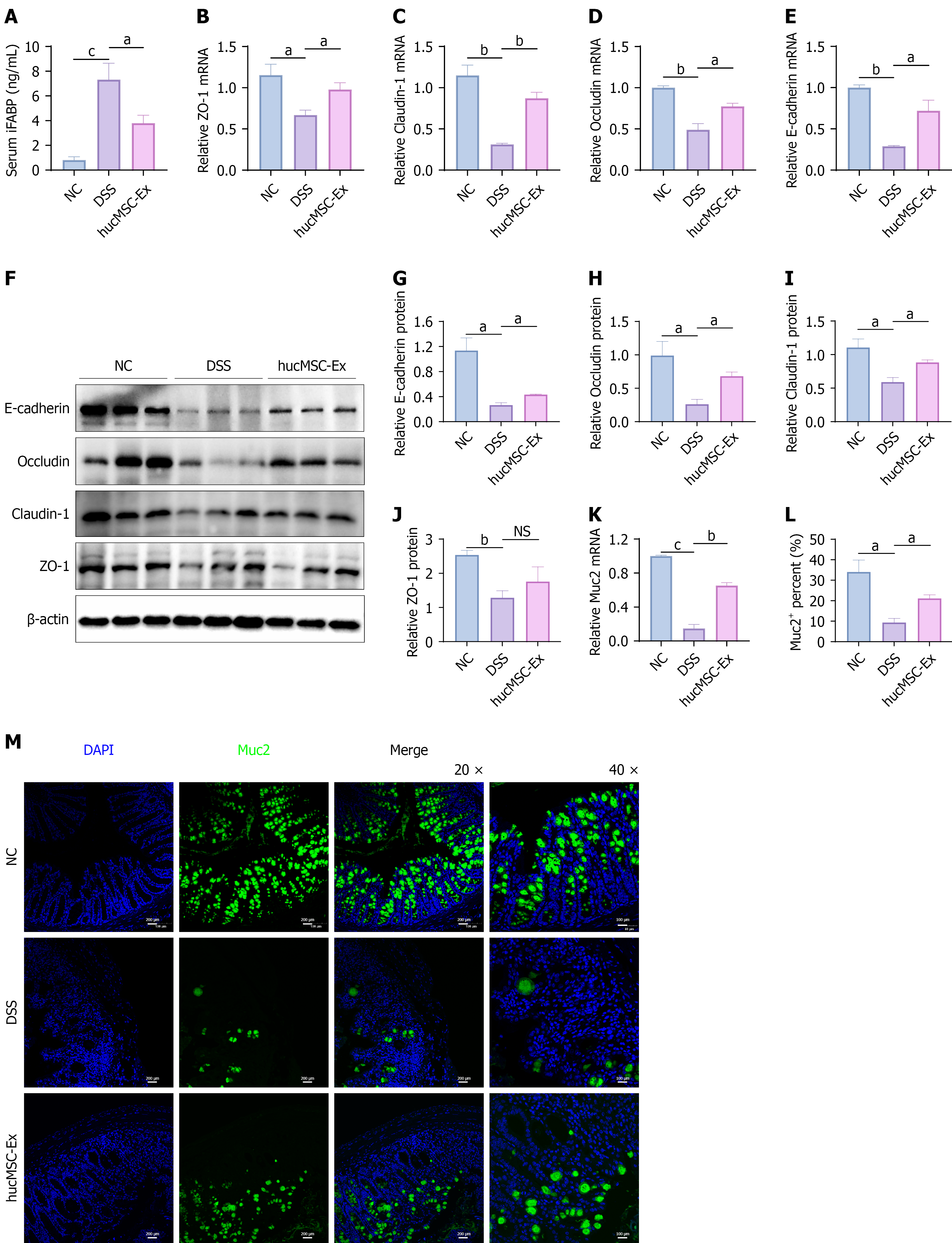
Figure 3 Human umbilical cord mesenchymal stem cell-derived exosomes alleviate intestinal mucosal barrier dysfunction in dextran sulfate sodium-induced colitis mice.
A: Serum levels of intestinal fatty acidbinding protein (iFABP) as an indicator of intestinal mucosal permeability; B-E: Messenger RNA expression levels of the tight junction proteins ZO-1, claudin-1, and occludin, and the adhesion junction protein Ecadherin; F: Representative Western blot bands showing protein expression of ZO-1, claudin-1, occludin, and E-cadherin; G-J: Quantitative analysis of protein expression for ZO-1, occludin, claudin-1, and E-cadherin by Western blot; K: Messenger RNA expression level of mucin 2 (Muc2) (20 ×, scale bar = 200 μm; 40 ×, scale bar = 100 μm); L and M: Immunofluorescence staining for Muc2 in colonic sections. Data are presented as the mean ± SD. aP < 0.05. bP < 0.01. cP < 0.001. dP < 0.0001. Each experiment was repeated three times independently (n = 8 mice per group). NC: Negative control; DSS: Dextran sulfate sodium; hucMSC-Ex: Human umbilical cord mesenchymal stem cell-derived exosomes; NS: No significance; mRNA: Messenger RNA; ZO-1: Zonula occludens-1; iFABP: Intestinal fatty acid-binding protein; DAPI: 4’,6-diamidino-2-phenylindole; Muc2: Mucin 2.
- Citation: Tian LL, Zhu J, Fan ZZ, Shi YT, Zhao LQ, He JD, Liang J. Human umbilical cord mesenchymal stem cell-derived exosomes alleviate experimental colitis by maintaining the intestinal barrier and remodeling macrophage polarization. World J Gastroenterol 2026; 32(42): 117657
- URL: https://www.wjgnet.com/1007-9327/full/v32/i42/117657.htm
- DOI: https://dx.doi.org/10.3748/wjg.117657