
















Copyright: ©Author(s) 2026.
World J Gastroenterol. Oct 21, 2026; 32(39): 121007
Published online Oct 21, 2026. doi: 10.3748/wjg.121007
Published online Oct 21, 2026. doi: 10.3748/wjg.121007
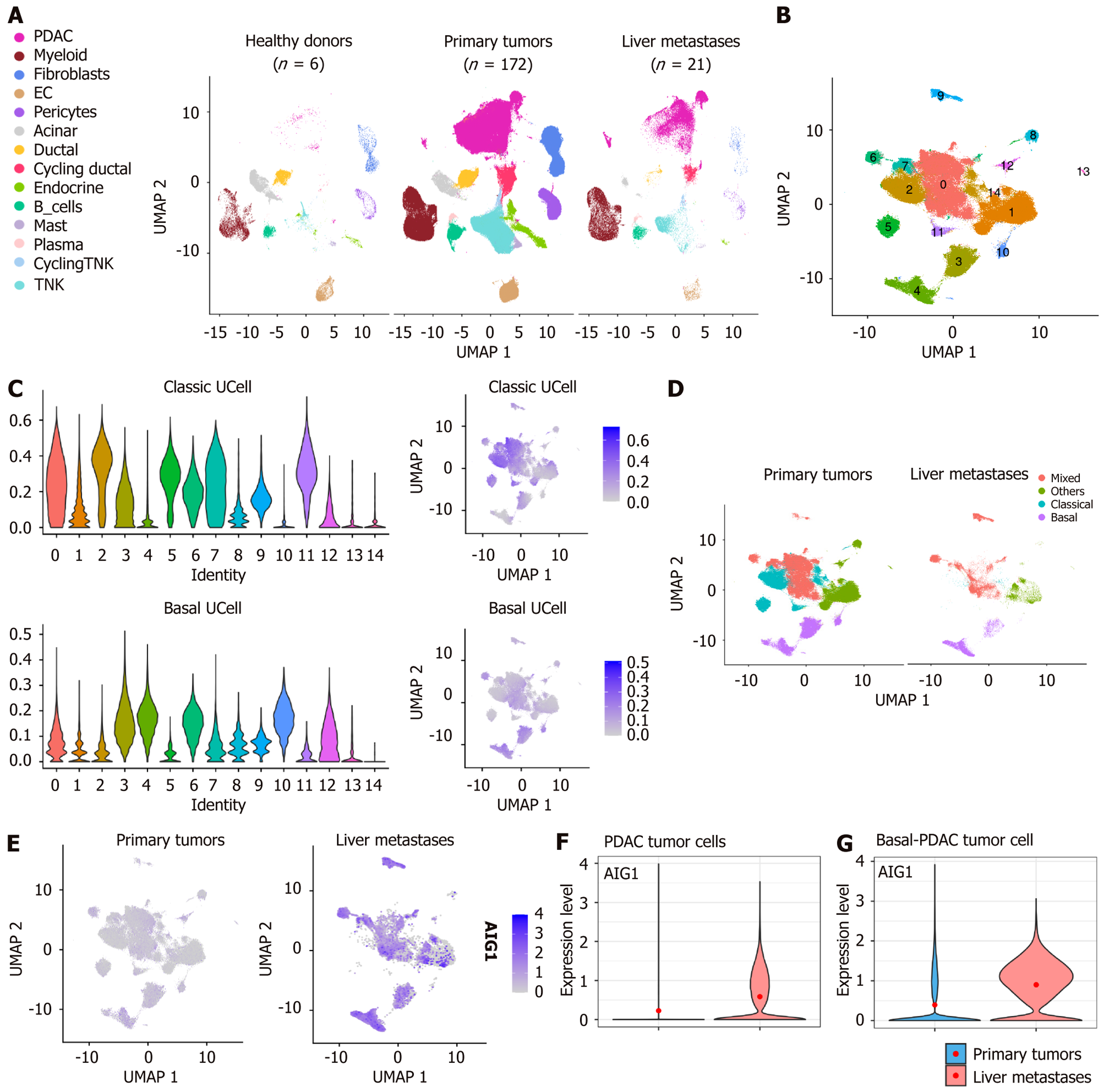
Figure 1 Human single-cell RNA sequencing analysis identifies basal-associated androgen-induced gene 1 upregulation during pancreatic ductal adenocarcinoma liver metastasis.
A: Global cellular landscape of human pancreatic tissues across disease states. Uniform manifold approximation and projection (UMAP) visualization of (n = 6) healthy donor pancreata, (n = 172) primary pancreatic tumors, and (n = 21) metastatic biopsies from the liver. The “pancreatic ductal adenocarcinoma (PDAC)” cluster represents PDAC tumor cells; B: Subclustering of PDAC tumor cells from primary tumor and liver metastatic. UMAP analysis resolved the cells into 15 distinct clusters; C: Single-cell scoring of classical and basal transcriptional programs in PDAC tumor cells. Violin plots (left) show the distribution of classical and basal signature scores across individual tumor cell subpopulations. FeaturePlots (right) visualize the spatial distribution of signature scores across the tumor cell UMAP embedding; D: UMAP visualization of PDAC tumor cells stratified by disease state and renamed by molecular subtypes; E: FeaturePlot showing increased AIG1 expression and broad distribution in tumor cells from liver metastases; F: Violin plot showing elevated AIG1 expression in tumor cells from liver metastases. Compared using Wilcoxon rank-sum test, with adjusted P < 0.0001; G: Enhanced AIG1 expression in basal-like tumor cells during liver metastasis. Compared using Wilcoxon rank-sum test, with adjusted P < 0.0001. PDAC: Pancreatic ductal adenocarcinoma; EC: Endothelial cells; TNK: T and natural killer; NK: Natural killer; AIG1: Androgen-induced gene 1.
- Citation: Luo YZ, Zhao Q, Wang FF, Li JH, Lyu SC, Liu Z, Lang R, He Q. Androgen-induced gene 1 correlates with extracellular vesicle-associated cholesterol metabolism and hepatic metastasis of pancreatic cancer. World J Gastroenterol 2026; 32(39): 121007
- URL: https://www.wjgnet.com/1007-9327/full/v32/i39/121007.htm
- DOI: https://dx.doi.org/10.3748/wjg.121007