
















Copyright: ©Author(s) 2026.
World J Gastroenterol. Oct 14, 2026; 32(38): 121425
Published online Oct 14, 2026. doi: 10.3748/wjg.121425
Published online Oct 14, 2026. doi: 10.3748/wjg.121425
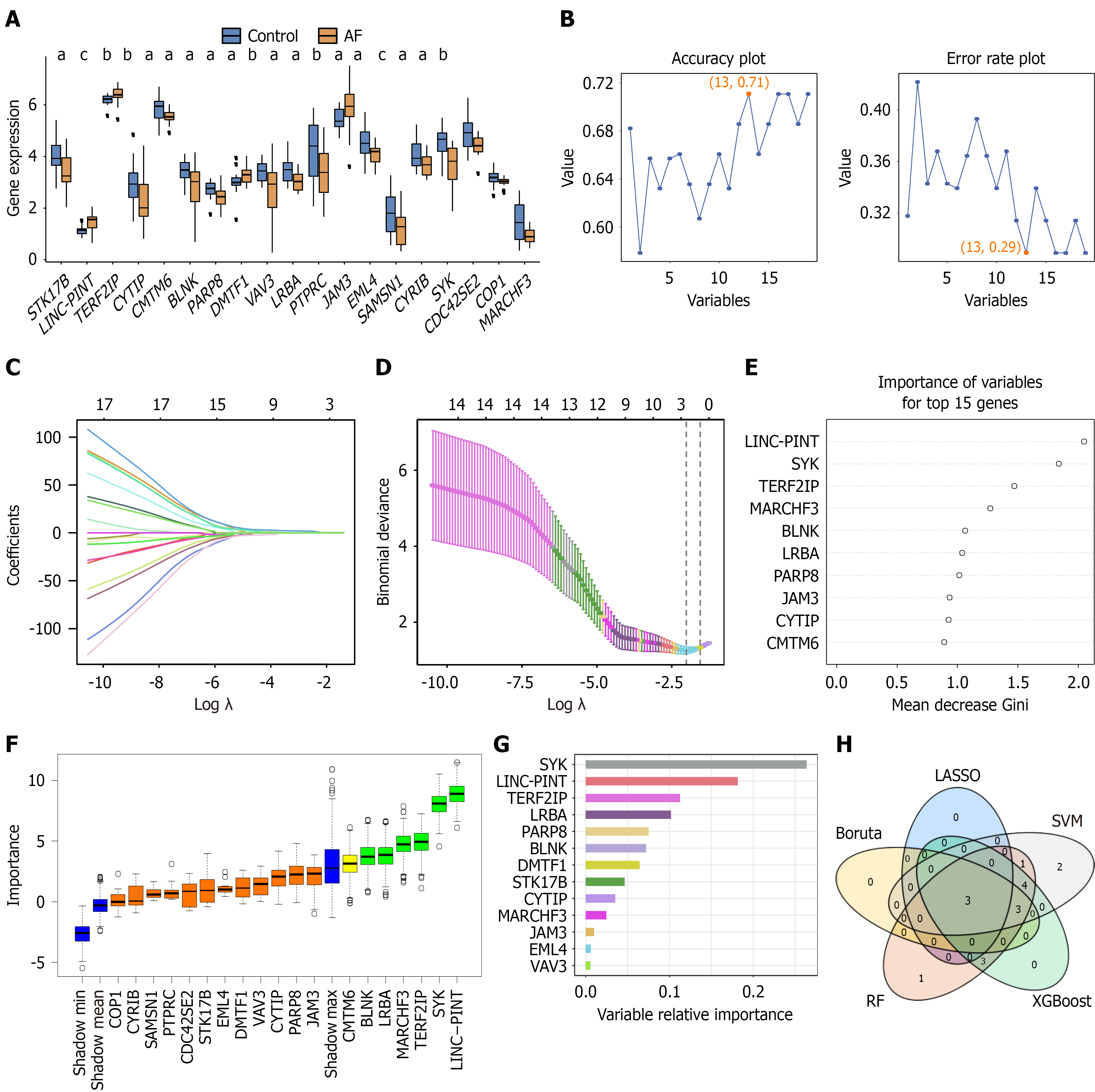
Figure 5 Machine learning-based identification of key genes related to anal fistula-associated B cells.
A: Box plot showing the expression levels of 19 candidate genes in B cells from anal fistula (AF) and control samples. Four genes were significantly upregulated in the AF group; B: Support vector machine model performance: Accuracy peaked (0.71) and error rate reached a minimum (0.29) when 13 variables were used; C: Coefficient profiles from least absolute shrinkage and selection operator (LASSO) regression analysis of the 19 genes across a range of penalty values (logλ); D: LASSO cross-validation plot identifying three key genes; E: Variable importance ranking of the top 15 genes derived from random forest analysis; F: Boruta algorithm identified 6 important genes; G: Extreme gradient boosting model ranking of variable importance across all input genes; H: Venn diagram showing the intersection of genes identified by five machine learning algorithms, with three common genes emerging as core candidates. aP < 0.05; bP < 0.01; cP < 0.001. AF: Anal fistula; LASSO: Least absolute shrinkage and selection operator; RF: Random forest; XGBoost: Extreme gradient boosting; SVM: Support vector machine.
- Citation: Li TT, Li JN, Yang HW, Dou XY, Jiang L, Lai LX, Yu Q, Chen XY, Wang Y, Zhang XC, Ma HF, Song XB. Single-cell and bulk transcriptomics with machine learning decode B cell hub genes and diagnostic biomarkers in anal fistula. World J Gastroenterol 2026; 32(38): 121425
- URL: https://www.wjgnet.com/1007-9327/full/v32/i38/121425.htm
- DOI: https://dx.doi.org/10.3748/wjg.121425