
















Copyright: ©Author(s) 2026.
World J Gastroenterol. Oct 7, 2026; 32(37): 120885
Published online Oct 7, 2026. doi: 10.3748/wjg.120885
Published online Oct 7, 2026. doi: 10.3748/wjg.120885
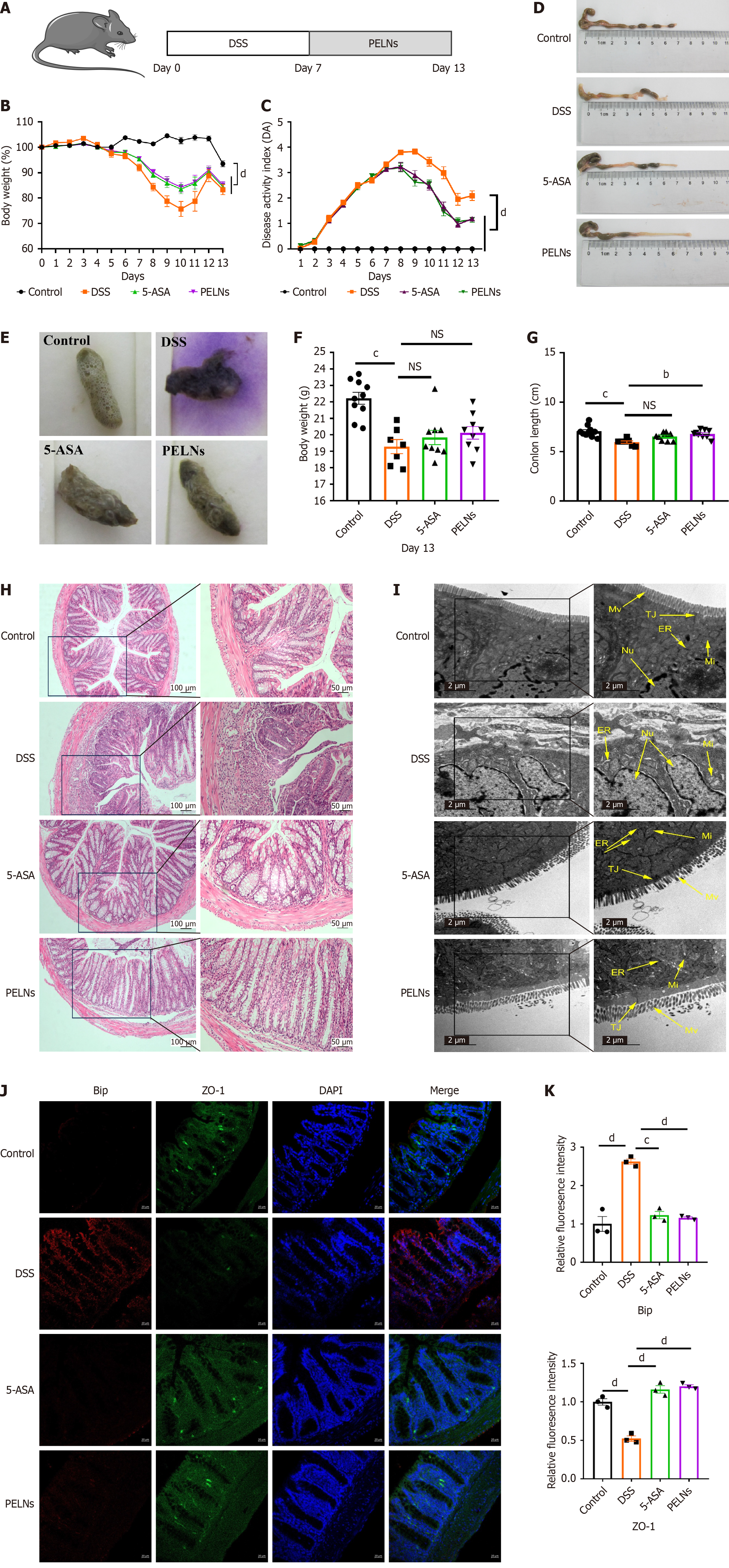
Figure 2 Portulaca oleracea L.
-derived exosome-like nanoparticles alleviate dextran sulfate sodium-induced colitis in mice. A: Schematic diagram of the experimental timeline; B: Body weight changes of mice throughout the experiment; C: Disease activity index scores of mice; D: Representative images and measurement of colon lengths; E: Fecal occult blood test results on day 13; F: Body weight of mice on day 13; G: Colon length of mice on day 13; H: Hematoxylin & eosin staining (× 50, × 100); I: Transmission electron microscopy observation of the ultrastructure of tight junctions and endoplasmic reticulum in intestinal epithelial cells (× 6000, × 8200); J: Representative immunofluorescence images showing Bip (red), ZO-1 (green), and DAPI (blue) staining in mouse colon tissues (× 200); K: Quantitative analysis of the relative fluorescence intensity of Bip and ZO-1 in mouse colon tissues. bP < 0.01, cP < 0.001, dP < 0.0001. NS: Not significant; DSS: Dextran sulfate sodium; PELNs: Portulaca oleracea L.-derived exosome-like nanoparticles; 5-ASA: 5-aminosalicylic acid.
- Citation: Liu XY, Liu ZX, Tan WW, Zhang WB, Qiao D, Chen SH, Zhang YL, Zheng L, Ge WS, Dai YC. Portulaca oleracea L.-derived exosome-like nanoparticles ameliorate colitis by modulating gut microbiota and metabolites to reduce endoplasmic reticulum stress. World J Gastroenterol 2026; 32(37): 120885
- URL: https://www.wjgnet.com/1007-9327/full/v32/i37/120885.htm
- DOI: https://dx.doi.org/10.3748/wjg.120885