
















Copyright: ©Author(s) 2026.
World J Gastroenterol. Aug 28, 2026; 32(32): 120382
Published online Aug 28, 2026. doi: 10.3748/wjg.120382
Published online Aug 28, 2026. doi: 10.3748/wjg.120382
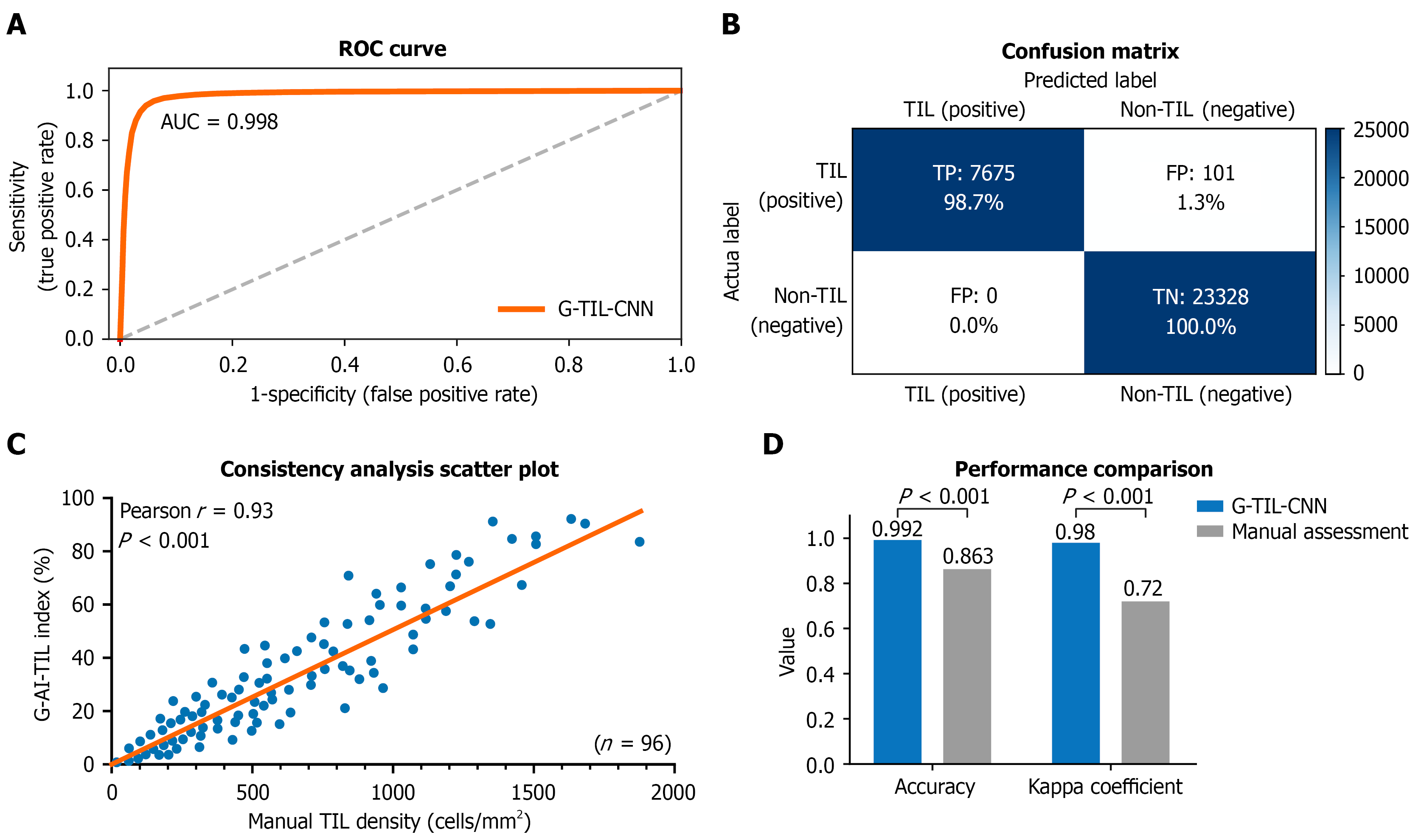
Figure 3 Performance evaluation of the gastric tumour-infiltrating lymphocyte-convolutional neural network model for tumour-infiltrating lymphocyte recognition.
Model performance was evaluated on 31104 test set patches. A: The receiver operating characteristic curve shows excellent discriminative ability for tumour-infiltrating lymphocyte (TILs)/non-TILs; B: The confusion matrix reveals 100.0% specificity (no false positives) and 98.7% sensitivity (1.3% miss rate); C: The scatter plot shows a strong positive correlation (Pearson r = 0.93, P < 0.001) between the gastric artificial intelligence-based TIL and the pathologist-manual TIL density, confirming quantitative consistency; D: The bar chart shows that the model outperforms the manual evaluation in terms of accuracy (99.2% vs 86.3%) and kappa coefficient (0.98 vs 0.72, P < 0.001), indicating that the interobserver variability is reduced. ROC: Receiver operating characteristic; AUC: Area under the curve; TIL: Tumour-infiltrating lymphocyte; CNN: Convolutional neural network; G-AI-TIL: Gastric artificial intelligence-based tumor-infiltrating lymphocytes.
- Citation: Fan Y, Wang SN, Jiang B, Li YY, Zhu CY, Liao XH, Zhang FS, Wang YK. Automatic recognition of tumour-infiltrating lymphocytes in pathological biopsy images of the gastric mucosa. World J Gastroenterol 2026; 32(32): 120382
- URL: https://www.wjgnet.com/1007-9327/full/v32/i32/120382.htm
- DOI: https://dx.doi.org/10.3748/wjg.120382