
















Copyright: ©Author(s) 2026.
World J Gastroenterol. Jun 21, 2026; 32(23): 117320
Published online Jun 21, 2026. doi: 10.3748/wjg.v32.i23.117320
Published online Jun 21, 2026. doi: 10.3748/wjg.v32.i23.117320
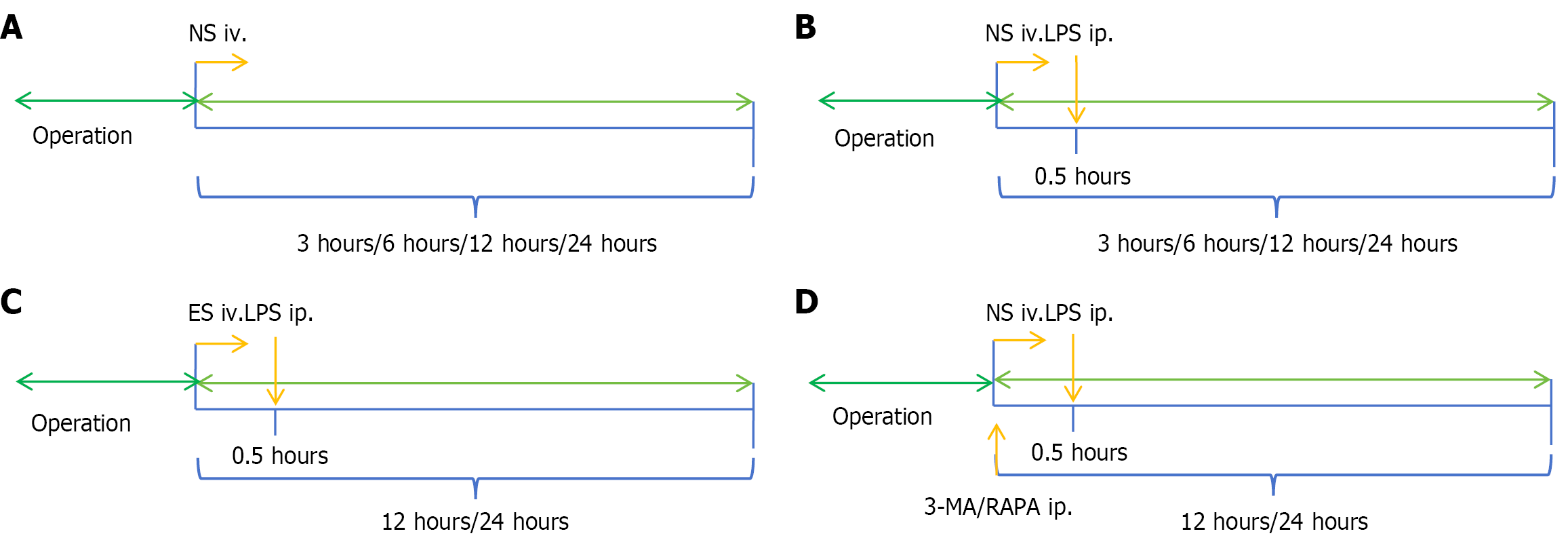
Figure 1 Schematic of the study design.
A: Rats in the Sham group continuously received normal saline (NS) for 3, 6, 12, or 24 hours after surgery; B: Rats in the lipopolysaccharide (LPS) group continuously received NS for 3, 6, 12, or 24 hours, and LPS was administered 30 minutes after the start of the NS infusion; C: Rats in the LPS + ES group continuously received ES for 12 or 24 hours, and LPS was administered 30 minutes after the start of ES and LPS treatment; D: Rats in the LPS + 3-methyladenine (3-MA) and LPS + rapamycin (RAPA) groups continuously received with NS for 12 or 24 hours as well as an intraperitoneal injection of 3-MA or RAPA, followed by an intraperitoneal injection of LPS 30 minutes after the start of the NS infusion. 3-MA: 3-methyladenine; ES: Esmolol; NS: Normal saline; RAPA: Rapamycin; LPS: Lipopolysaccharide.
- Citation: Zhang YB, Yu ZJ, Jin J, Liu MX, Ji FH, Yang XJ. Esmolol alleviates lipopolysaccharide-induced intestinal injuries by enhancing autophagy through the AMPK/mTOR/ULK1 pathway. World J Gastroenterol 2026; 32(23): 117320
- URL: https://www.wjgnet.com/1007-9327/full/v32/i23/117320.htm
- DOI: https://dx.doi.org/10.3748/wjg.v32.i23.117320