
















Copyright: ©Author(s) 2026.
World J Gastroenterol. May 28, 2026; 32(20): 116020
Published online May 28, 2026. doi: 10.3748/wjg.v32.i20.116020
Published online May 28, 2026. doi: 10.3748/wjg.v32.i20.116020
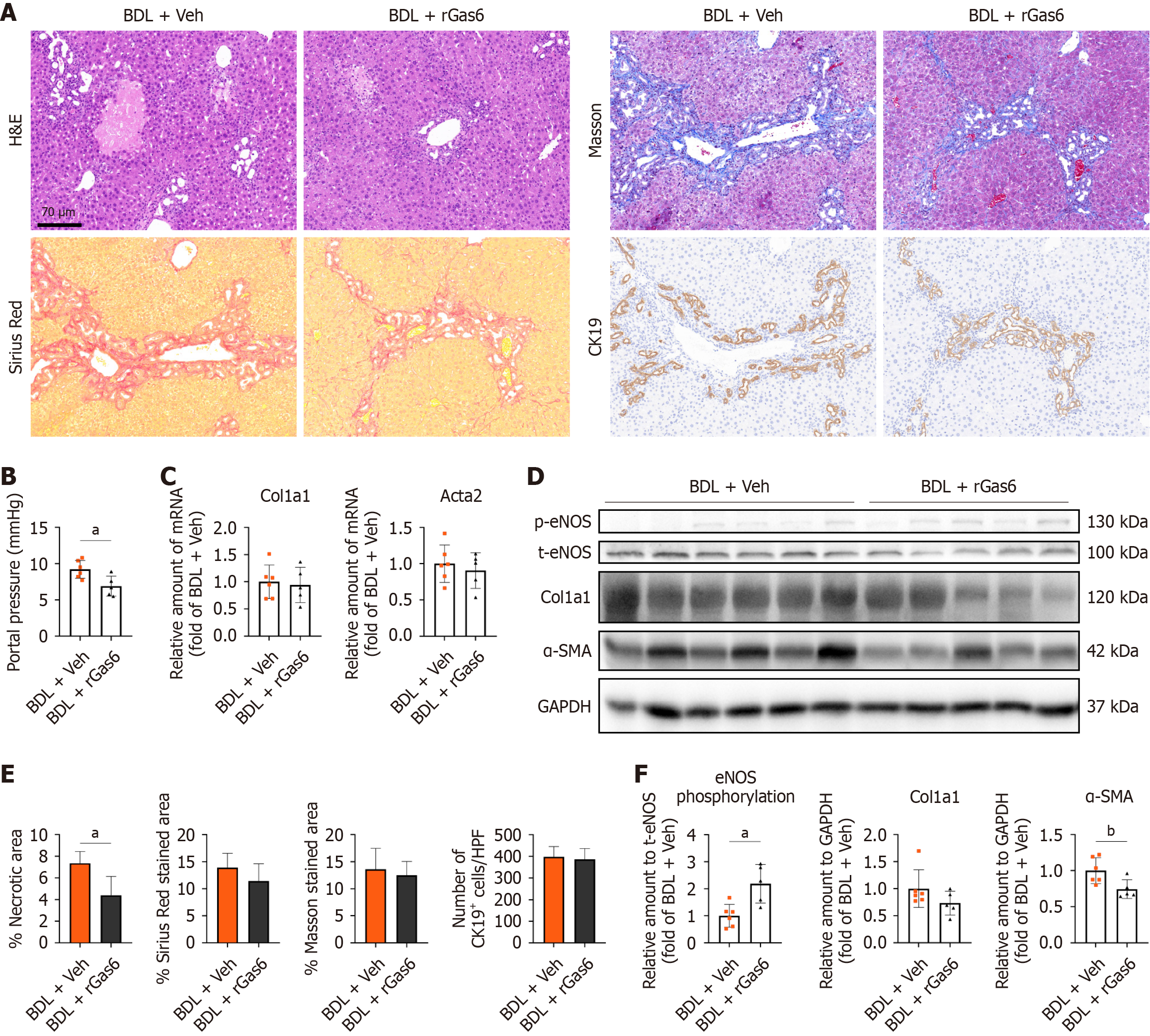
Figure 4 Recombinant growth arrest specific 6 ameliorated bile duct ligation-induced portal hypertension without alleviation of fibrosis.
A: The representative images of liver sections stained with hematoxylin & eosin (H&E), Sirius Red, Masson, or by immunohistochemical with primary antibody against CK19 between two groups; B: The portal pressures of bile duct ligation (BDL) mice treated with vehicle or recombinant growth arrest specific 6; C: Transcription levels of fibrosis genes including Col1a1 and Acta2 measured by qRT-PCR; D: Western blotting analysis of intrahepatic vascular resistance (p-eNOS and t-eNOS) and fibrosis (Col1a1 and α-SMA) in liver of BDL mice; E: The quantifications of necrotic area in H&E staining, Masson- or Sirius Red-stained area, and numbers of CK19+ cholangiocytes; F: Quantitative analysis of western blotting in panel (D). aP < 0.05, bP < 0.01. H&E: Hematoxylin & eosin; BDL: Bile duct ligation; rGas6: Recombinant growth arrest specific 6.
- Citation: Luo GQ, Zhao JB, Wu ZH, Lin JY, Zhang CH, Wu GB, Fan Q, Qi XL, Li HJ, Luo M, Zheng L. Growth arrest specific 6 ameliorated inflammation and portal pressure through activating efferocytosis in cholestasis and portal hypertension. World J Gastroenterol 2026; 32(20): 116020
- URL: https://www.wjgnet.com/1007-9327/full/v32/i20/116020.htm
- DOI: https://dx.doi.org/10.3748/wjg.v32.i20.116020