
















Copyright: ©Author(s) 2026.
World J Gastroenterol. Apr 28, 2026; 32(16): 116781
Published online Apr 28, 2026. doi: 10.3748/wjg.v32.i16.116781
Published online Apr 28, 2026. doi: 10.3748/wjg.v32.i16.116781
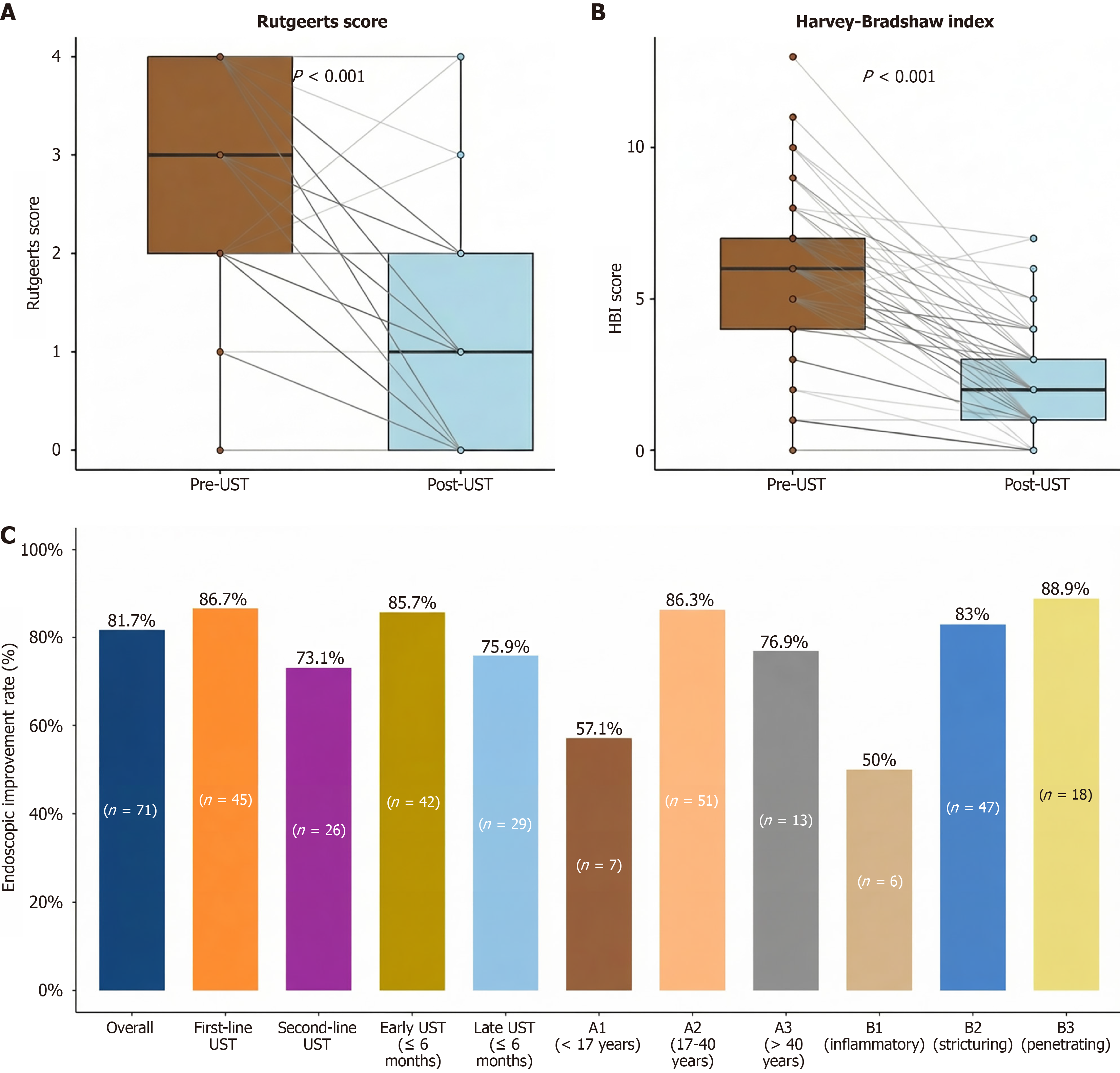
Figure 2 Changes in Rutgeerts score, Harvey-Bradshaw Index, and endoscopic improvement by subgroup following ustekinumab treatment.
A and B: Box plots that demonstrated the significant reduction in both endoscopic Rutgeerts scores and clinical Harvey-Bradshaw index (HBI) scores following ustekinumab (UST) treatment. The statistical significance was determined using paired analyses (P < 0.001 for Rutgeerts score; P < 0.001 for HBI score); C: Histogram illustrating endoscopic improvement rates (defined as ≥ 1-point reduction in the Rutgeerts score) across key patient subgroups, including the treatment line (i.e., first-line vs second-line UST) and disease characteristics based on the Montreal classification. The overall endoscopic improvement rate was 81.7% (58/71 patients). Together, these panels indicate substantial improvement in endoscopic and clinical disease activity following UST treatment, with differential responses observed across the patient subgroups. UST: Ustekinumab.
- Citation: Ma XZ, Han XZ, Zhang WY, Tian F, Zhou XC, Zhou LY, Teng YS, Lei L, Sheng JQ, Jin P, Zhao XM, Jia Y. Effectiveness of ustekinumab in postoperative Crohn's disease management: Evidence from a Chinese multicenter cohort. World J Gastroenterol 2026; 32(16): 116781
- URL: https://www.wjgnet.com/1007-9327/full/v32/i16/116781.htm
- DOI: https://dx.doi.org/10.3748/wjg.v32.i16.116781