
















Copyright: ©Author(s) 2026.
World J Gastroenterol. Apr 21, 2026; 32(15): 116364
Published online Apr 21, 2026. doi: 10.3748/wjg.v32.i15.116364
Published online Apr 21, 2026. doi: 10.3748/wjg.v32.i15.116364
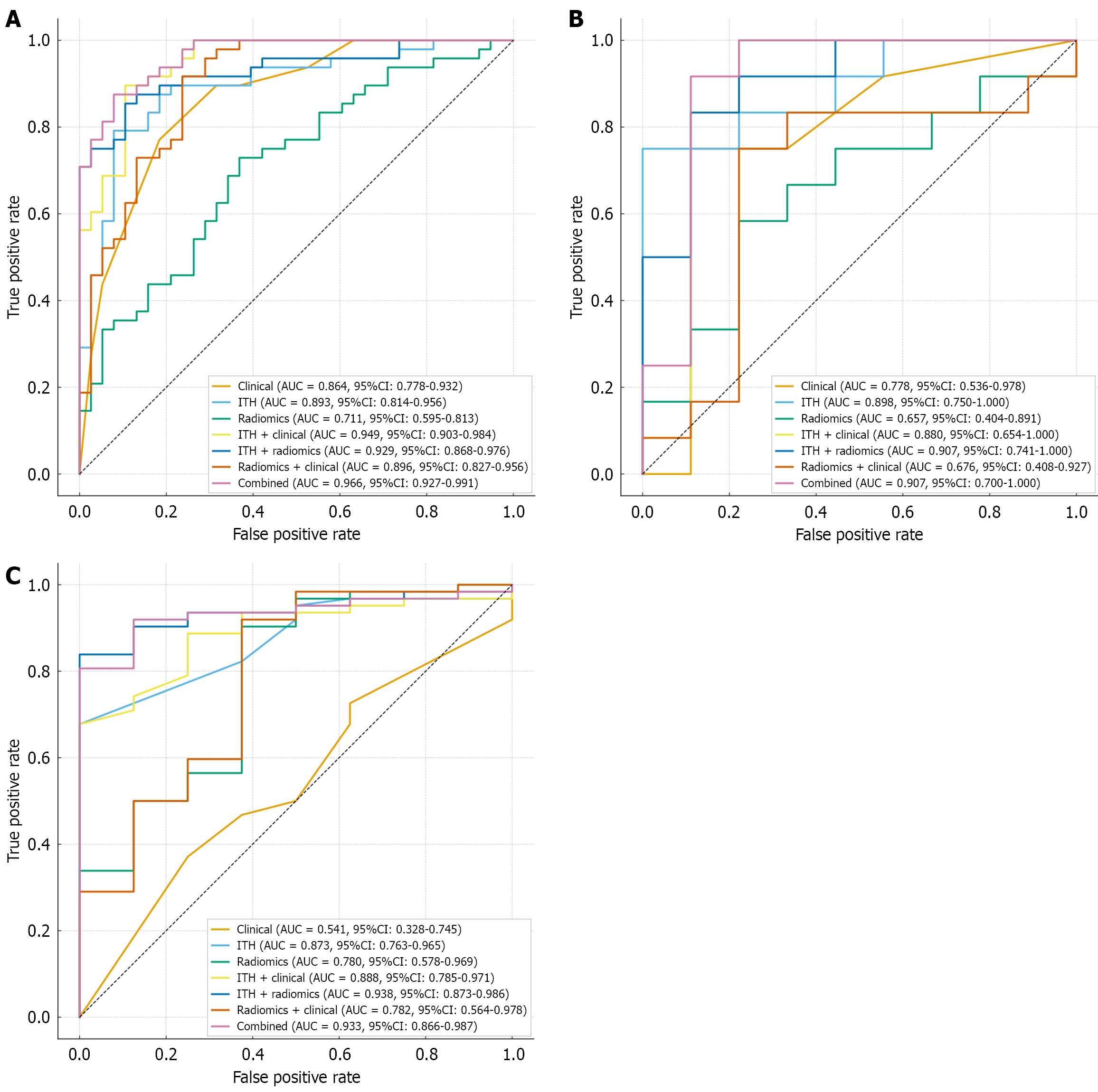
Figure 3 Performance and comparison of the seven models in the internal training set, internal validation set, and external validation set.
This figure presents the receiver operating characteristic curves of the seven models across three cohorts. A: Internal training set; B: Internal validation set; C: External validation set. The results show that the combined model, integrating clinical variables, traditional radiomics features, and the intratumoral heterogeneity index, exhibits the best performance. Its area under the curve values reach 0.97, 0.91, and 0.93 in the internal training set, internal validation set, and external validation set, respectively, which are the highest among all evaluated models. AUC: Area under the curve; CI: Confidence interval; ITH: Intratumoral heterogeneity.
- Citation: Lv JB, Liu W, Wei YG, Tang HN, Chen QQ, Hu HJ, Hu JB. Habitat imaging on contrast-enhanced magnetic resonance imaging predicts early response to transarterial chemoembolization in hepatocellular carcinoma. World J Gastroenterol 2026; 32(15): 116364
- URL: https://www.wjgnet.com/1007-9327/full/v32/i15/116364.htm
- DOI: https://dx.doi.org/10.3748/wjg.v32.i15.116364