
















Copyright: ©Author(s) 2026.
World J Gastroenterol. Apr 21, 2026; 32(15): 116105
Published online Apr 21, 2026. doi: 10.3748/wjg.v32.i15.116105
Published online Apr 21, 2026. doi: 10.3748/wjg.v32.i15.116105
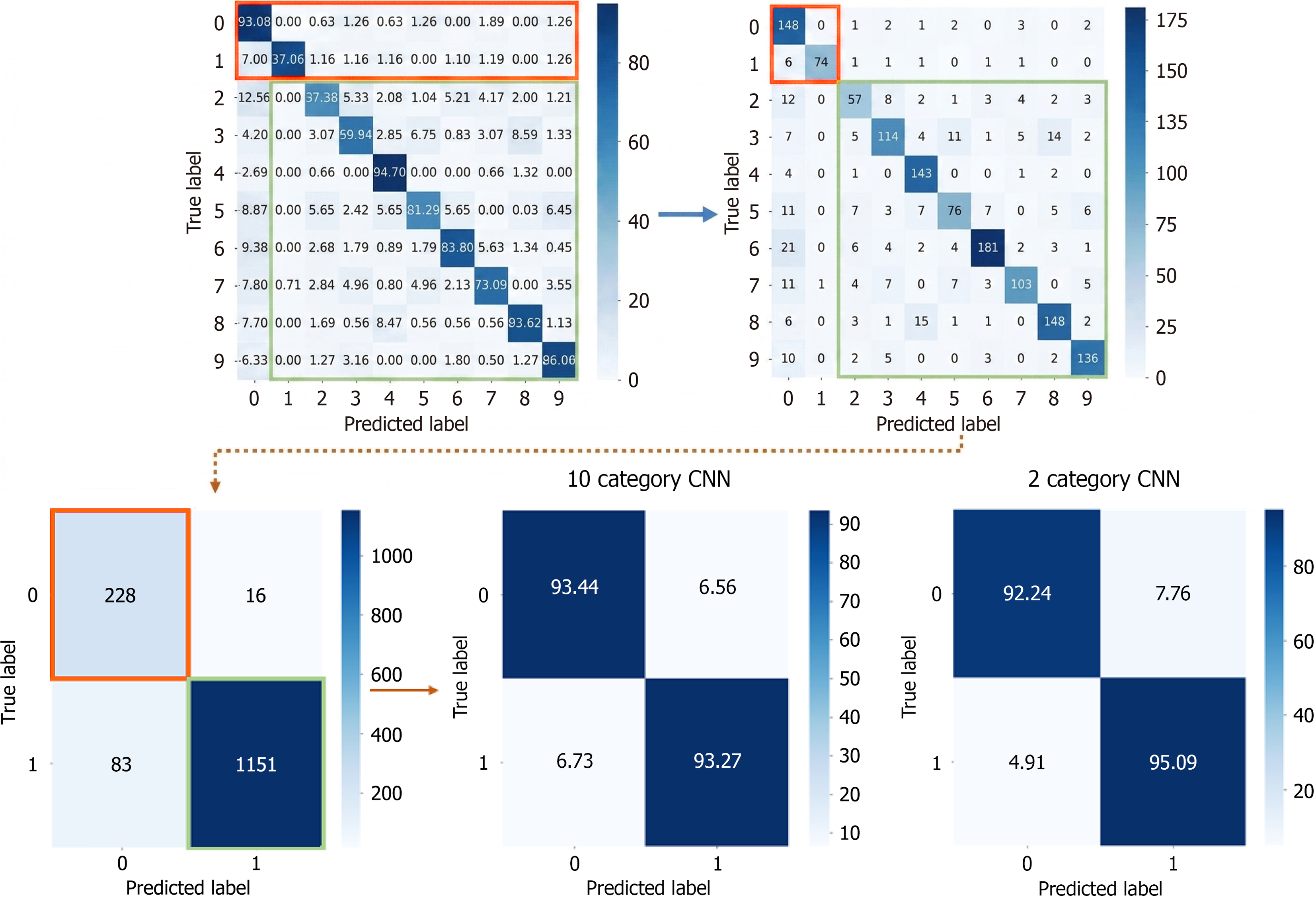
Figure 6 Confusion matrices comparing 10-class and 2-class convolutional neural network performance for capsule endoscopy bleeding detection.
(Top) Original 10-class confusion matrix (left) and the corresponding collapsed 2-class version (right), where bleeding-related categories (classes 0-1) were grouped as “bleeding” and classes 2-9 were grouped as “non-bleeding.” (Bottom left) Collapsed 10-class confusion matrix showing classification counts (true positive = 228, false negative = 16, false positive = 83, true negative = 1151). (Bottom middle and right) Normalized confusion matrices for the 10-class convolutional neural network (CNN) (converted to 2-class) and the direct 2-class CNN, respectively. Results indicate nearly identical performance between the collapsed and direct 2-class models, with high sensitivity and specificity in both cases. CNN: Convolutional neural network.
- Citation: Kuo HY, Lee KH, Chou CK, Mukundan A, Karmakar R, Chen TH, Wang TL, Liu PH, Wang HC. Deep learning-enhanced prediction of small intestinal bleeding points using long short-term memory networks. World J Gastroenterol 2026; 32(15): 116105
- URL: https://www.wjgnet.com/1007-9327/full/v32/i15/116105.htm
- DOI: https://dx.doi.org/10.3748/wjg.v32.i15.116105