
















Copyright: ©Author(s) 2026.
World J Gastroenterol. Mar 28, 2026; 32(12): 116287
Published online Mar 28, 2026. doi: 10.3748/wjg.v32.i12.116287
Published online Mar 28, 2026. doi: 10.3748/wjg.v32.i12.116287
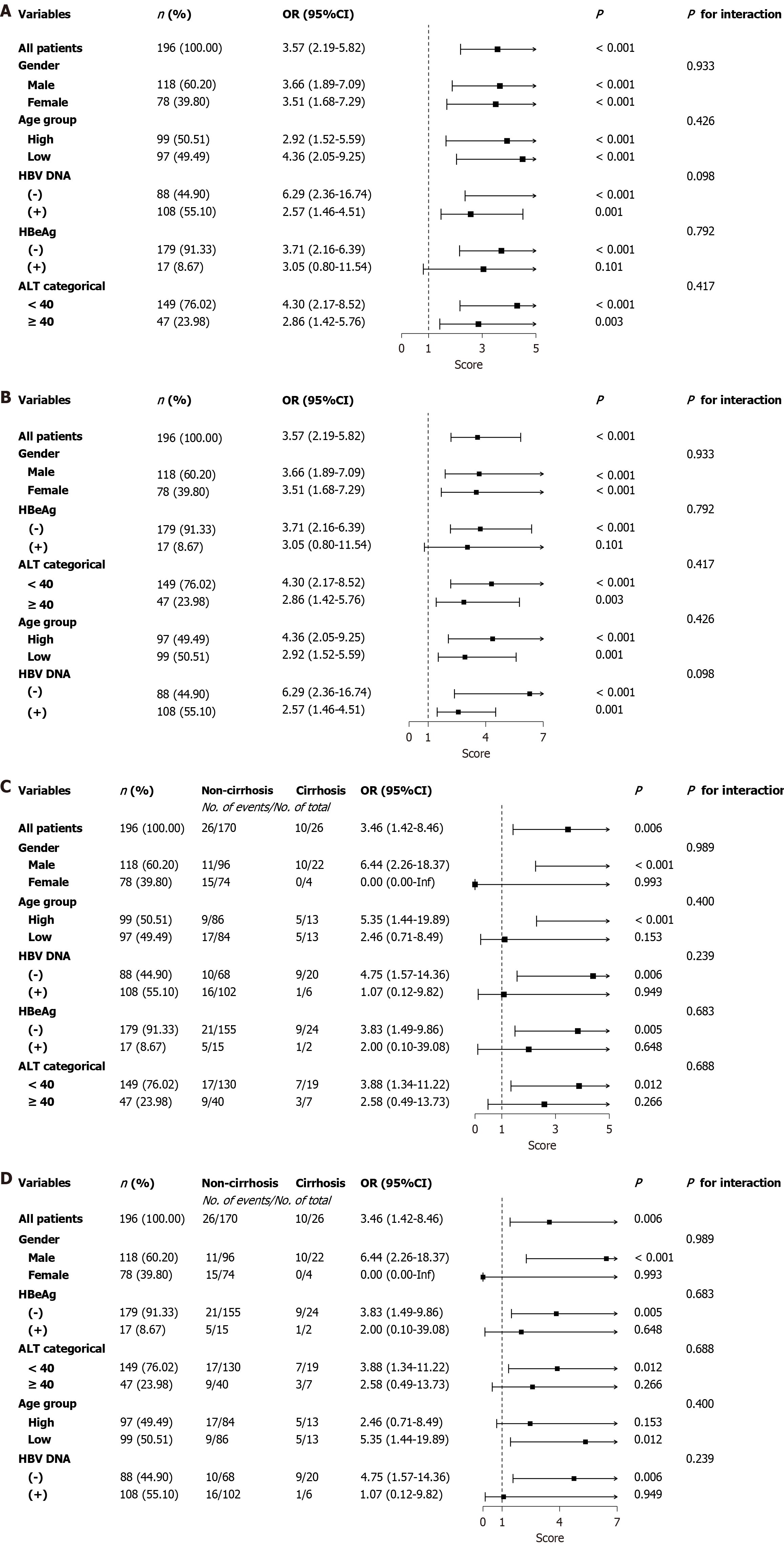
Figure 6 Subgroup analyses stratified by gender, age, baseline hepatitis B envelope antigen, baseline hepatitis B virus DNA, and baseline alanine aminotransferase in the training and validation cohorts.
The relationships of both baseline hepatitis B surface antigen (HBsAg) and liver cirrhosis with extended course interferon (≥ 48 weeks) were consistent with the primary outcome in most subgroups. Furthermore, no significant interactions were observed concerning the association with extended course interferon (≥ 48 weeks). A and B: Baseline HBsAg: Training cohort (A); Validation cohort (B); C and D: Cirrhosis: Training cohort (C); Validation cohort (D). OR: Odds ratio; CI: Confidence interval; HBeAg: Hepatitis B envelope antigen; HBV: Hepatitis B virus; ALT: Alanine aminotransferase.
- Citation: Yan F, Xue XL, Guo Y, Zhang QR, You RR, Shang J, Wu XP, Geng JW, Gao XH, Ye Q, Liang J, Wang XY, Zeng JY, Chen J, Lin YC, Chen XY, Du Q, Yin WL, Liu L, Wang F, Xu BG, Zhang WH, Xiang HL. Baseline hepatitis B surface antigen and cirrhosis predict extended interferon therapy in chronic hepatitis B: A retrospective study. World J Gastroenterol 2026; 32(12): 116287
- URL: https://www.wjgnet.com/1007-9327/full/v32/i12/116287.htm
- DOI: https://dx.doi.org/10.3748/wjg.v32.i12.116287