
















Copyright: ©Author(s) 2026.
World J Gastroenterol. Mar 28, 2026; 32(12): 114576
Published online Mar 28, 2026. doi: 10.3748/wjg.v32.i12.114576
Published online Mar 28, 2026. doi: 10.3748/wjg.v32.i12.114576
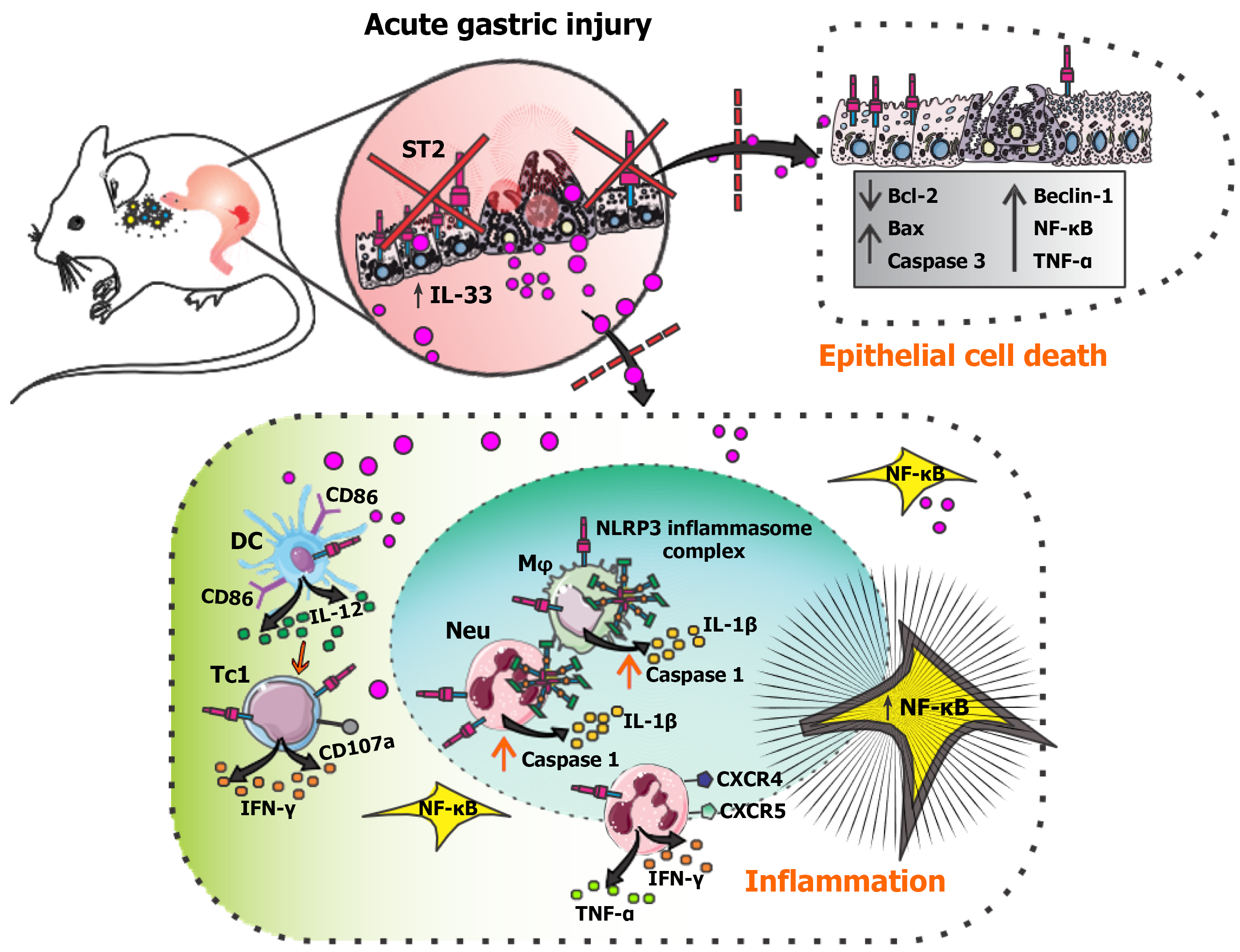
Figure 8 Schematic representation of the immunopathological mechanisms regulated by suppression of tumorigenicity 2 deletion in acute gastric injury.
Ethanol exerts both direct cytotoxic effects on the gastric epithelium and indirect effects through the induction of inflammation. Tissue injury triggers the release of the nuclear alarmin interleukin (IL)-33 from gastric mucosal cells, which, by binding to its receptor suppression of tumorigenicity 2 (ST2), orchestrates a broad range of immune responses. ST2 deletion attenuates the infiltration and activation of dendritic cells, reducing the number of IL-12-producing and CD86-expressing dendritic cells, and impairs type 1 cytotoxic polarization, resulting in decreased interferon-γ production. Furthermore, ST2 gene deficiency limits the infiltration of neutrophils and macrophages, with a decreased number of neutrophils expressing C-X-C motif chemokine receptor 4 and C-X-C motif chemokine receptor 5, as well as reduced tumor necrosis factor-α and interferon-γ production. Both cell types exhibit decreased activation of the NOD-like receptor family, pyrin domain containing 3 inflammasome and caspase-1, resulting in lower IL-1β production. This cascade is further supported by dampened activation of nuclear factor kappa B, a transcription factor driving the expression of multiple proinflammatory mediators. In gastric epithelial cells, ST2 deletion decreases apoptosis and pyroptosis, while reduced levels of tumor necrosis factor-α and Beclin-1 suggest potential involvement of necroptosis and autophagy-associated cell death. Altogether, the IL-33/ST2 axis blockade uncouples epithelial injury from downstream innate and adaptive immune activation and limits engagement of multiple regulated cell death pathways, thereby mitigating acute gastric mucosal damage. ST2: Suppression of tumorigenicity 2; IL-33: Interleukin-33; TNF-α: Tumor necrosis factor-α; NF-κB: Nuclear factor kappa B; Neu: Neutrophils; Mφ: Macrophages; DC: Dendritic cell; Tc1: Type 1 cytotoxic; NLRP3: NOD-like receptor family, pyrin domain containing 3; CXCR: C-X-C motif chemokine receptor; IFN: Interferon.
- Citation: Corovic IF, Pantic JM, Stanisavljevic IA, Pavlovic SM, Jovanovic IP, Radosavljevic GD, Simovic Markovic BJ. ST2 gene deficiency alleviates acute gastric injury in mice by modulating inflammation and epithelial cell death. World J Gastroenterol 2026; 32(12): 114576
- URL: https://www.wjgnet.com/1007-9327/full/v32/i12/114576.htm
- DOI: https://dx.doi.org/10.3748/wjg.v32.i12.114576