
















©Author(s) (or their employer(s)) 2026.
World J Gastroenterol. Mar 14, 2026; 32(10): 116152
Published online Mar 14, 2026. doi: 10.3748/wjg.v32.i10.116152
Published online Mar 14, 2026. doi: 10.3748/wjg.v32.i10.116152
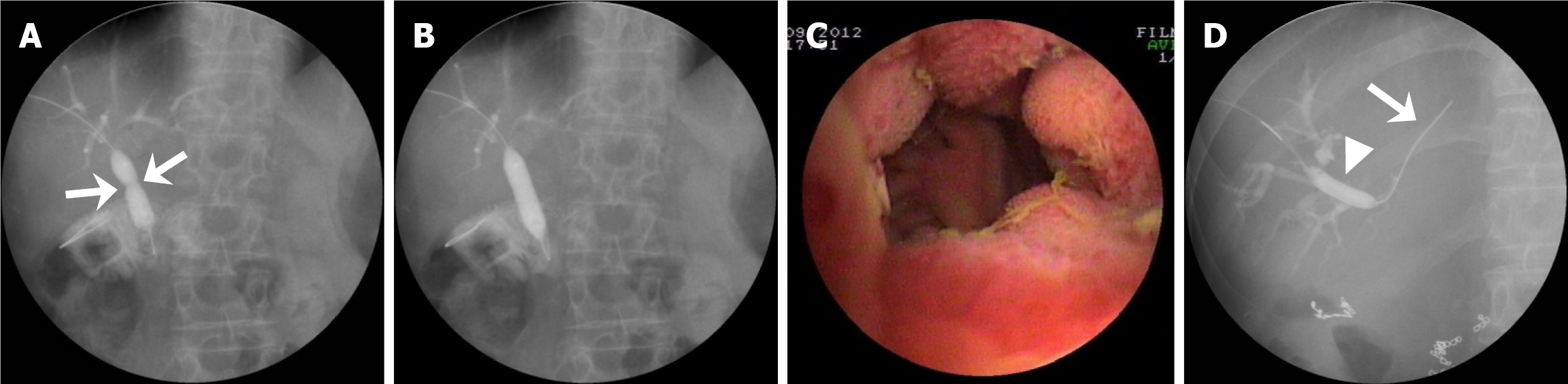
Figure 2 Representative images showing successful percutaneous transhepatic cholangioscopy-assisted balloon dilation for the treatment of simple and complex benign bilioenteric anastomotic strictures.
A-C: Cholangiogram showing that the 10-mm balloon is incompletely inflated in the waist (arrow, A) and the balloon waist disappeared (arrow) when the appropriate pressure had been reached (B), and patent anastomosis 18 months after the dilation (C) in a patient with a simple benign bilioenteric anastomotic stricture (BBAS); D: An 8-mm balloon was inserted under guidance of a guidewire (arrow) to dilate the stricture in the opposite left hepatic duct; the X-ray shows the disappearance of the balloon waist (arrow) in a patient with a complex BBAS.
- Citation: Ren X, Wang C, Qu YP, Tang XF, Xia T, Lu YX, Sun XM. Percutaneous transhepatic cholangioscopy-assisted procedures for the management of postoperative benign bilioenteric anastomotic strictures with or without biliary stones. World J Gastroenterol 2026; 32(10): 116152
- URL: https://www.wjgnet.com/1007-9327/full/v32/i10/116152.htm
- DOI: https://dx.doi.org/10.3748/wjg.v32.i10.116152