
















©Author(s) (or their employer(s)) 2026.
World J Gastroenterol. Mar 14, 2026; 32(10): 116152
Published online Mar 14, 2026. doi: 10.3748/wjg.v32.i10.116152
Published online Mar 14, 2026. doi: 10.3748/wjg.v32.i10.116152
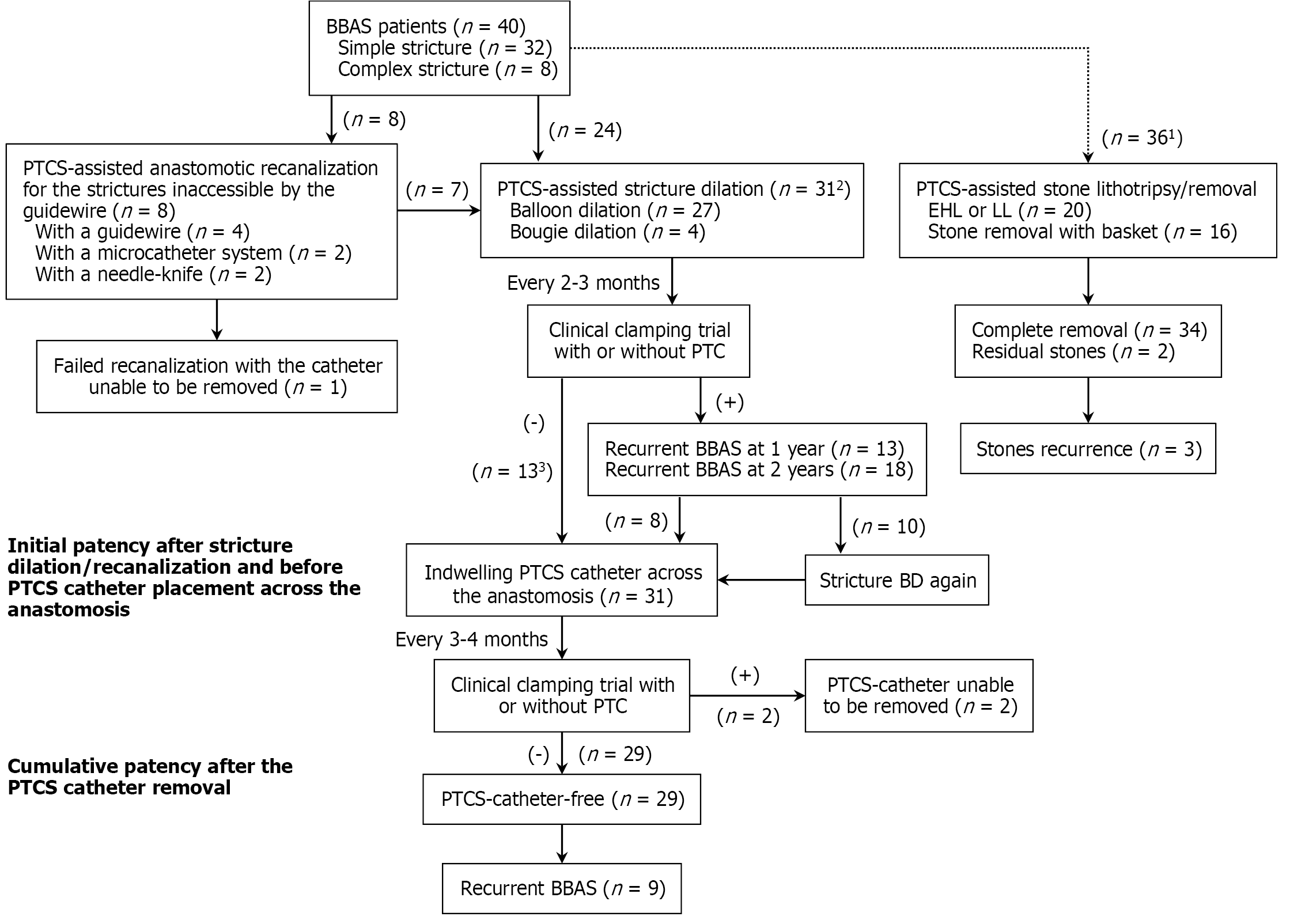
Figure 1 The technical details of percutaneous transhepatic cholangioscopy-assisted procedures for the treatment of benign bilioenteric anastomotic strictures in 40 patients.
1Including 31 patients who underwent percutaneous transhepatic cholangioscopy-assisted stricture dilation (24 with stricture dilation alone and 7 with successful anastomotic recanalization prior to stricture dilation). 2Twenty-eight patients received anastomotic stricture dilation/recanalization and 8 with mild stricture did not receive stricture dilation. 3Placement of an indwelling percutaneous transhepatic cholangioscopy catheter across the anastomosis due to unsuccessful first balloon dilation, residual or potential stone, or bougie dilation alone. PTCS: Percutaneous transhepatic cholangioscopy; BBAS: Benign bilioenteric anastomotic stricture; EHL: Electrohydraulic lithotripsy; LL: Laser lithotripsy; PTC: Percutaneous transhepatic cholangiography; BD: Balloon dilation.
- Citation: Ren X, Wang C, Qu YP, Tang XF, Xia T, Lu YX, Sun XM. Percutaneous transhepatic cholangioscopy-assisted procedures for the management of postoperative benign bilioenteric anastomotic strictures with or without biliary stones. World J Gastroenterol 2026; 32(10): 116152
- URL: https://www.wjgnet.com/1007-9327/full/v32/i10/116152.htm
- DOI: https://dx.doi.org/10.3748/wjg.v32.i10.116152