
















©The Author(s) 2026.
World J Gastroenterol. Jan 7, 2026; 32(1): 112090
Published online Jan 7, 2026. doi: 10.3748/wjg.v32.i1.112090
Published online Jan 7, 2026. doi: 10.3748/wjg.v32.i1.112090
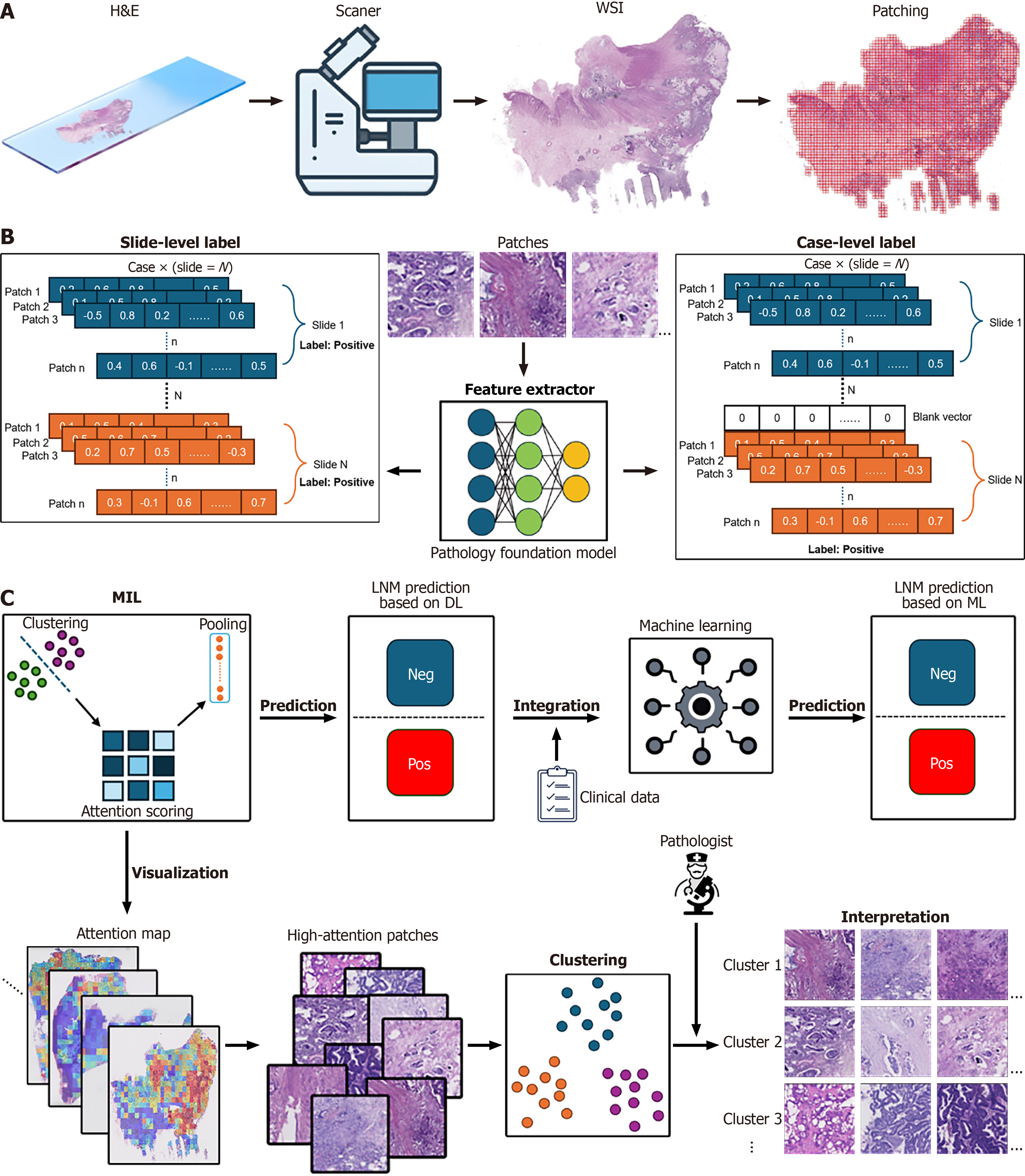
Figure 2 Workflow of case-level multiple instance learning for lymph node metastasis prediction in colorectal cancer histopathology.
A: Data acquisition and preprocessing. Hematoxylin and eosin (H&E) stained slides from primary tumor resections are scanned using a digital scanner to generate whole-slide images (WSIs). WSIs are then processed into smaller, non-overlapping patches for subsequent analysis; B: Feature extraction with slide-level and case-level labeling. Slide-level label: For each slide, patches are extracted and fed into the feature extractor. Case-level label: Patches from all slides belonging to a single patient case are processed by the feature extractor; C: Multiple instance learning (MIL) Framework for lymph node metastasis (LNM) Prediction and Interpretation. MIL: Feature embeddings from patches of a case are input into the clustering-constrained-attention MIL framework. Attention scoring is applied to assign importance weights to different patches. Clustering is used to group similar patches. Pooling mechanisms aggregate these attention scores to generate a case-level or slide-level prediction. Attention scoring is applied to assign importance weights to different patches, potentially highlighting diagnostically relevant regions. Pooling mechanisms aggregate these attention scores to generate a case-level prediction. LNM prediction based on deep learning (DL): The MIL framework, utilizing deep learning, outputs a prediction for LNM (negative or positive). Integration: The DL based LNM prediction is integrated with clinical data to potentially enhance prediction accuracy. Machine learning: Integrated clinical and pathology features can be further analyzed using traditional machine learning classifiers to generate a final LNM prediction. H&E: Hematoxylin and eosin; WSIs: Whole-slide images; MIL: Multiple instance learning; LNM: Lymph node metastasis; ML: Machine learning; DL: Deep learning.
- Citation: Zou LF, Wang XB, Li JW, Ouyang X, Luo YY, Luo Y, Wang CL. Predicting lymph node metastasis in colorectal cancer using case-level multiple instance learning. World J Gastroenterol 2026; 32(1): 112090
- URL: https://www.wjgnet.com/1007-9327/full/v32/i1/112090.htm
- DOI: https://dx.doi.org/10.3748/wjg.v32.i1.112090