
















©The Author(s) 2025.
World J Gastroenterol. Dec 28, 2025; 31(48): 113856
Published online Dec 28, 2025. doi: 10.3748/wjg.v31.i48.113856
Published online Dec 28, 2025. doi: 10.3748/wjg.v31.i48.113856
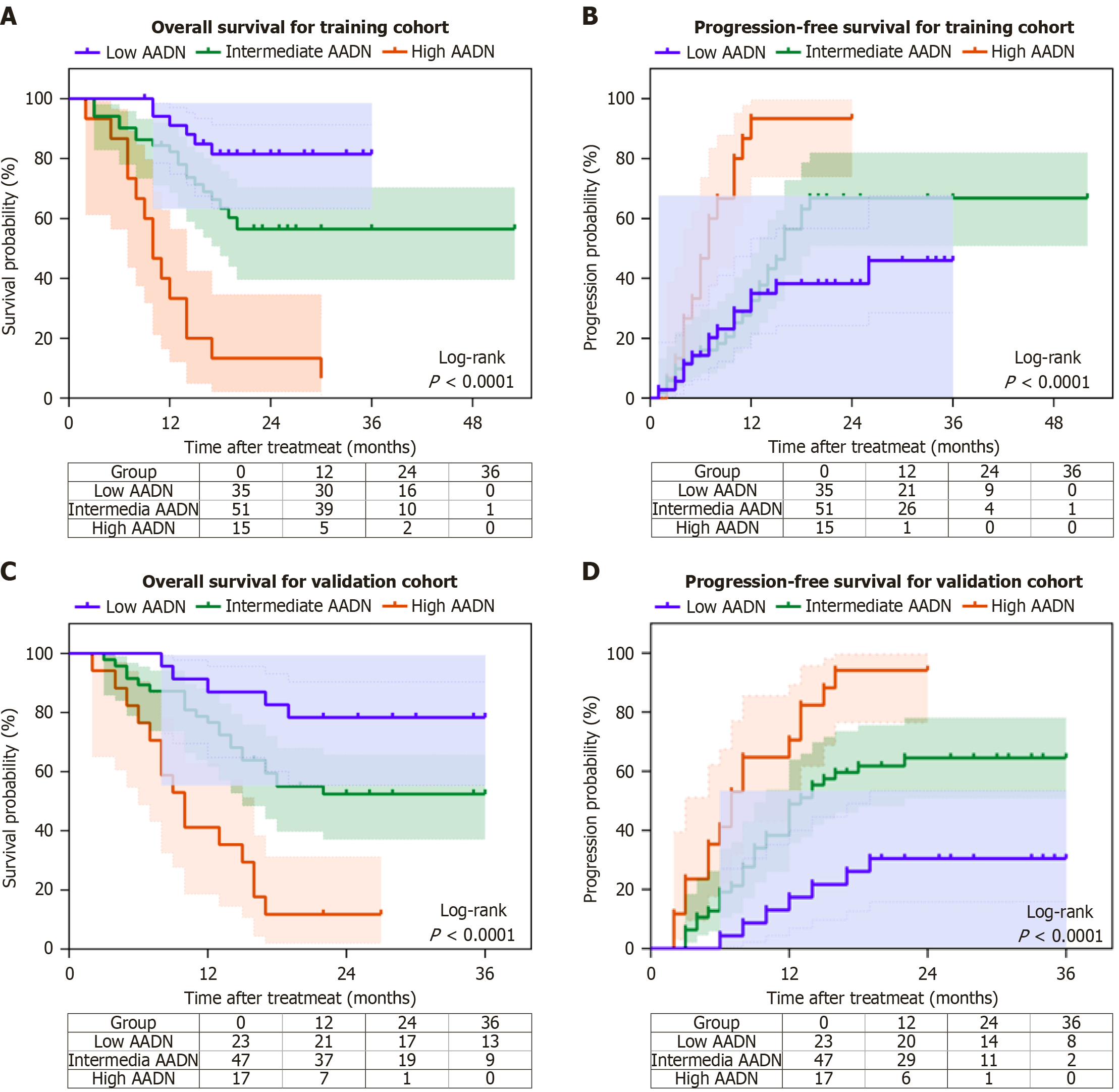
Figure 3 The prognosis of both the training cohort and the validation cohort based on the AADN score.
A: The Kaplan-Meier overall survival curves for the training cohort classify patients into low-risk, intermediate-risk, and high-risk groups according to their AADN score (log-rank P < 0.0001); B: The Kaplan-Meier progression-free survival curves for the training cohort classify patients into low-risk, intermediate-risk, and high-risk groups according to their AADN score (log-rank P < 0.0001); C: The Kaplan-Meier overall survival curves for the validation cohort classify patients into low-risk, intermediate-risk, and high-risk groups according to their AADN score (log-rank P < 0.0001); D: The Kaplan-Meier progression-free survival curves for the validation cohort classify patients into low-risk, intermediate-risk, and high-risk groups according to their AADN score (log-rank P < 0.0001).
- Citation: Zhang X, Liao MJ, Ren LY, Qin WY, Mu SW, She SP, Fei R, Cong X, Zhou YP, Chen DB, Chen HS. AADN score: Predicting response to transarterial chemoembolization, sintilimab and lenvatinib in patients with hepatocellular carcinoma. World J Gastroenterol 2025; 31(48): 113856
- URL: https://www.wjgnet.com/1007-9327/full/v31/i48/113856.htm
- DOI: https://dx.doi.org/10.3748/wjg.v31.i48.113856