
















©The Author(s) 2025.
World J Gastroenterol. Dec 28, 2025; 31(48): 112653
Published online Dec 28, 2025. doi: 10.3748/wjg.v31.i48.112653
Published online Dec 28, 2025. doi: 10.3748/wjg.v31.i48.112653
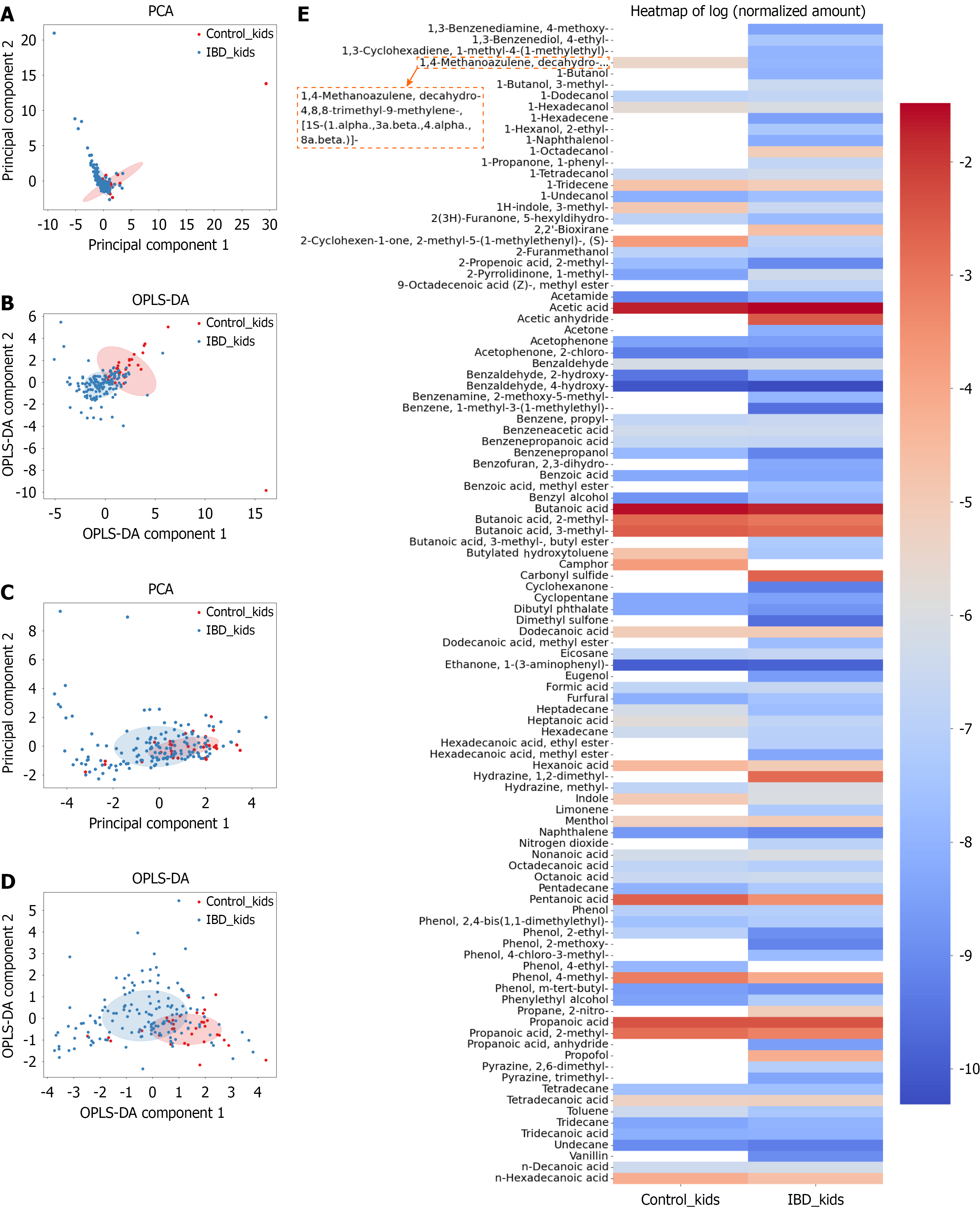
Figure 1 Total headspace-gas chromatography-mass spectrometry data obtained for inflammatory bowel disease and control groups of pediatric patients.
A and B: Principal component analysis and Orthogonal Partial Least Squares Discriminant Analysis data represent two independent groups of samples [inflammatory bowel disease (IBD) kids and control kids] according to the relative concentration of all detected volatile compounds; C and D: Principal component analysis and Orthogonal Partial Least Squares Discriminant Analysis data represent two independent groups of samples (IBD kids and control kids) according to the relative concentration of stable detected volatile compounds; E: Comparison of volatile organic compound composition for two independent groups of samples (IBD kids and control kids). Relative concentrations in the vapor phase were used. PCA: Principal component analysis; IBD: Inflammatory bowel disease; OPLS-DA: Orthogonal Partial Least Squares Discriminant Analysis.
- Citation: Zakharzhevskaya NB, Erdes SI, Belousova EA, Samolygo IS, Manina MA, Kondrashova PV, Lomakina EY, Kardonsky DA, Vorobyeva EA, Shagaleeva OY, Silantyev AA, Kazakova VD, Kashatnikova DA, Kalachnuk TN, Kolesnikova IV, Chaplin AV, Markelova MI, Grigoryeva TV, Olekhnovich EI, Veselovsky VA, Morozov MD, Zoruk PY, Boldyreva DI, Vanyushkina AA, Efimov BA. Combined metabolomic and metagenomic analysis reveals inflammatory bowel disease diversity in pediatric and adult patients. World J Gastroenterol 2025; 31(48): 112653
- URL: https://www.wjgnet.com/1007-9327/full/v31/i48/112653.htm
- DOI: https://dx.doi.org/10.3748/wjg.v31.i48.112653