
















©The Author(s) 2025.
World J Gastroenterol. Nov 28, 2025; 31(44): 112719
Published online Nov 28, 2025. doi: 10.3748/wjg.v31.i44.112719
Published online Nov 28, 2025. doi: 10.3748/wjg.v31.i44.112719
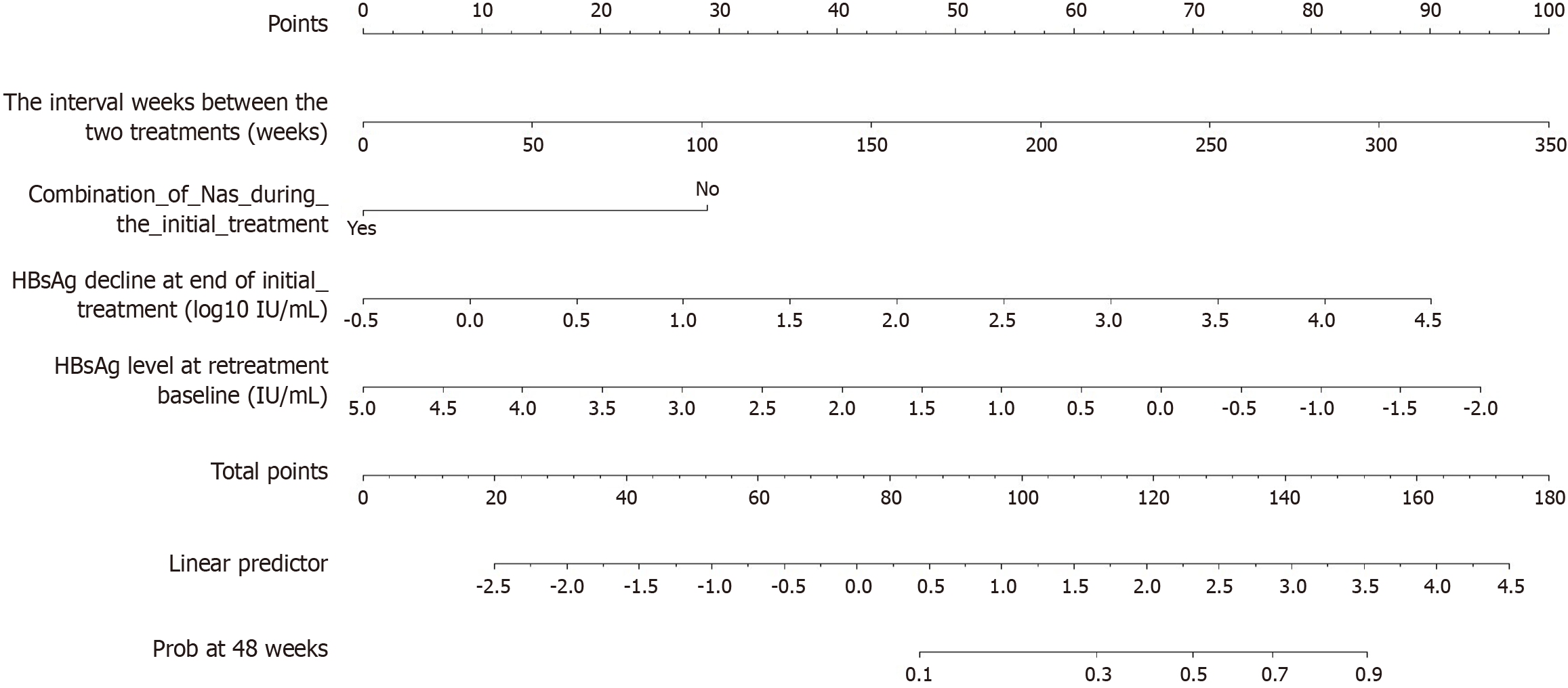
Figure 2 Nomogram for predicting hepatitis B surface antigen clearance after retreatment.
This prognostic model was constructed based on independent predictors identified through least absolute shrinkage and selection operator regression and multivariable Cox analysis. The nomogram integrates four variables: Interval between treatments (weeks; range: 0-350); Combination of nucleos(t)ide analogues (NAs) during initial treatment (binary: Yes/no); Hepatitis B surface antigen (HBsAg) decline at end of initial treatment (log10 IU/mL; range: -0.5 to 4.5); HBsAg level at retreatment baseline (IU/mL; range: -5.0 to -2.0). Scoring procedure: (1) Locate patient values on each variable axis; (2) Draw vertical lines to the points axis to obtain individual scores; (3) Sum all scores to calculate total points; and (4) Project total points to the linear predictor and prob at 48 weeks axes for predicted clearance probability. The retreatment HBsAg clearance prediction score (RHCP-S) is derived as: RHCP-S = 18 × (HBsAg decline) - 29 × (NA combination) + 0.29 × (interval weeks) - 13.43 × (baseline HBsAg) + 105.15. Where NA combination: Yes = 1; No = 0. Linear predictor scaling factor k = 21.971. HBsAg: Hepatitis B surface antigen.
- Citation: Fu YC, Li J, Wang JY, Zhang YW, Yan F, Chen J, Du Q, Yang C, Liang J, Ye Q, Xiang HL. Retreatment hepatitis B surface antigen clearance prediction model identifies pegylated interferon alpha candidates in chronic hepatitis B. World J Gastroenterol 2025; 31(44): 112719
- URL: https://www.wjgnet.com/1007-9327/full/v31/i44/112719.htm
- DOI: https://dx.doi.org/10.3748/wjg.v31.i44.112719