
















©The Author(s) 2025.
World J Gastroenterol. Nov 21, 2025; 31(43): 111609
Published online Nov 21, 2025. doi: 10.3748/wjg.v31.i43.111609
Published online Nov 21, 2025. doi: 10.3748/wjg.v31.i43.111609
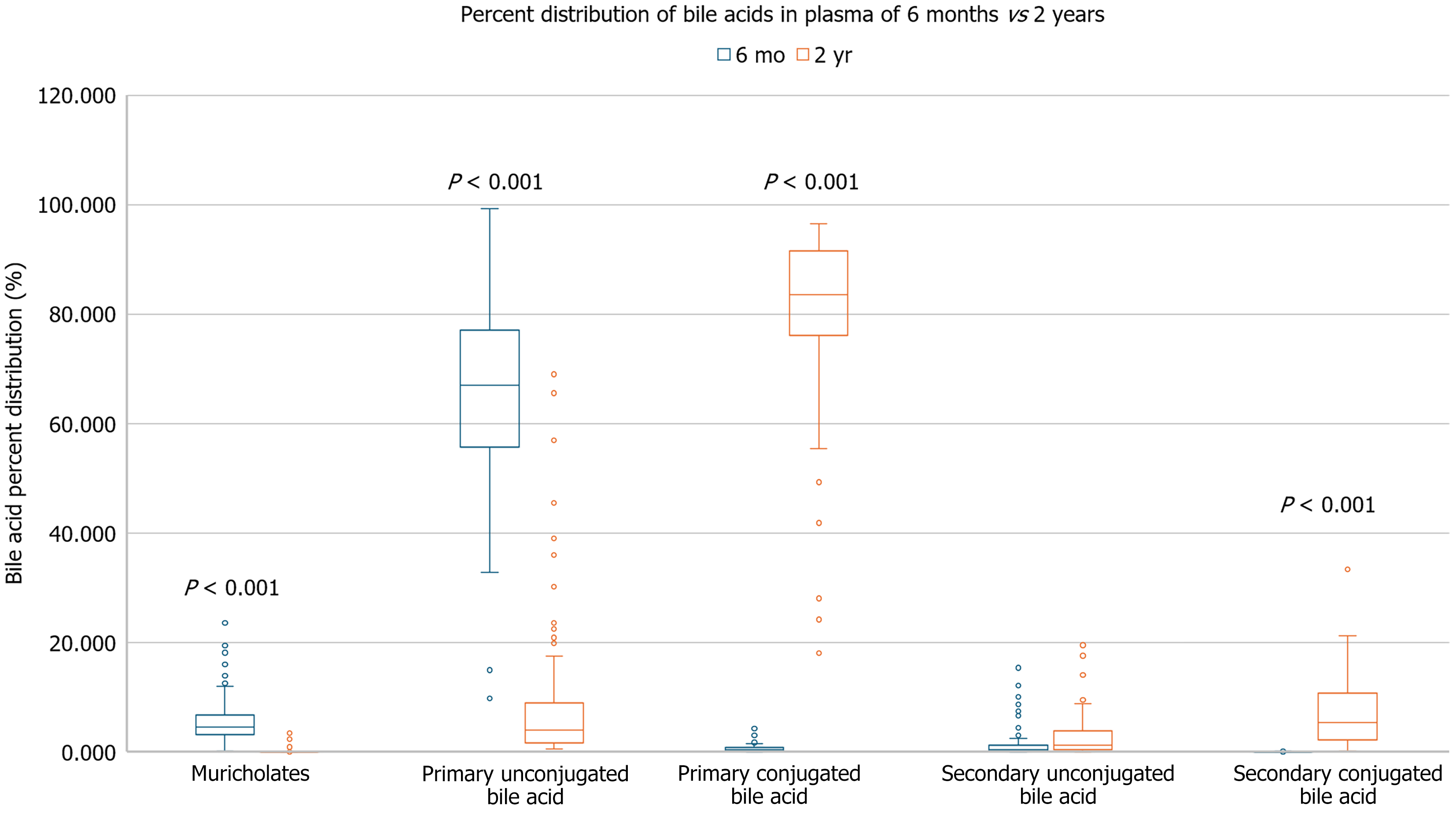
Figure 6 Box-and-whiskers plot showing percent distribution of bile acids in plasma between the Bangladeshi infants (aged 6-9 months) and the Bangladeshi children (aged 2-years-old).
The younger Bangladeshi infants' distributions are shown in blue and the older Bangladeshi children are shown in orange. If P value was not denoted, there was no significant difference between the two groups. The central line in each box represents the median, while the box spans the interquartile range (IQR). Whiskers extend to 1.5 times the IQR, with individual points representing outliers. The younger infants showed higher levels of unconjugated bile acids compared to their older counterparts.
- Citation: Hasan F, Hylemon PB, Haque R, Petri WA, Faruque ASG, Kirkpatrick BD, Alam M, Ferdous T, Shama T, Moreau B, Ramakrishnan G, Zhou H, Chesney A, Medrano Garcia F, Smirnova E, Prem P, Huang Y, Bojja R, Thapaliya A, Donowitz JR. Bile acid dysmetabolism in Bangladeshi infants associated with poor linear growth, enteric inflammation, and small intestine bacterial overgrowth. World J Gastroenterol 2025; 31(43): 111609
- URL: https://www.wjgnet.com/1007-9327/full/v31/i43/111609.htm
- DOI: https://dx.doi.org/10.3748/wjg.v31.i43.111609