
















©The Author(s) 2025.
World J Gastroenterol. Nov 7, 2025; 31(41): 111184
Published online Nov 7, 2025. doi: 10.3748/wjg.v31.i41.111184
Published online Nov 7, 2025. doi: 10.3748/wjg.v31.i41.111184
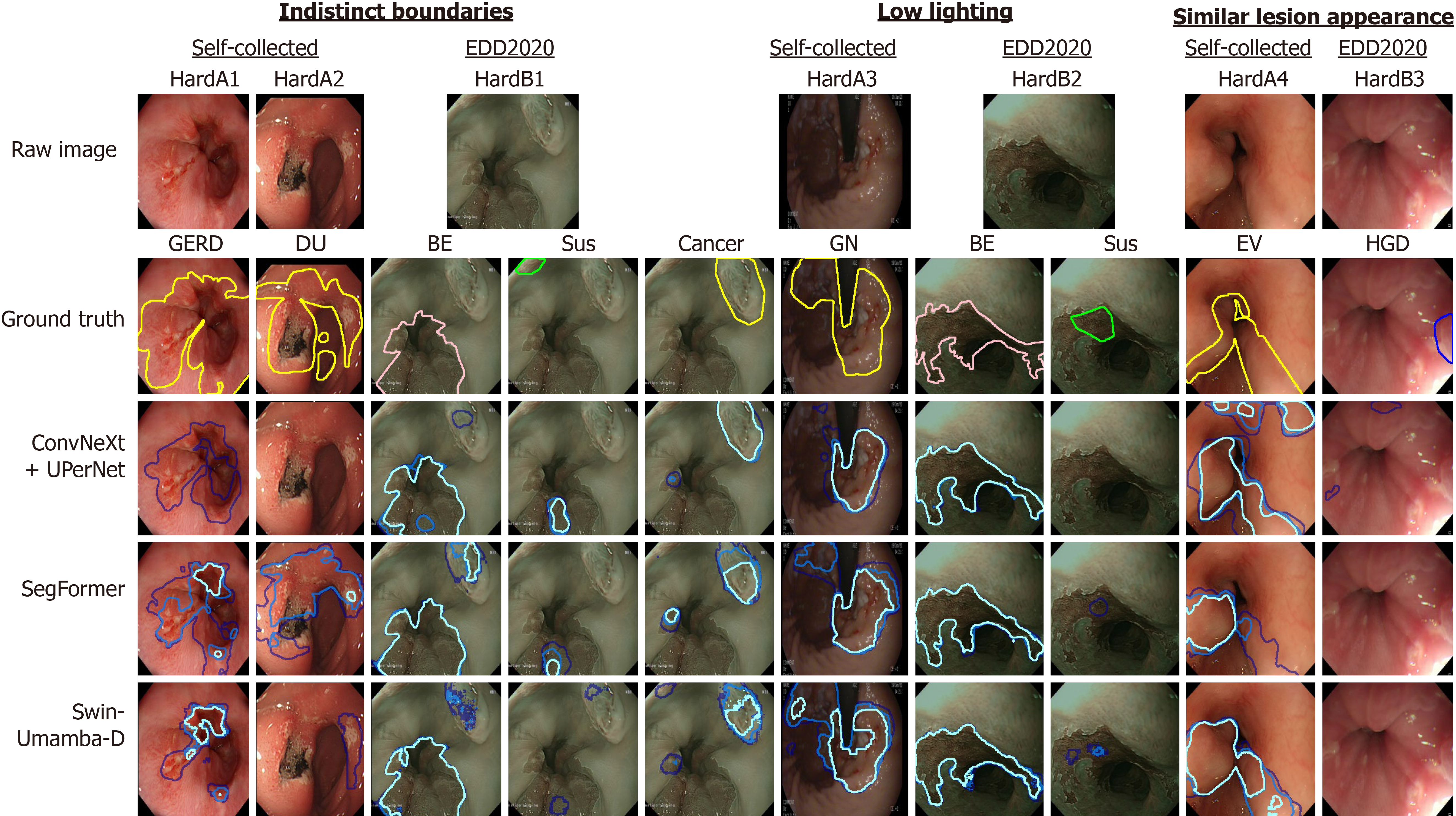
Figure 8 Representative examples of these challenging cases with predicted masks generated by the top-performing models.
Light blue: Fully overlapping regions; Medium blue: Two-map overlaps; Dark blue: Single-map regions; Yellow (self-collected): Ground truth lesions; Pink: Barrett’s esophagus ground truth masks; Lime: Suspicious regions ground truth masks; Blue: High-grade dysplasia ground truth masks; Yellow (EDD2020): Cancer; HardA: Hard examples from self-collected dataset; HardB: Hard examples from EDD2020 dataset; GERD: Gastroesophageal reflux disease; DU: Duodenal ulcer; GN: Gastric neoplasm; EV: Esophageal varices; HGD: High-grade dysplasia; Sus: Suspicious precancerous lesions; BE: Barrett’s esophagus.
- Citation: Chan IN, Wong PK, Yan T, Hu YY, Chan CI, Qin YY, Wong CH, Chan IW, Lam IH, Wong SH, Li Z, Gao S, Yu HH, Yao L, Zhao BL, Hu Y. Assessing deep learning models for multi-class upper endoscopic disease segmentation: A comprehensive comparative study. World J Gastroenterol 2025; 31(41): 111184
- URL: https://www.wjgnet.com/1007-9327/full/v31/i41/111184.htm
- DOI: https://dx.doi.org/10.3748/wjg.v31.i41.111184