
















©The Author(s) 2025.
World J Gastroenterol. Oct 7, 2025; 31(37): 110942
Published online Oct 7, 2025. doi: 10.3748/wjg.v31.i37.110942
Published online Oct 7, 2025. doi: 10.3748/wjg.v31.i37.110942
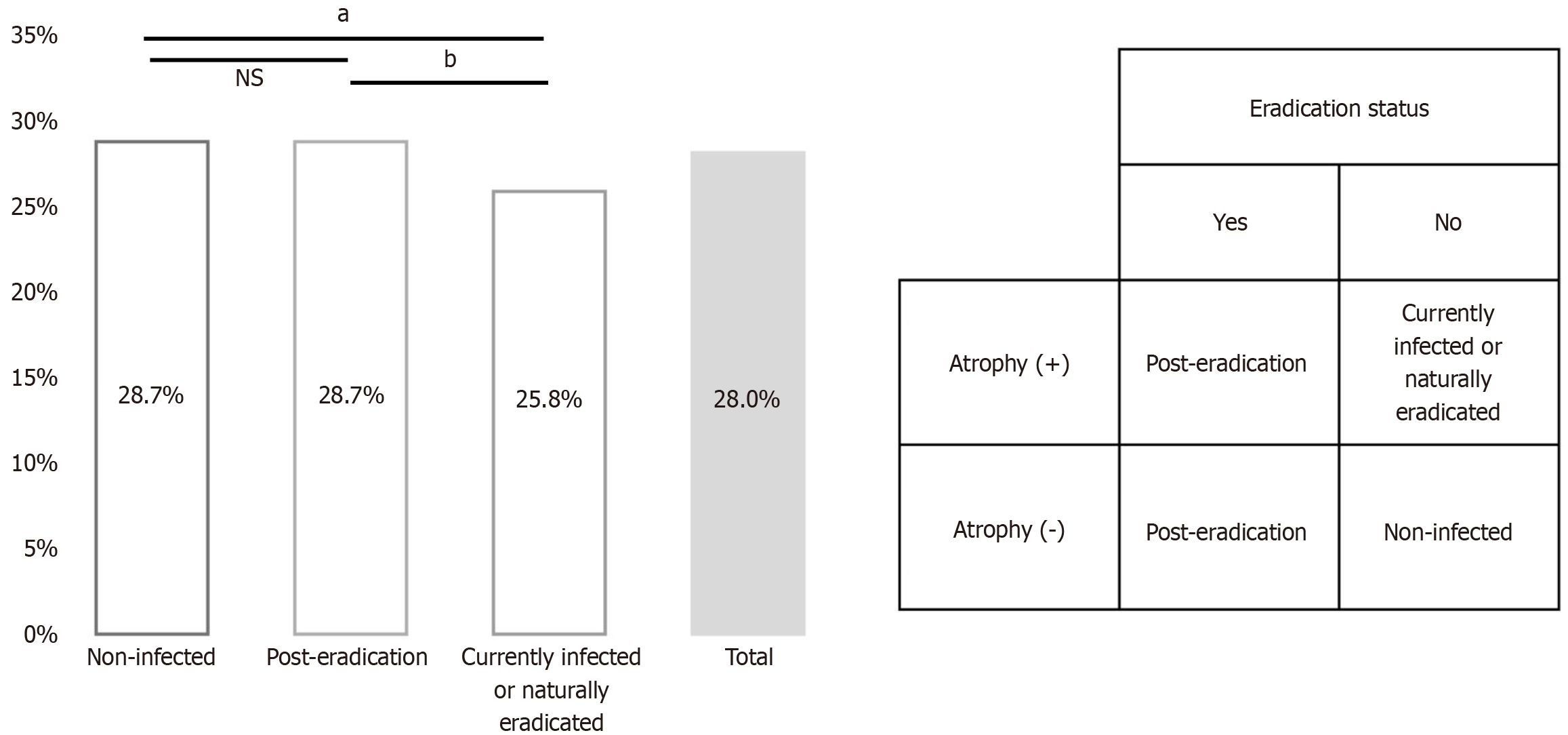
Figure 2 Prevalence of dyspepsia according to the Helicobacter pylori status and gastric atrophy.
The prevalence of dyspepsia across the three cohorts categorized by Helicobacter pylori (H. pylori) eradication history and endoscopic evidence of atrophic gastritis is presented. Dyspepsia prevalence is 28.7% in the non-infected and post-eradication cohorts, with no marked difference. The currently infected/naturally eradicated cohort has a prevalence (25.8%) lower than that of the other two cohorts (Kruskal-Wallis test: aP < 0.05 and bP < 0.01, respectively). The “currently infected or naturally eradicated” cohort includes individuals without a self-reported H. pylori eradication history but with endoscopic gastric atrophy, representing a heterogeneous group where active H. pylori infection cannot be precisely distinguished from a few spontaneous eradications due to the absence of additional infection testing. NS: Not significant.
- Citation: Suzuki S, Kanno T, Koike T, Chiba T, Asanuma K, Kato K, Hatayama Y, Ogata Y, Saito M, Hatta W, Uno K, Imatani A, Masamune A. Epidemiology of dyspepsia and esophagogastroduodenoscopic findings in the era of Helicobacter pylori eradication. World J Gastroenterol 2025; 31(37): 110942
- URL: https://www.wjgnet.com/1007-9327/full/v31/i37/110942.htm
- DOI: https://dx.doi.org/10.3748/wjg.v31.i37.110942