
















©The Author(s) 2025.
World J Gastroenterol. Sep 14, 2025; 31(34): 110051
Published online Sep 14, 2025. doi: 10.3748/wjg.v31.i34.110051
Published online Sep 14, 2025. doi: 10.3748/wjg.v31.i34.110051
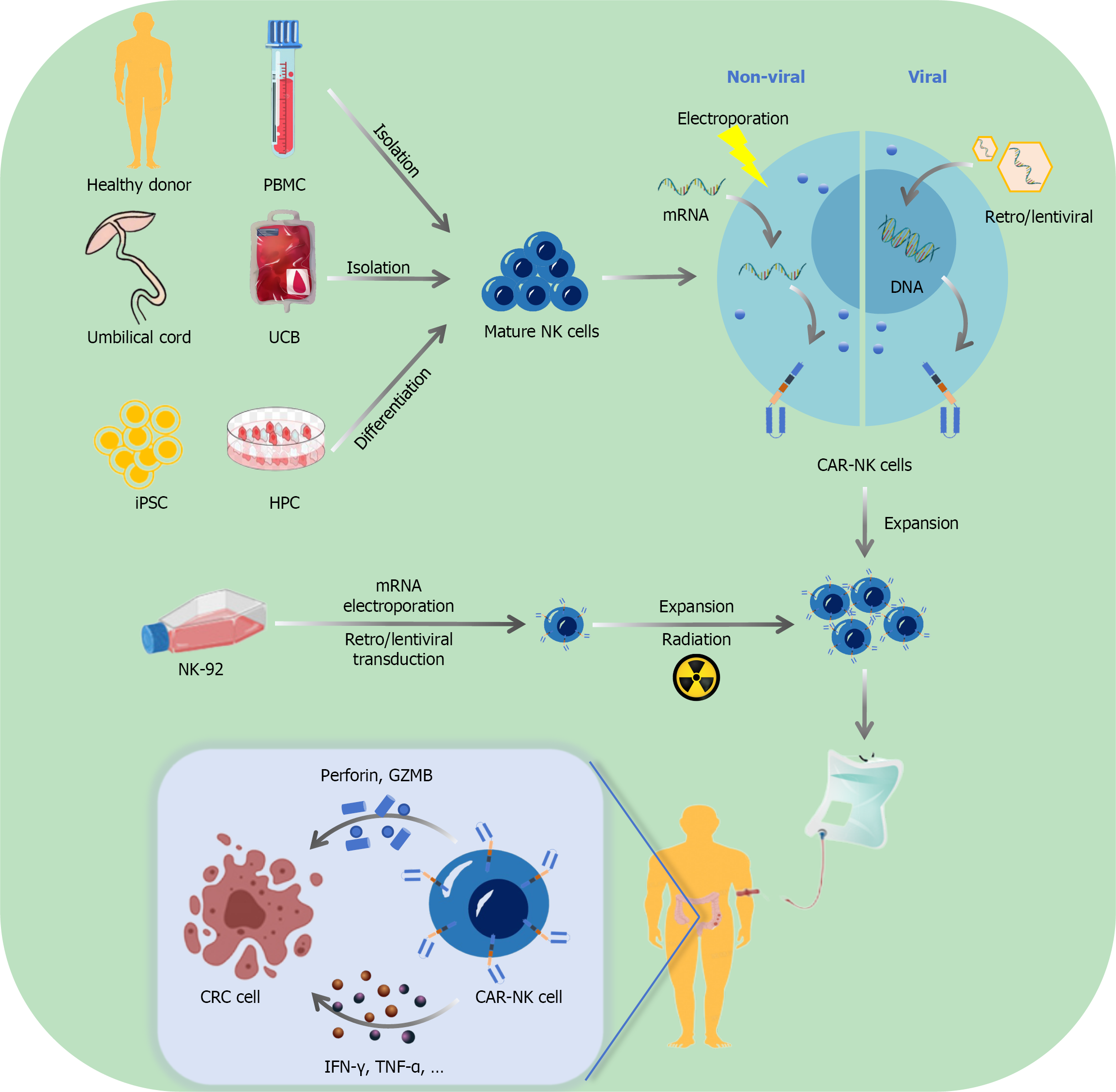
Figure 3 Generation and mechanism of chimeric antigen receptor-natural killer cells in colorectal cancer therapy[16,131-135,152,153,159,160].
Cell sources for chimeric antigen receptor (CAR)-natural killer (NK) generation: CAR-NK cells can be derived from multiple sources, including peripheral blood mononuclear cells from healthy donors, umbilical cord blood, hematopoietic progenitor cells differentiated from induced pluripotent stem cells, and the immortalized NK-92 cell line. Genetic modification methods: Two primary approaches are used for CAR delivery, including nonviral methods (electroporation for transient mRNA transfection), and viral methods (retroviral or lentiviral vectors for stable DNA integration). Cell processing and expansion: Following genetic modification, the cells undergo ex vivo expansion to achieve therapeutic quantities as well as radiation treatment (for certain cell types derived from NK-92) to ensure safety. Therapeutic mechanism in colorectal cancer: When infused into patients, CAR-NK cells recognize and bind to tumor-associated antigens on colorectal cancer cells, and initiate cytotoxic responses through the release of perforin and granules containing perforin and granzyme B and the secretion of pro-inflammatory cytokines, thereby effectively eliminating tumor cells while minimizing off-target effects. PBMC: Peripheral blood mononuclear cell; UCB: Umbilical cord blood; NK: Natural killer; CAR: Chimeric antigen receptor; iPSC: Induced pluripotent stem cell; HPC: Hematopoietic progenitor cell; GZMB: Granules containing perforin and granzyme B; CRC: Colorectal cancer; IFN-γ: Interferon-gamma; TNF-α: Tumor necrosis factor-α.
- Citation: Zhang XJ, Yu Y, Li JY, Yan YZ, Jiang SS, Zhang Y, Fei Q, Zhang YR, Zhao YX, Guo L, Lv J, Zhao HP. Natural killer cell-based immunotherapies for colorectal cancer: Current strategies, challenges, and future perspectives. World J Gastroenterol 2025; 31(34): 110051
- URL: https://www.wjgnet.com/1007-9327/full/v31/i34/110051.htm
- DOI: https://dx.doi.org/10.3748/wjg.v31.i34.110051