
















©The Author(s) 2025.
World J Gastroenterol. Sep 7, 2025; 31(33): 105466
Published online Sep 7, 2025. doi: 10.3748/wjg.v31.i33.105466
Published online Sep 7, 2025. doi: 10.3748/wjg.v31.i33.105466
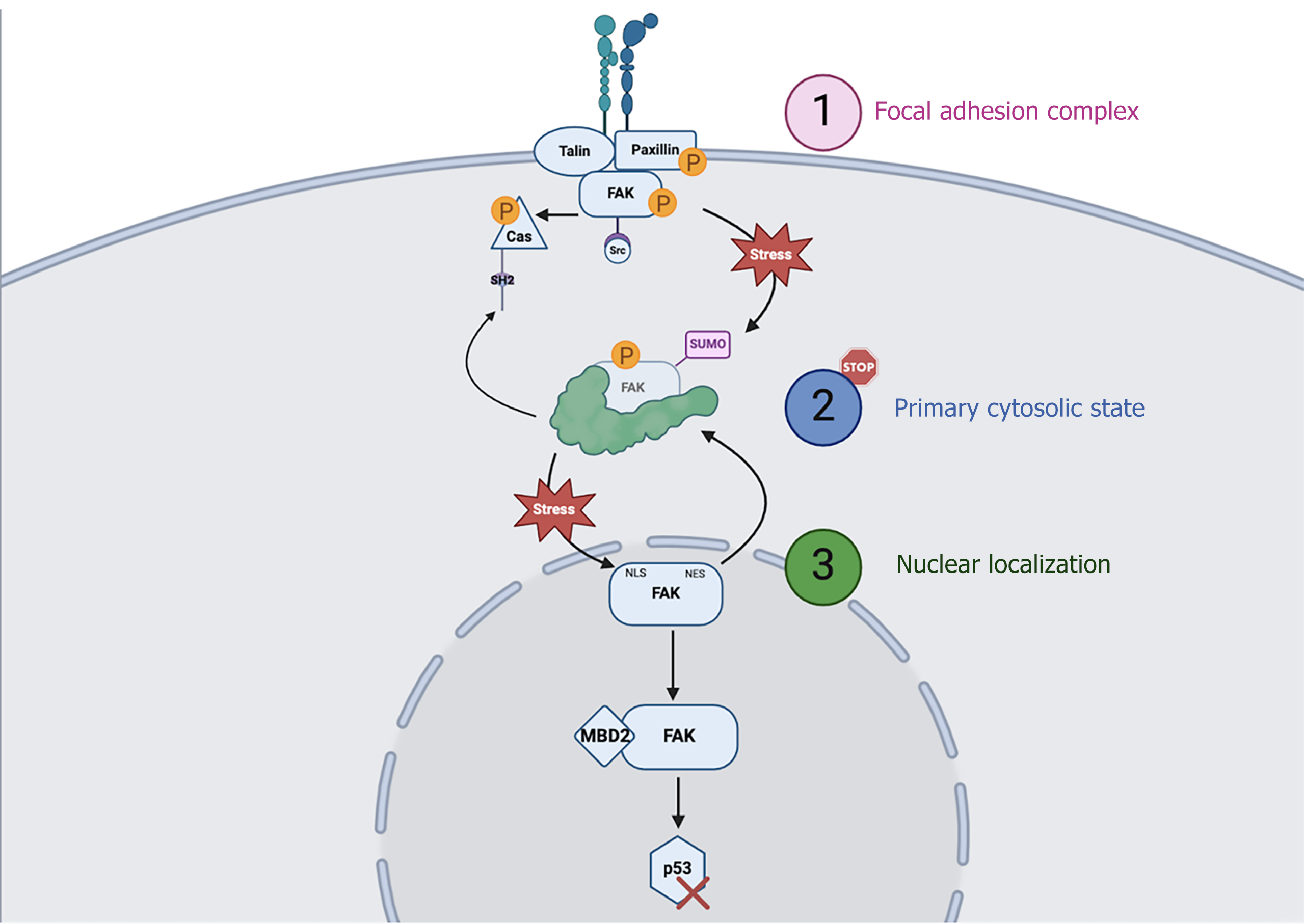
Figure 3 Focal adhesion kinase cycling.
Focal adhesion kinase (FAK) exhibits dynamic cycling between three cellular compartments: (1) The focal adhesion complex at the plasma membrane, where it is activated via autophosphorylation to facilitate integrin signaling and downstream Src and CRISPR associated proteins protein recruitment; (2) The primary cytosolic state, where FAK resides in an inactive or post-translationally modified (e.g., SUMOylated) reservoir, and (3) The nucleus, where stress-induced translocation via the nuclear localization signals triggers FAK nuclear functions, such as binding methyl-CpG-binding domain protein and promoting p53 degradation. FAK’s shuttling is tightly regulated, and its return to the cytosol is mediated by nuclear export signals. MBD2: Methyl-CpG-binding domain protein; FAK: Focal adhesion kinase; Cas: CRISPR associated proteins; SH: Src homology domain; SUMO: Small ubiquitin-related modifier; NES: Nuclear export signal; NLS: Nuclear localization signals.
- Citation: Malek KK, Kumar B, Ahmad R, Singh A, Basson MD. Focal adhesion kinase: A promising regulator of colitis-associated healing. World J Gastroenterol 2025; 31(33): 105466
- URL: https://www.wjgnet.com/1007-9327/full/v31/i33/105466.htm
- DOI: https://dx.doi.org/10.3748/wjg.v31.i33.105466