
















©The Author(s) 2025.
World J Gastroenterol. Aug 14, 2025; 31(30): 109186
Published online Aug 14, 2025. doi: 10.3748/wjg.v31.i30.109186
Published online Aug 14, 2025. doi: 10.3748/wjg.v31.i30.109186
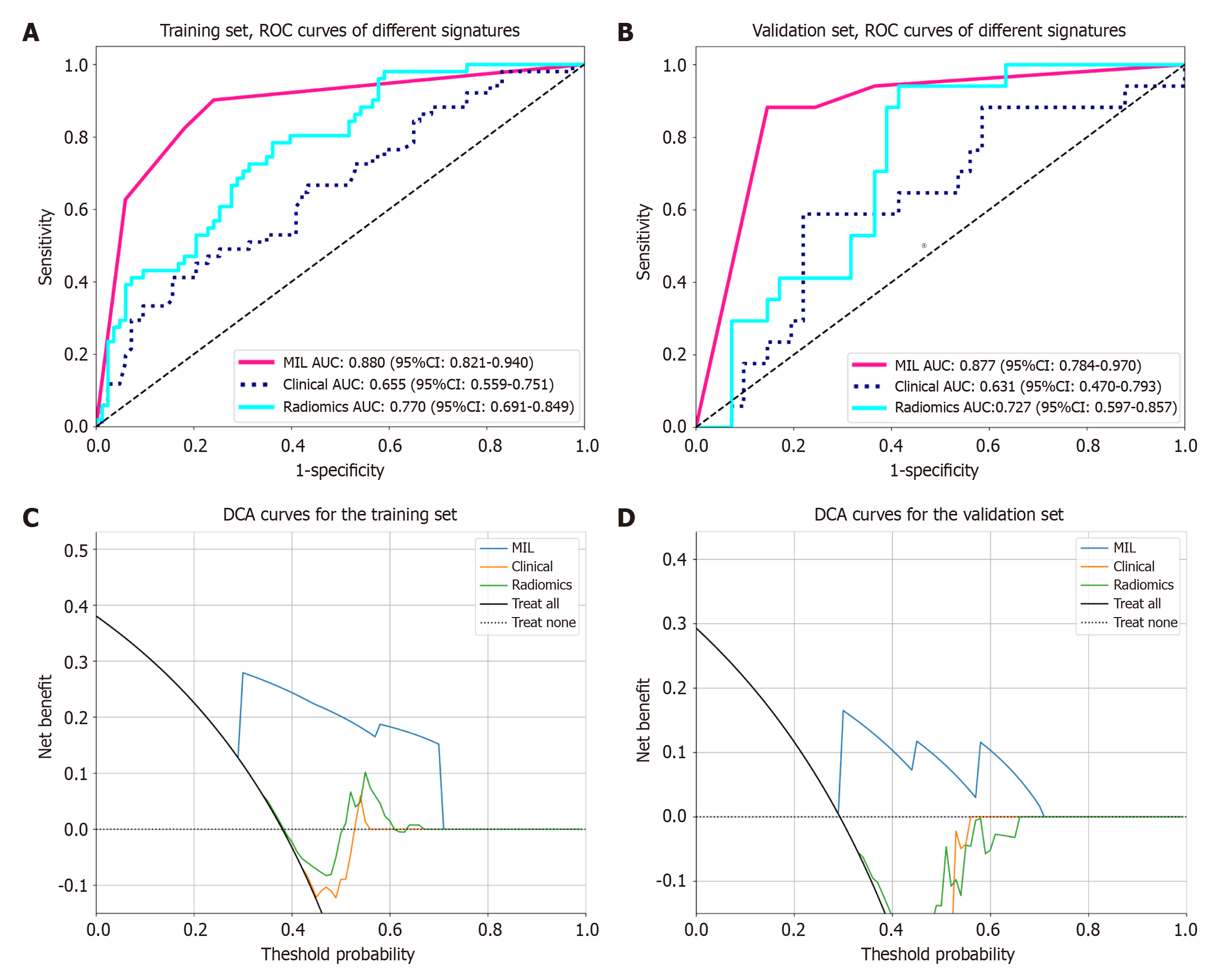
Figure 5 Receiver operating characteristic and decision curve analysis curves for different signatures.
A and B: The receiver operating characteristic curves for the training and validation sets, with red, cyan, and dark blue representing the multi-instance learning (MIL) signature, clinical signature, and radiomics signature, respectively; C and D: The decision curve analysis curves for the training and validation sets, with blue, yellow, and green representing the MIL signature, clinical signature, and radiomics signature, respectively. The results showed that the MIL signature consistently demonstrates better clinical net benefit than the clinical signature and radiomics signature. ROC: Receiver operating characteristic; MIL: Multi-instance; AUC: Area under the curve; DCA: Decision curve analysis.
- Citation: Cen YY, Nong HY, Huang XX, Lu XX, Pu CH, Huang LH, Zheng XJ, Pan ZL, Huang Y, Ding K, Huang DY. Computed tomography-based deep learning and multi-instance learning for predicting microvascular invasion and prognosis in hepatocellular carcinoma. World J Gastroenterol 2025; 31(30): 109186
- URL: https://www.wjgnet.com/1007-9327/full/v31/i30/109186.htm
- DOI: https://dx.doi.org/10.3748/wjg.v31.i30.109186