
















©2014 Baishideng Publishing Group Inc.
World J Gastroenterol. Jun 7, 2014; 20(21): 6560-6572
Published online Jun 7, 2014. doi: 10.3748/wjg.v20.i21.6560
Published online Jun 7, 2014. doi: 10.3748/wjg.v20.i21.6560
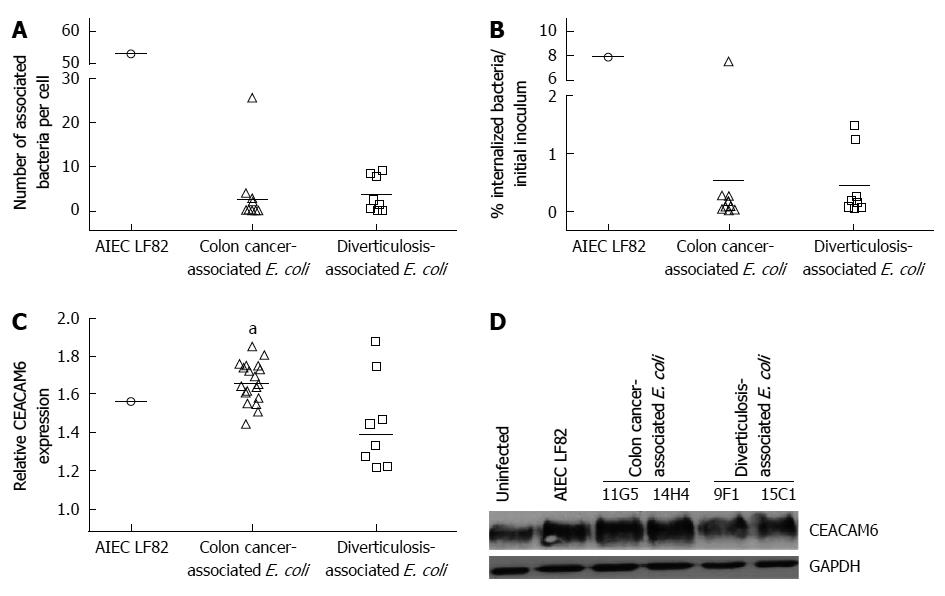
Figure 1 Adhesion, invasion and ability to induce carcinoembryonic antigen-related cell adhesion molecule 6 expression of B2 Escherichia coli strains.
A and B: Ability of colon cancer- and diverticulosis-associated B2 Escherichia coli (E. coli) strains and AIEC strain LF82 to adhere to and to invade I-407 intestinal epithelial cells. A: Adhesion. Results are expressed as number of associated bacteria per cell after 3 h of infection; B: Invasion. Results are expressed as percentage of inoculum surviving after 3 h of infection and 1 h of gentamicin treatment; C and D: Induction of carcinoembryonic antigen-related cell adhesion molecule 6 (CEACAM6) expression in colon epithelial T84 cells infected for 6h with colon cancer- and diverticulosis-associated B2 E. coli strains and AIEC strain LF82. C: Quantitative dosage of CEACAM6 by ELISA. Results are expressed as amounts of CEACAM6 in stimulated or infected cells relative to untreated cells. aP≤ 0.05 vs diverticulosis associated E. coli. D: CEACAM6 expression analysis by Western Blot. E. coli strains 11G5 and 14H4 were isolated from colon cancer patients and E. coli strains 9F1 and 15C1 from patients with diverticulosis.
-
Citation: Raisch J, Buc E, Bonnet M, Sauvanet P, Vazeille E, de Vallée A, Déchelotte P, Darcha C, Pezet D, Bonnet R, Bringer MA, Darfeuille-Michaud A. Colon cancer-associated B2
Escherichia coli colonize gut mucosa and promote cell proliferation. World J Gastroenterol 2014; 20(21): 6560-6572 - URL: https://www.wjgnet.com/1007-9327/full/v20/i21/6560.htm
- DOI: https://dx.doi.org/10.3748/wjg.v20.i21.6560