
















Copyright: ©Author(s) 2026.
Artif Intell Cancer. Sep 8, 2026; 7(1): 116460
Published online Sep 8, 2026. doi: 10.35713/aic.v7.i1.116460
Published online Sep 8, 2026. doi: 10.35713/aic.v7.i1.116460
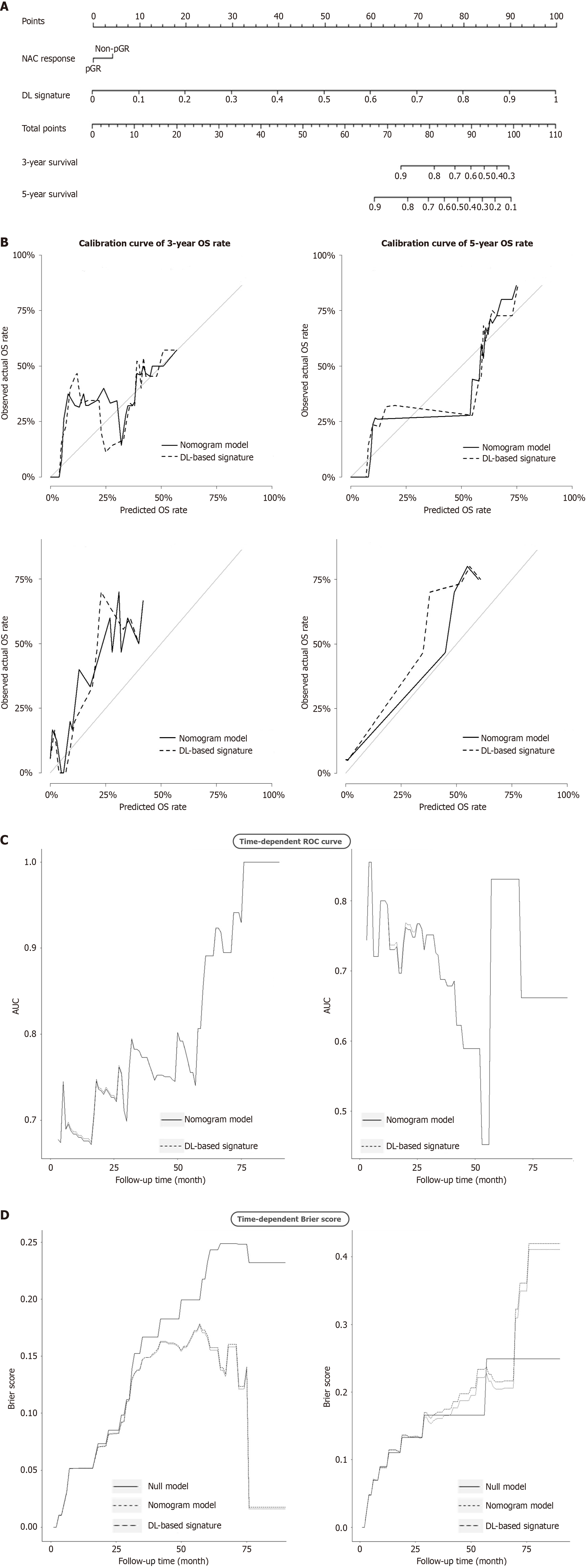
Figure 4 Development and performance evaluation of the integrated prognostic model and the deep learning-based signature for prediction of overall survival in adolescents and young adults with osteosarcoma.
A: Nomogram model in prediction of 3-year and 5-year overall survival (OS) combining prognostic clinical variables and the deep learning (DL)-based signature from treatment prediction in the training and testing cohort; B: Calibration curves in measurement of predicted 3-year (left) and 5-year (right) survival probabilities in the training (upper) and testing (lower) cohorts. The X-axis represented predicted survival risks, while the Y-axis showed observational survival probabilities. The line Y = X performed the ideal agreement between the estimated and actual survival probabilities; C: Time-dependent receiver operating characteristic analysis for the DL-based signature and the integrated nomogram model on OS showing the fluctuation of area under the receiver operating characteristics curves with follow-up in the training and testing cohorts; D: Time-dependent Brier scores for the DL-based signature and the integrated nomogram model on OS in the training and testing cohorts. NAC: Neoadjuvant chemotherapy; DL: Deep learning; OS: Overall survival; ROC: Receiver operating characteristic; AUC: Area under the receiver operating characteristic curve.
- Citation: Yang YH. Magnetic resonance imaging-based deep learning model for prediction of the neoadjuvant chemotherapy response and survival prognosis in adolescents with osteosarcoma. Artif Intell Cancer 2026; 7(1): 116460
- URL: https://www.wjgnet.com/2644-3228/full/v7/i1/116460.htm
- DOI: https://dx.doi.org/10.35713/aic.v7.i1.116460