
















Copyright: ©Author(s) 2026.
Artif Intell Cancer. Sep 8, 2026; 7(1): 114273
Published online Sep 8, 2026. doi: 10.35713/aic.v7.i1.114273
Published online Sep 8, 2026. doi: 10.35713/aic.v7.i1.114273
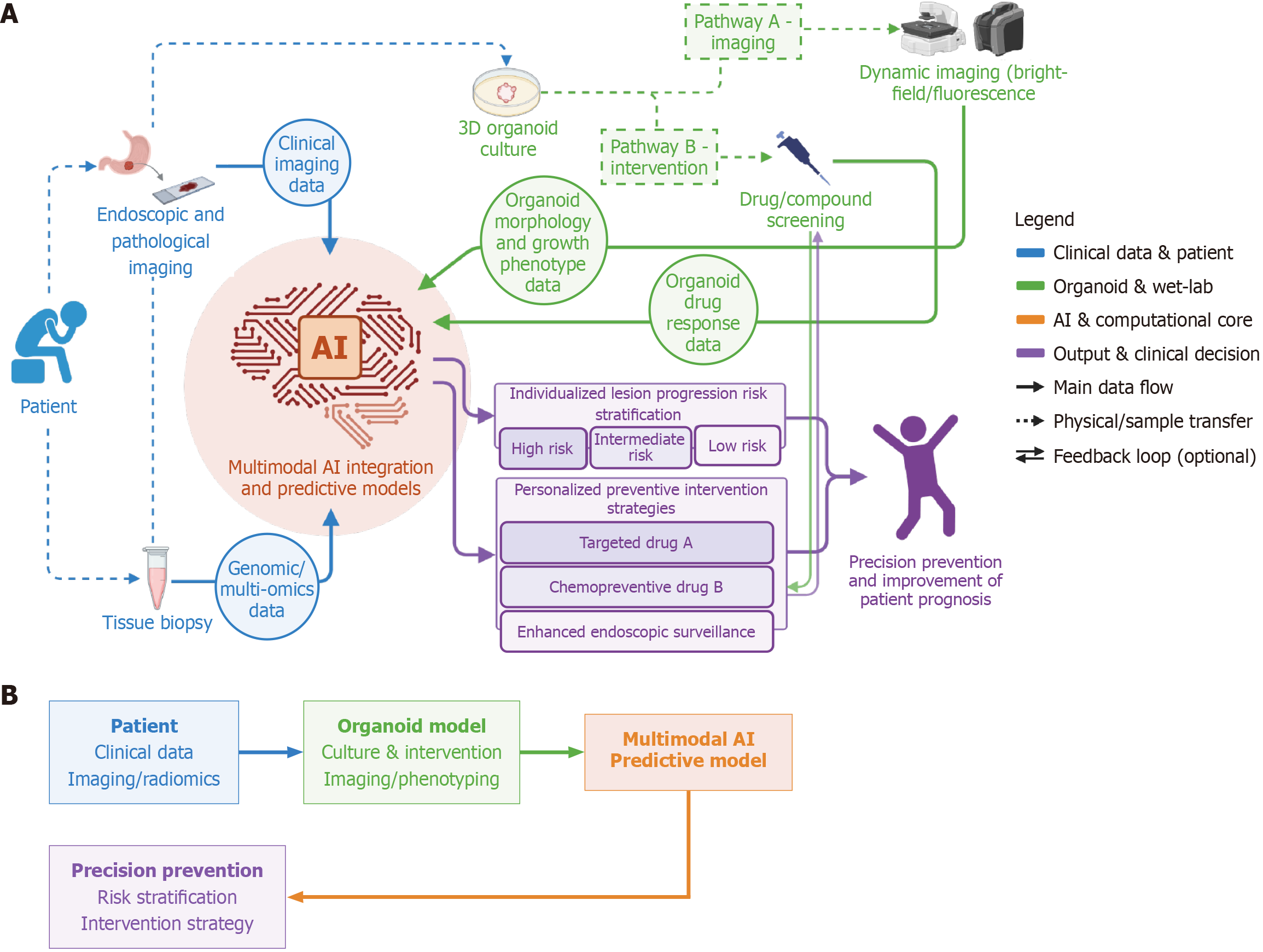
Figure 1 The integrative paradigm of artificial intelligence and organoid technology for gastric precancerous lesion research.
A: A detailed schematic diagram of the artificial intelligence (AI)-organoid synergy pipeline. The framework begins with the collection of clinical data (endoscopic/pathological images and genomics) and tissue biopsies from patients. Biopsies are used to establish patient-derived organoids, which are subjected to high-throughput dynamic imaging and drug screening. The multimodal AI integration and prediction model (central core) fuses all clinical, imaging, and drug response data. This integrated analysis outputs personalized risk stratification and preventive intervention strategies, enabling precision prevention. Arrows indicate the direction of data and sample flow; B: A simplified closed-loop flowchart summarizing the core logic of the AI-organoid integration. The model depicts the cyclical process where clinical data and biopsies from the patient inform the generation and analysis of organoid models. The resulting data is processed by the multimodal AI prediction model to generate personalized outputs that guide clinical decision-making, ultimately feeding back to improve patient care. AI: Artificial intelligence; 3D: Three-dimensional.
- Citation: Wu CH, Qiu JX, Jia YB, Quan Y, Liu C, Ling JH. Synergistic applications of artificial intelligence and organoid technology in gastric precancerous lesion research: Mechanisms, translation, and challenges. Artif Intell Cancer 2026; 7(1): 114273
- URL: https://www.wjgnet.com/2644-3228/full/v7/i1/114273.htm
- DOI: https://dx.doi.org/10.35713/aic.v7.i1.114273