
















©The Author(s) 2025.
World J Clin Cases. Nov 16, 2025; 13(32): 104208
Published online Nov 16, 2025. doi: 10.12998/wjcc.v13.i32.104208
Published online Nov 16, 2025. doi: 10.12998/wjcc.v13.i32.104208
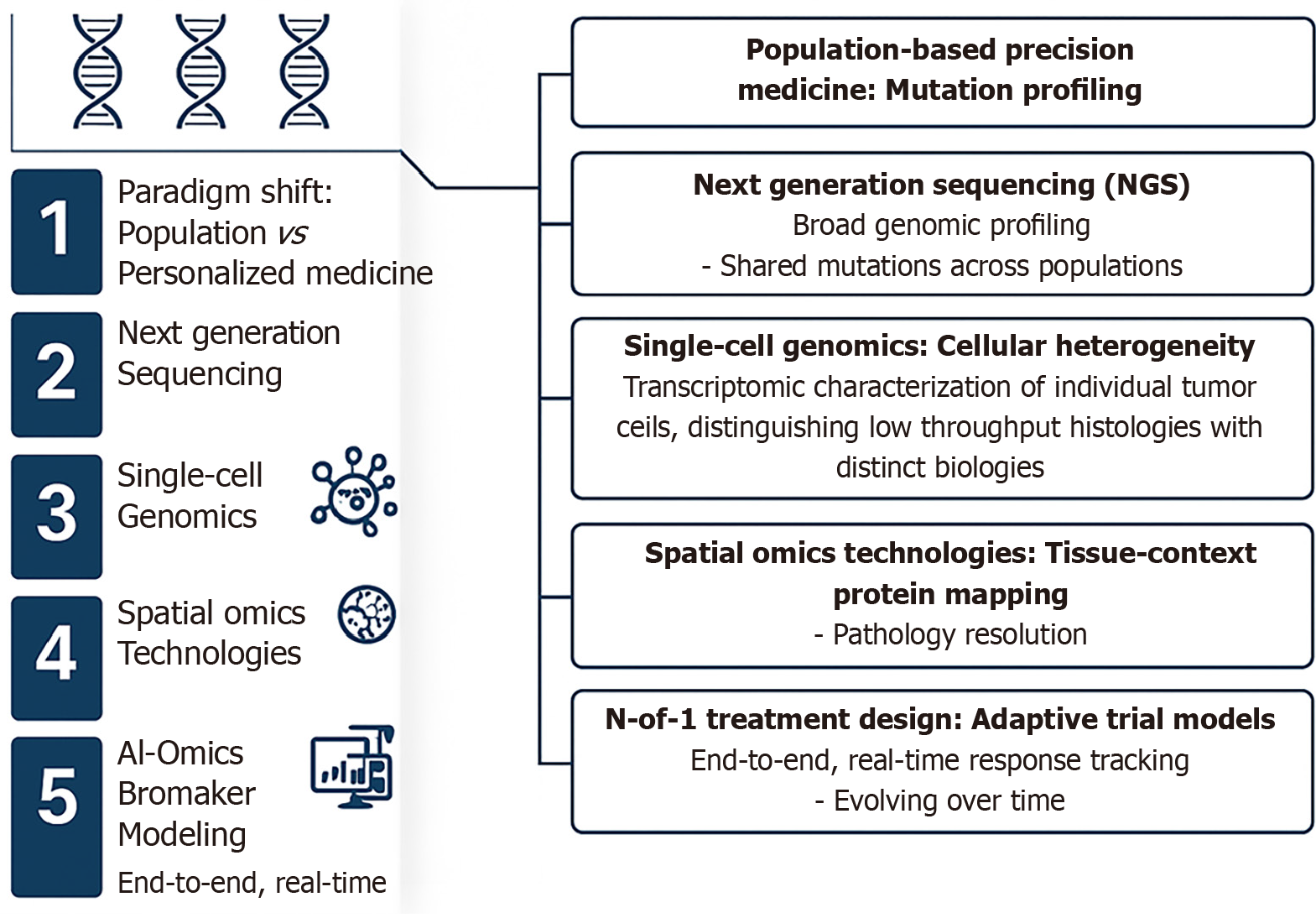
Figure 3 Comprehensive and visually structured overview of the evolution of precision medicine, tracing its development from population-based mutation profiling toward fully personalized, spatiotemporal cancer care.
It begins with the paradigm shift from generalized population-level strategies to personalized medicine, where the integration of individual genomic and lifestyle data takes center stage. The next major advancement depicted is next-generation sequencing, enabling broad genomic profiling and the identification of shared mutations across populations, a foundational step in large-scale precision oncology. This leads into the application of single-cell genomics, which addresses cellular heterogeneity by mapping the transcriptional landscapes of individual tumor cells, uncovering subpopulations with distinct biological characteristics. Further refinement is achieved through spatial omics and proteomics technologies, which provide tissue-contextual protein mapping at high resolution, crucial for pathology insights and tumor microenvironment analysis. The figure then emphasizes the role of artificial intelligence-assisted imaging and biomarker modeling, which supports real-time, end-to-end response tracking and dynamic patient monitoring. As precision deepens, the N-of-1 treatment design is introduced, highlighting adaptive trial models tailored to individual patients through the integration of genomic data and lifestyle factors. The final component in the figure encapsulates spatiotemporal assessment of prognosis and monitoring, where therapy responses, resistance patterns, recurrence risks, and lifestyle influences are evaluated across time to enable personalized lifetime cancer care. This integrated, stepwise visualization underscores the convergence of omics technologies, artificial intelligence, and individualized data in revolutionizing modern cancer diagnostics and therapeutics. AI: Artificial intelligence; NGS: Next-generation sequencing.
- Citation: Lee HM, Li SC. Rethinking p16, p53, and HPV in HNCSCC through lessons from glioblastoma subclonal evolution toward patient-centric N-of-1 single-cell RNA sequencing paradigm. World J Clin Cases 2025; 13(32): 104208
- URL: https://www.wjgnet.com/2307-8960/full/v13/i32/104208.htm
- DOI: https://dx.doi.org/10.12998/wjcc.v13.i32.104208