
















©The Author(s) 2025.
World J Transplant. Dec 18, 2025; 15(4): 108376
Published online Dec 18, 2025. doi: 10.5500/wjt.v15.i4.108376
Published online Dec 18, 2025. doi: 10.5500/wjt.v15.i4.108376
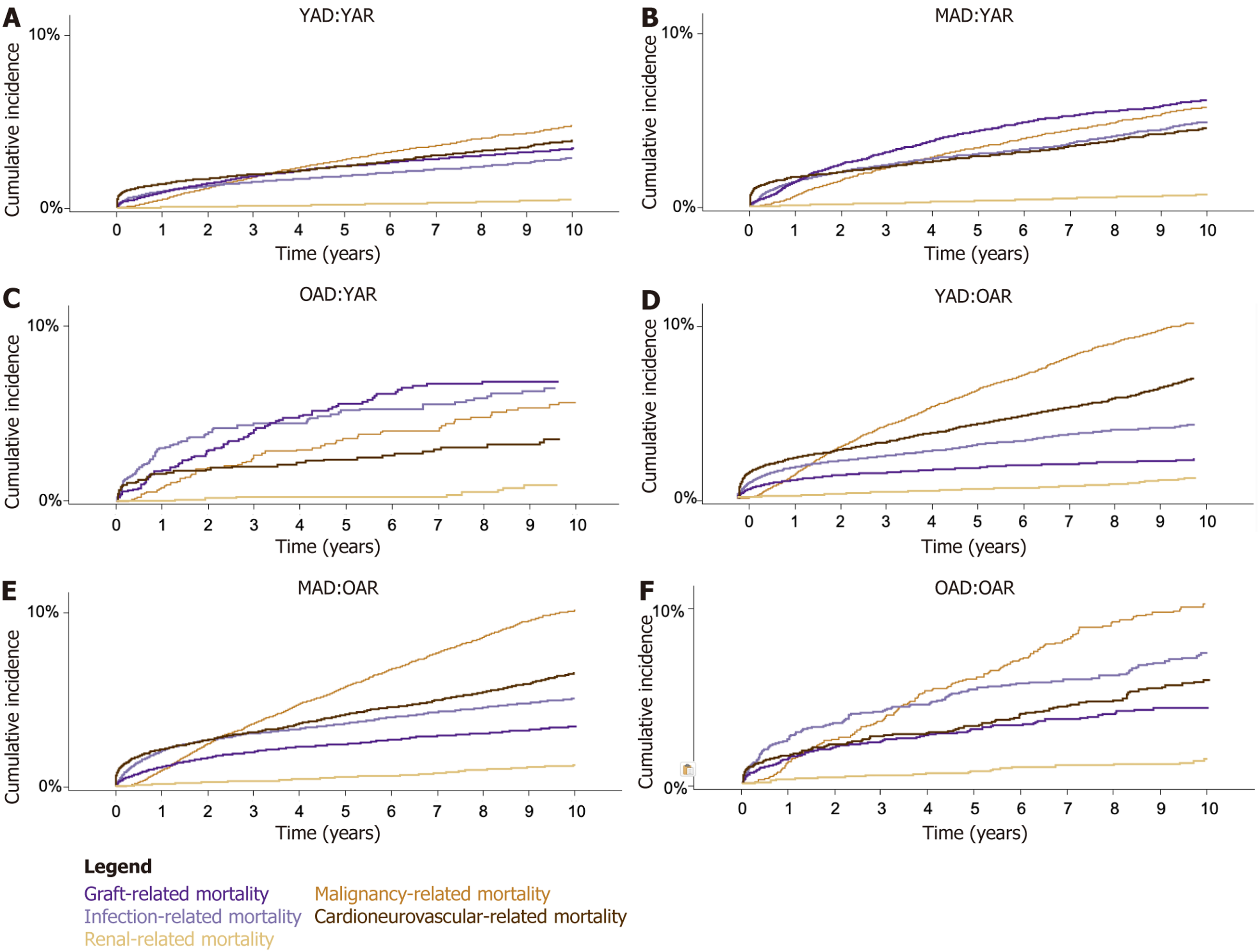
Figure 3 Competing risk cumulative incidence curves for post-liver transplantation, cause-specific mortality by each donor:recipient age pair.
Cause-specific mortality and alternative causes of death were treated as competing risks. Within each donor:recipient subgroup, infection-, graft-, and cardioneurovascular-related mortality were most prevalent within the first 1.5 years of follow-up. Rates of graft- and Infection-related mortality rise with incremental increases of donor age among young recipients. Malignancy-related mortality begins to rise at later follow-up endpoints and eventually surpasses most causes of death. Among older recipients (younger age donors, ≤ 45-years (YAD): Older age recipients, > 55-years (OAR), middle-aged donors, 46-69-years: OAR: Older age donors, ≥ 70-years: OAR), malignancy-related mortality surpasses other causes of death sooner in follow-up. A: YAD: Younger age recipients, ≤ 55-years; B: Middle-aged donors, 46-69-years: YAR; C: Older age donors, ≥ 70-years: Younger age recipients, ≤ 55-years; D: YAD: OAR; E: Middle-aged donors, 46-69-years: OAR; F: Older age donors, ≥ 70-years: OAR. YAD: Younger age donors, ≤ 45-years; MAD: Middle-aged donors, 46-69-years; OAD: Older age donors, ≥ 70-years; YAR: Younger age recipients, ≤ 55-years; OAR: Older age recipients, > 55-years.
- Citation: Hasjim BJ, Chen SY, Hlaing NK, Ichii H, Redfield RR, Imagawa DK, Bhat M. Donor-recipient age mismatch and outcomes in liver transplantation: A scientific registry of transplant recipients database analysis. World J Transplant 2025; 15(4): 108376
- URL: https://www.wjgnet.com/2220-3230/full/v15/i4/108376.htm
- DOI: https://dx.doi.org/10.5500/wjt.v15.i4.108376