
















Copyright: ©Author(s) 2026.
World J Psychiatry. Jul 19, 2026; 16(7): 117921
Published online Jul 19, 2026. doi: 10.5498/wjp.117921
Published online Jul 19, 2026. doi: 10.5498/wjp.117921
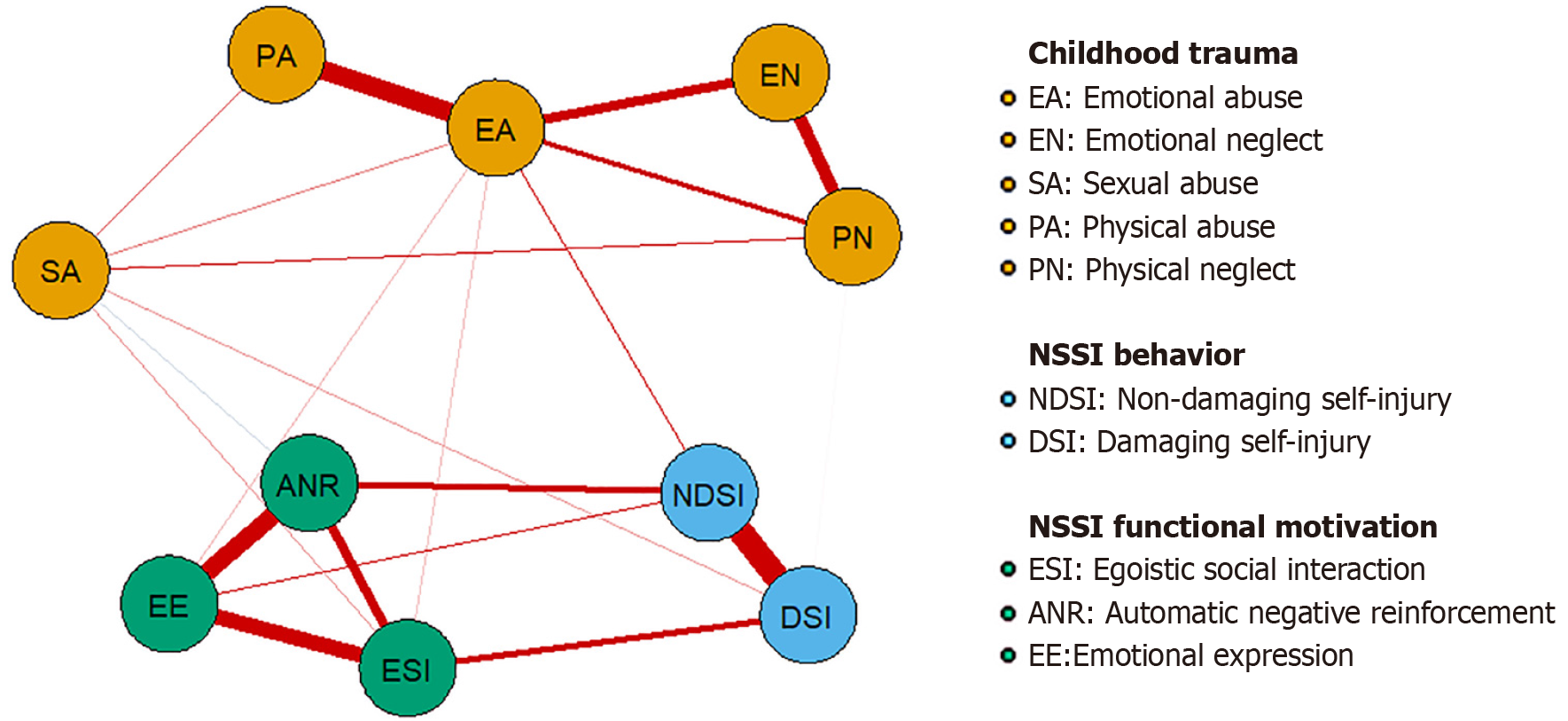
Figure 1 Network structure of childhood trauma and non-suicidal self-injury behaviors and functions in adolescents with depressive disorders.
This network illustrates the relationships among childhood-trauma dimensions (emotional abuse, emotional neglect, physical abuse, physical neglect, and sexual abuse), non-suicidal self-injury behaviors (non-damaging and damaging self-injuries), and functional motivations (egoistic social interaction, automatic negative reinforcement, and emotional expression). Solid red lines represent positive associations between nodes. The thickness of the line represents the strength of the association between symptom nodes. SA: Sexual abuse; PA: Physical abuse; EA: Emotional abuse; EN: Emotional neglect; PN: Physical neglect; EE: Emotional expression; ANR: Automatic negative reinforcement; ESI: Egoistic social interaction; NDSI: Non-damaging self-injury; DSI: Damaging self-injury; NSSI: Non-suicidal self-injury.
- Citation: Zhang FF, Ma MF, Zhou LN, Gao R, Guo R, Yang W, Liang XL, Wang J. Network perspective on childhood trauma and non-suicidal self-injury behaviors and functions in adolescents with depressive disorders. World J Psychiatry 2026; 16(7): 117921
- URL: https://www.wjgnet.com/2220-3206/full/v16/i7/117921.htm
- DOI: https://dx.doi.org/10.5498/wjp.117921