
















Copyright: ©Author(s) 2026.
World J Psychiatry. Jun 19, 2026; 16(6): 115996
Published online Jun 19, 2026. doi: 10.5498/wjp.v16.i6.115996
Published online Jun 19, 2026. doi: 10.5498/wjp.v16.i6.115996
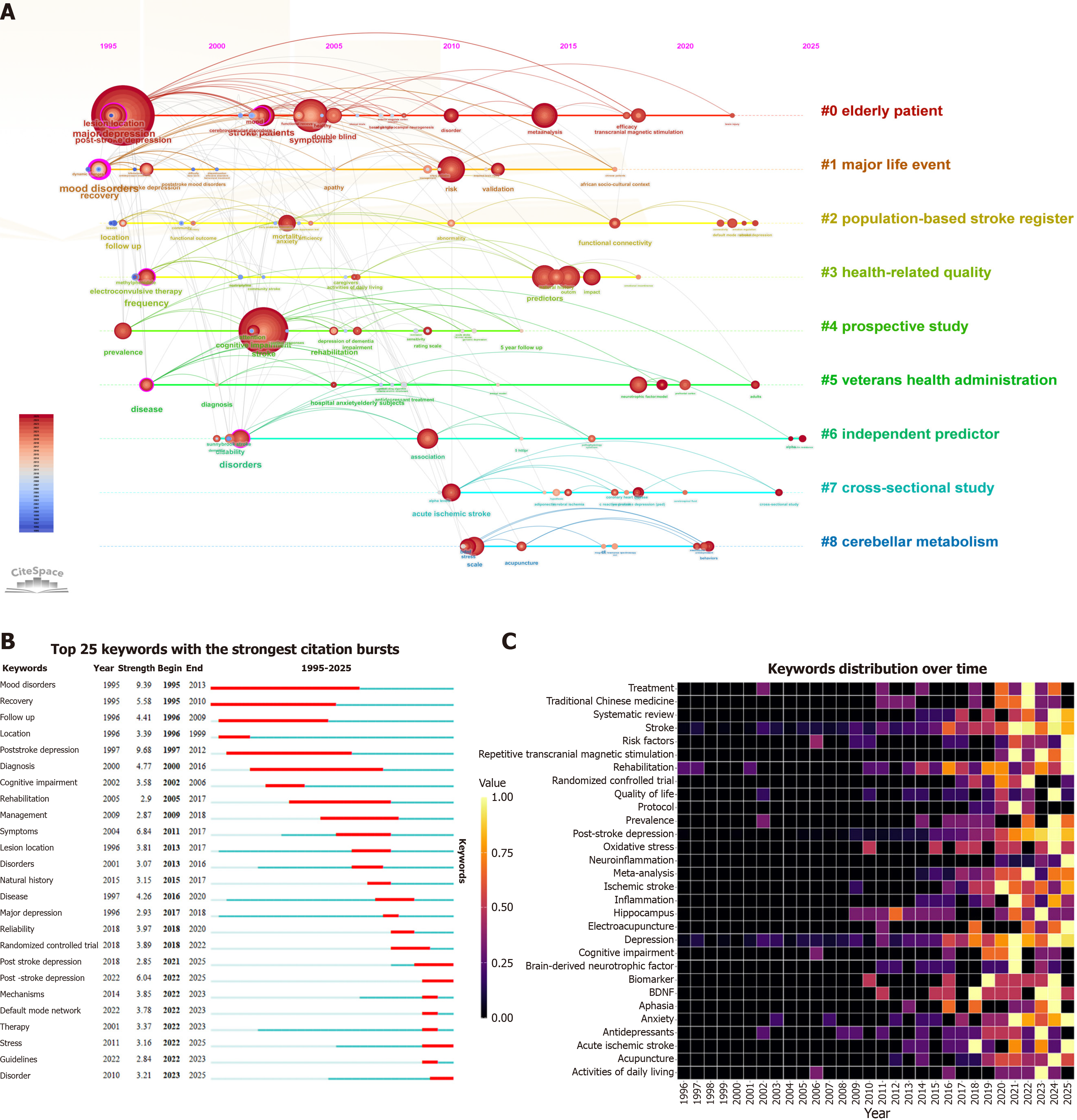
Figure 3 Evolution of research fronts and thematic trends in post-stroke depression.
A: Keyword co-occurrence network map. Nodes represent high-frequency keywords clustered into distinct research themes (e.g., 0 elderly patient), with node size proportional to frequency and links indicating co-occurrence strength. The multi-color gradient (red, yellow, green, blue) reflects the temporal evolution of keywords from 1989 to 2023, based on a timeline spanning 1995 to 2025, illustrating the shift from clinical phenomenology to mechanistic studies; B: Top 25 keywords with the strongest citation bursts. The bar chart displays burst strength (horizontal axis) and duration (blue-to-red gradient bars) for keywords spanning from 1995 to 2025. Early bursts include “mood disorders” and “recovery”, while recent bursts highlight “randomized controlled trial”, “default mode network”, and “post - stroke depression”, reflecting the evolution of research focus from clinical phenomenology to mechanistic and interventional studies; C: Temporal heatmap of keyword frequency. Rows represent years (1989-2023), columns show keywords, and color intensity (purple to yellow) indicates annual keyword prominence, visualizing the dynamic evolution of research hotspots over time. Analyses performed using CiteSpace (6.3.R1) and R (4.5.1). Clustering and burst detection reveal a paradigm shift toward neuroimmune mechanisms and systems-level interventions in recent decades.
- Citation: Gu JX, Liu CQ, Chen GX, Yao T, Sun ZX, Wang Y. Post-stroke depression update 2025: Mechanisms, prediction, and management. World J Psychiatry 2026; 16(6): 115996
- URL: https://www.wjgnet.com/2220-3206/full/v16/i6/115996.htm
- DOI: https://dx.doi.org/10.5498/wjp.v16.i6.115996