
















Copyright: ©Author(s) 2026.
World J Psychiatry. May 19, 2026; 16(5): 113866
Published online May 19, 2026. doi: 10.5498/wjp.v16.i5.113866
Published online May 19, 2026. doi: 10.5498/wjp.v16.i5.113866
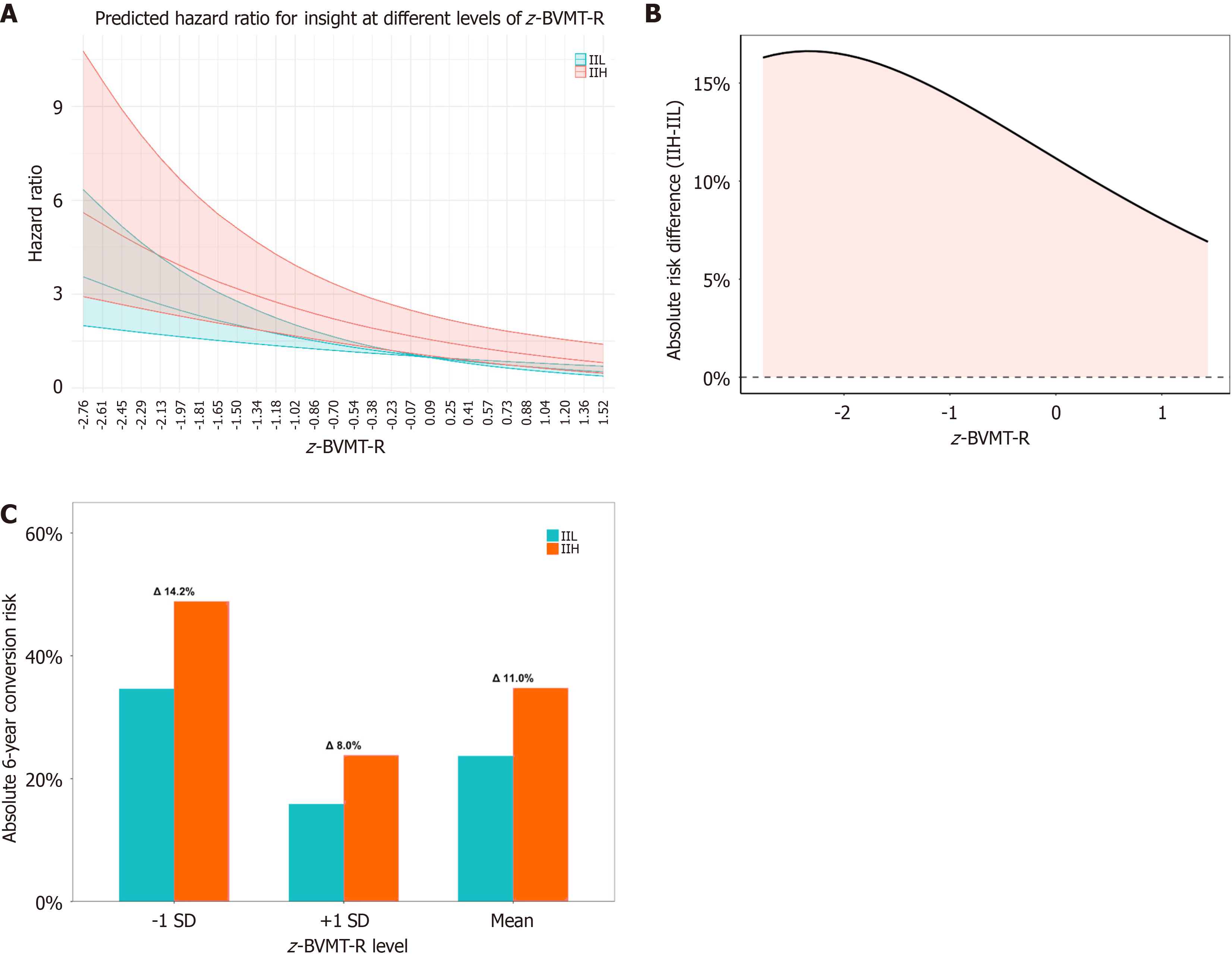
Figure 3 Predicted effects of visuospatial memory and impaired insight on conversion risk.
A: Shows predicted hazard ratios for impaired insight [high-impairment insight group (IIH) vs low-impairment insight group (IIL)] across the continuous range of z-score for the Brief Visuospatial Memory Test-Revised, based on the Cox model; B: Shows the continuous absolute 6-year conversion risk difference between IIH and IIL groups as visuospatial memory varies; C: Shows absolute 6-year risk differences between insight groups (IIL vs IIH) at representative visuospatial memory levels (-1 SD, +1 SD and mean). IIL: The 12th general psychopathology symptom item of the Positive and Negative Syndrome Scale, G12, scored as less than 3; IIH: G12 scored as 3 or higher. IIL: Low-impairment insight group; IIH: High-impairment insight group; z-BVMT-R: Z-score for the Brief Visuospatial Memory Test-Revised.
- Citation: Xu LH, Cui HR, Wei YY, Tang XC, Qian ZY, Zhang D, Zheng WS, Zhu TY, Hong XF, Zhu JJ, Hu YG, Liu X, Jiao X, Qing Y, Chen XC, Tang YY, Zhang TH, Wang JJ. Visuospatial memory modulates insight and its predictive value for 6-year psychosis risk in clinical high-risk individuals. World J Psychiatry 2026; 16(5): 113866
- URL: https://www.wjgnet.com/2220-3206/full/v16/i5/113866.htm
- DOI: https://dx.doi.org/10.5498/wjp.v16.i5.113866