
















Copyright: ©Author(s) 2026.
World J Psychiatry. Dec 19, 2026; 16(12): 125255
Published online Dec 19, 2026. doi: 10.5498/wjp.125255
Published online Dec 19, 2026. doi: 10.5498/wjp.125255
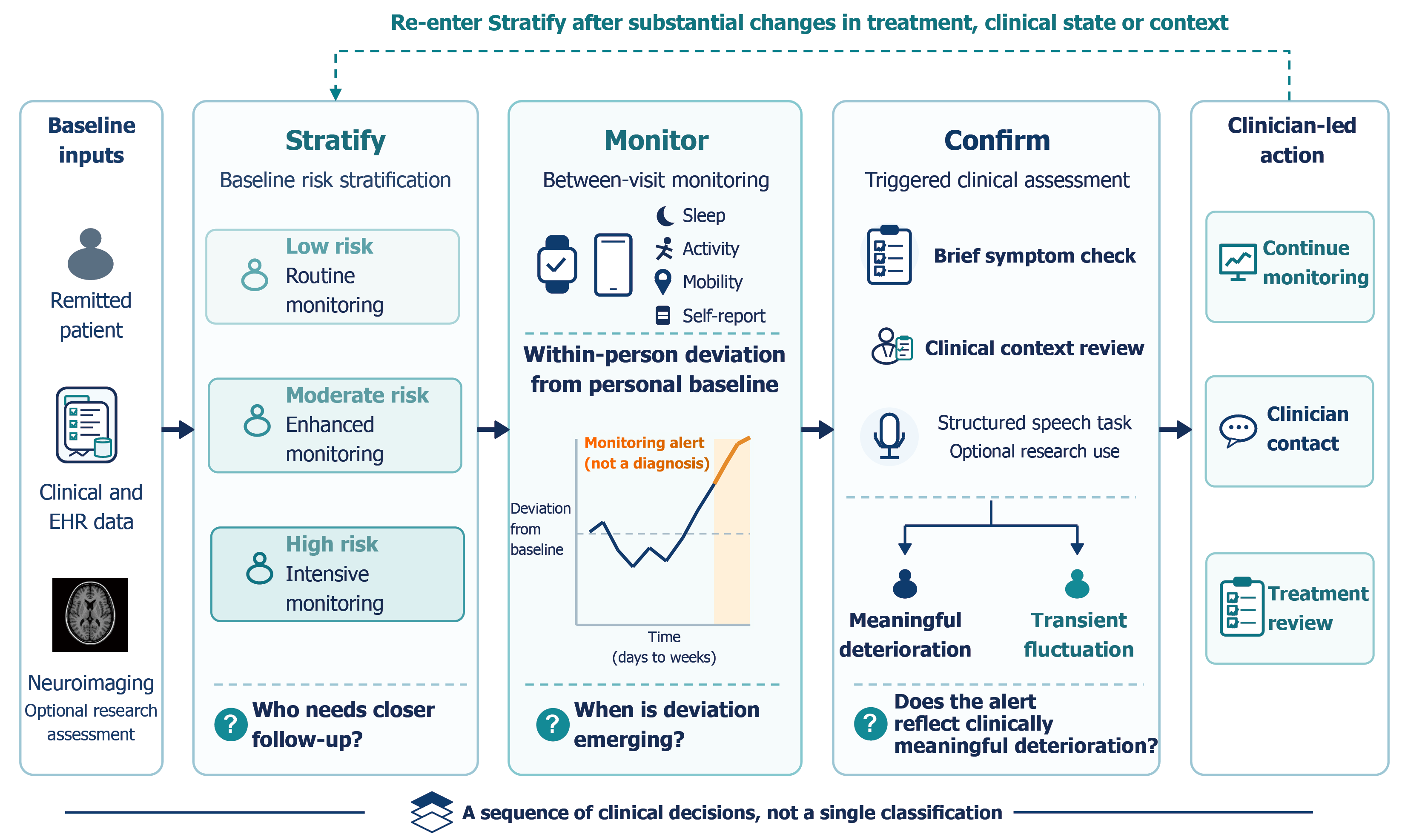
Figure 1 The proposed Stratify-Monitor-Confirm architecture for post-remission relapse prediction in remitted major depressive disorder.
Three sequential layers address distinct clinical decisions on different time scales: Stratify identifies which remitted patients warrant closer follow-up, initially using baseline data at remission or maintenance transition; Monitor detects when an individual has begun to drift from their own stable baseline through longitudinal within-person tracking, drawing on continuous passive sensing, brief repeated self-report, or both; Confirm clarifies whether that change reflects clinically meaningful deterioration through triggered assessment, which may combine brief validated symptom measures, the patient’s own account of familiar early warning signs, contextual information, clinician judgement and, where justified, a controlled-context probe. Each stage configures the operating conditions of the next, and substantial change in treatment, clinical state or context returns the patient to stratification. The management response to an alert is guided by Confirm-layer assessment rather than by the monitoring signal itself; direct evidence for the triggered post-alert Confirm role is currently absent. Stratify-Monitor-Confirm is a proposed conceptual framework, not a validated clinical algorithm or guideline; the sequence has not been tested end-to-end, and the data streams shown are illustrative candidates rather than prescribed or routinely available components. EHR: Electronic health record.
- Citation: Chen SY, Fang YF, Du Q, Li G, Zhu Z. Relapse prediction after remission in major depressive disorder: From single classification to sequential clinical decisions. World J Psychiatry 2026; 16(12): 125255
- URL: https://www.wjgnet.com/2220-3206/full/v16/i12/125255.htm
- DOI: https://dx.doi.org/10.5498/wjp.125255