
















Copyright: ©Author(s) 2026.
World J Psychiatry. Dec 19, 2026; 16(12): 120242
Published online Dec 19, 2026. doi: 10.5498/wjp.120242
Published online Dec 19, 2026. doi: 10.5498/wjp.120242
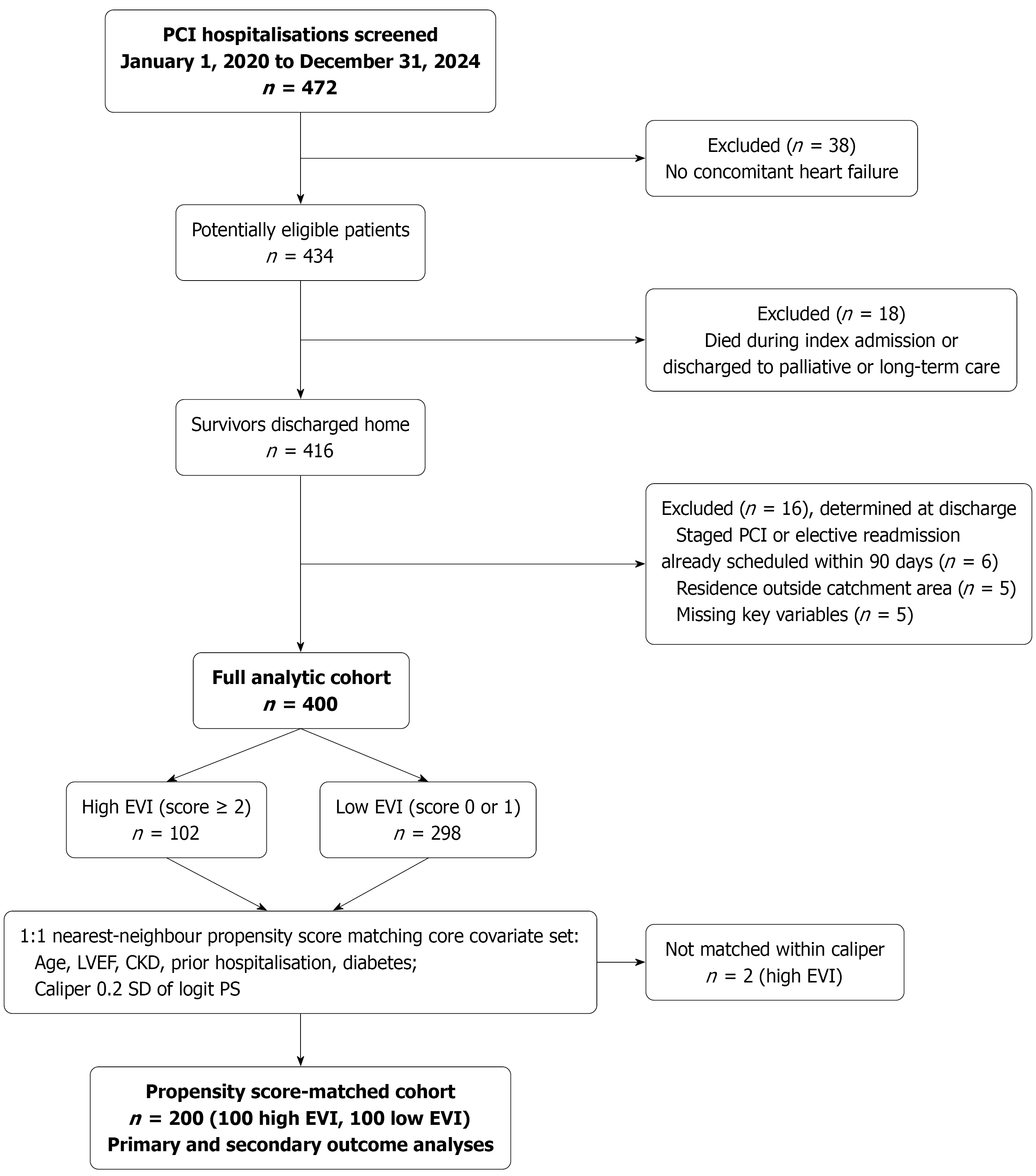
Figure 4 Study flow diagram.
Of 472 percutaneous coronary intervention hospitalisations screened between January 1, 2020 and December 31, 2024, 38 were excluded for absence of concomitant heart failure and 18 for in-hospital death or discharge to palliative or long-term care. Among 416 survivors discharged home, 16 were excluded on the basis of information available at discharge: A staged percutaneous coronary intervention or other elective readmission already scheduled within 90 days (n = 6), residence outside the hospital catchment area (n = 5), or missing key variables (n = 5), yielding a full analytic cohort of 400 patients. One-to-one nearest-neighbour propensity score matching on the core covariate set produced 100 matched pairs; 2 high-electronic medical record-derived psychosocial vulnerability index patients could not be matched within the caliper. CKD: Chronic kidney disease; EVI: Electronic medical record-derived psychosocial vulnerability index; LVEF: Left ventricular ejection fraction; PCI: Percutaneous coronary intervention; PS: Propensity score.
- Citation: Jin X, Wang Q, Mao FG, Tang YL, Wang XY. Electronic medical record-derived psychosocial vulnerability and unplanned readmission after percutaneous coronary intervention in heart failure. World J Psychiatry 2026; 16(12): 120242
- URL: https://www.wjgnet.com/2220-3206/full/v16/i12/120242.htm
- DOI: https://dx.doi.org/10.5498/wjp.120242