
















Copyright: ©Author(s) 2026.
World J Psychiatry. Dec 19, 2026; 16(12): 120242
Published online Dec 19, 2026. doi: 10.5498/wjp.120242
Published online Dec 19, 2026. doi: 10.5498/wjp.120242
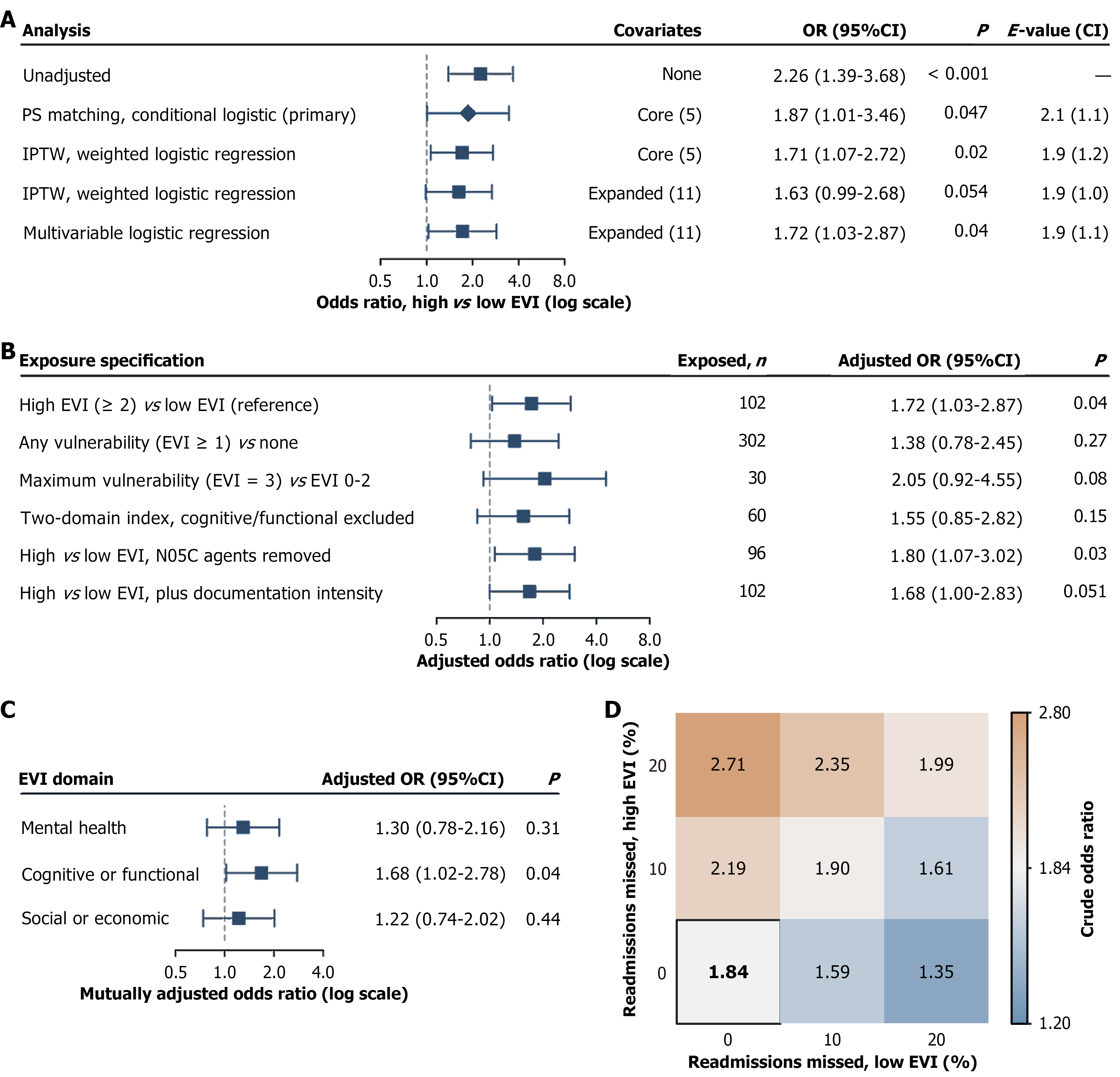
Figure 3 Robustness of the association between high electronic medical record-derived psychosocial vulnerability index and 90-day unplanned readmission.
A: Odds ratios (ORs) from five analytic approaches in the full (n = 400) or matched (n = 200) cohort, with the covariate set, P value, and E-values for the point estimate (and for the confidence limit closer to the null) shown alongside; the diamond marks the prespecified primary analysis (Supplementary Table 5); B: Mutually adjusted ORs for the three electronic medical record-derived psychosocial vulnerability index domains entered simultaneously in one multivariable model with the expanded covariate set (Supplementary Table 2); C: Adjusted ORs under alternative specifications of the exposure, each fitted in the same expanded multivariable model (Supplementary Table 3); D: Deterministic quantitative bias analysis: (1) Crude OR in the matched cohort recalculated under assumed proportions of true unplanned readmissions missed because they occurred at other institutions; and (2) The outlined cell is the observed value (Supplementary Table 3). All panels use a logarithmic axis with the dashed line at an OR of 1, and all analyses other than the primary analysis are exploratory. OR: Odds ratio; EVI: Electronic medical record-derived psychosocial vulnerability index; IPTW: Inverse probability of treatment weighting; PS: Propensity score.
- Citation: Jin X, Wang Q, Mao FG, Tang YL, Wang XY. Electronic medical record-derived psychosocial vulnerability and unplanned readmission after percutaneous coronary intervention in heart failure. World J Psychiatry 2026; 16(12): 120242
- URL: https://www.wjgnet.com/2220-3206/full/v16/i12/120242.htm
- DOI: https://dx.doi.org/10.5498/wjp.120242