
















Copyright: ©Author(s) 2026.
World J Psychiatry. Oct 19, 2026; 16(10): 123156
Published online Oct 19, 2026. doi: 10.5498/wjp.123156
Published online Oct 19, 2026. doi: 10.5498/wjp.123156
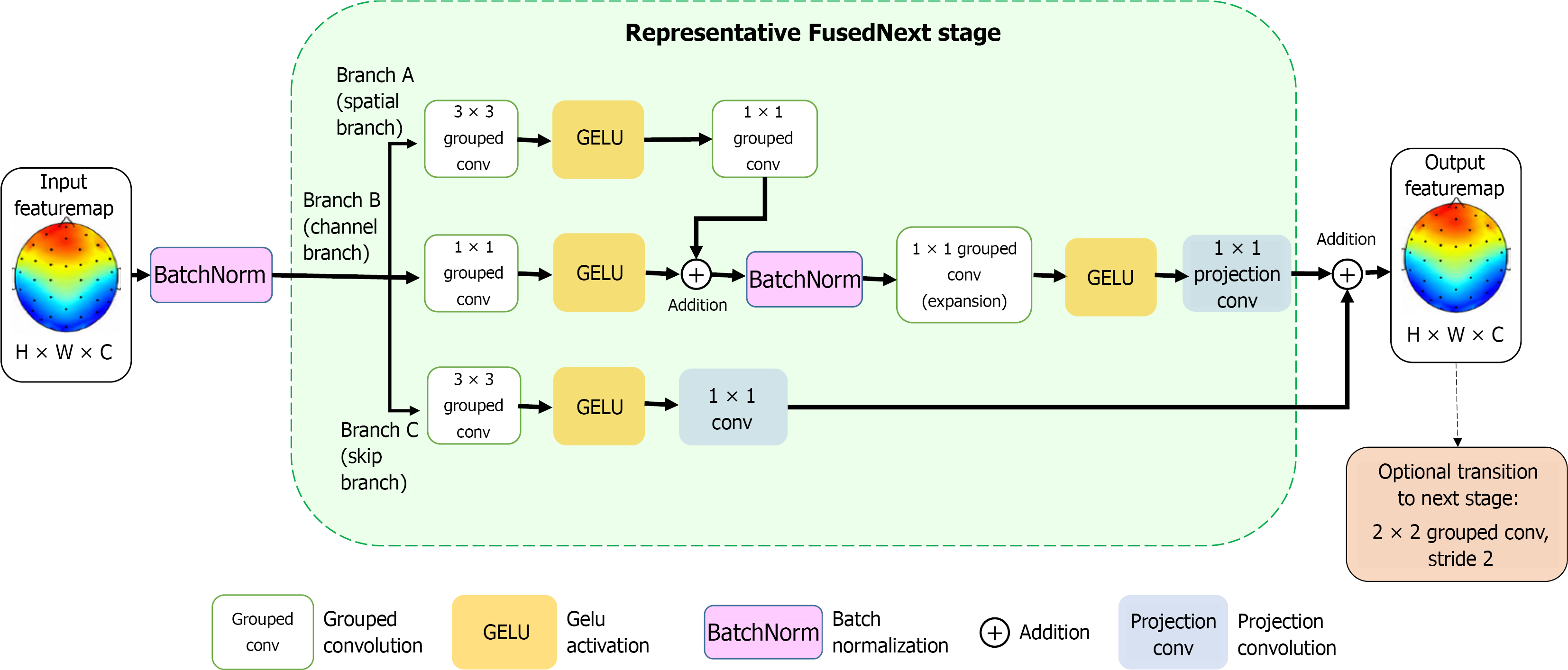
Figure 4 Detailed internal structure of a representative FusedNeXt stage, showing block A (spatial-mixing; equations 5-7) and block B (channel-mixing; equations 8-10) with their two parallel paths and additive hyper-connection (⊕) fusion points.
Block A combines a 3 × 3 depthwise-convolution path (P1) with a 1 × 1 grouped-convolution path (P2) and fuses them by element-wise addition followed by batch normalization. Block B combines a transformer-style inverted-bottleneck path (M; 1 × 1 grouped expansion → GELU → 1 × 1 projection) with a complementary 3 × 3 grouped-convolution path (R), again fused by element-wise addition followed by batch normalization. The two additive fusions form the hyper-connection points of the stage, allowing features from spatial and channel transformation paths to be combined within a shared representation space. GELU: Gaussian Error Linear Unit.
- Citation: Kaya S, Tasci G, Tuncer İ, Tasci B, Baygın N, Tasci I, Baygin M, Dogan S, Tuncer T. FusedNeXt-based anxiety detection from electroencephalography topographic maps: A comparative analysis of alpha, beta, and theta bands. World J Psychiatry 2026; 16(10): 123156
- URL: https://www.wjgnet.com/2220-3206/full/v16/i10/123156.htm
- DOI: https://dx.doi.org/10.5498/wjp.123156