
















Copyright: ©Author(s) 2026.
World J Exp Med. Sep 20, 2026; 16(3): 124656
Published online Sep 20, 2026. doi: 10.5493/wjem.124656
Published online Sep 20, 2026. doi: 10.5493/wjem.124656
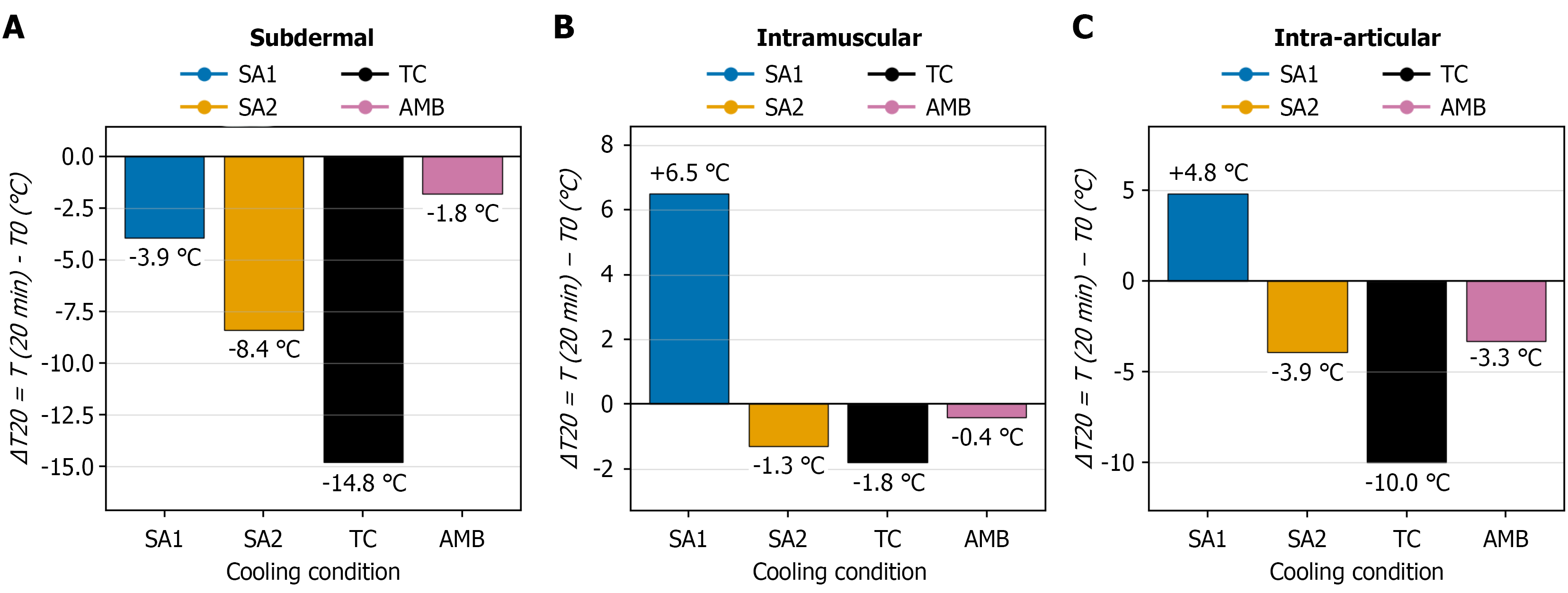
Figure 4 Temperature change at the 20-minute primary endpoint stratified by tissue depth and cooling condition.
The ΔT20, defined as T (20 minutes) - T0, for subdermal tissue, intramuscular tissue, and the intra-articular or retropatellar knee joint space. A: Subdermal tissue; B: Intramuscular tissue; C: The intra-articular or retropatellar knee joint space. Negative values represent cooling, and positive values represent warming. ThermoCuff produced the largest early reductions in subdermal and intra-articular temperatures under the tested cadaveric conditions. In contrast, intramuscular temperature changes were less pronounced across all conditions. SA1: SootheAway 1; SA2: SootheAway 2; TC: ThermoCuff; AMB: Ambient control.
- Citation: Ibrahim MA, Abdelhameed B, Beltagi A, Masoud M, Mohamed SAA, Khalifa AA. Convection-based vs conduction-based cooling in rehabilitation: A cadaveric porcine study of surface and intra-articular temperature reduction. World J Exp Med 2026; 16(3): 124656
- URL: https://www.wjgnet.com/2220-315x/full/v16/i3/124656.htm
- DOI: https://dx.doi.org/10.5493/wjem.124656