
















Copyright: ©Author(s) 2026.
World J Exp Med. Mar 20, 2026; 16(1): 115478
Published online Mar 20, 2026. doi: 10.5493/wjem.v16.i1.115478
Published online Mar 20, 2026. doi: 10.5493/wjem.v16.i1.115478
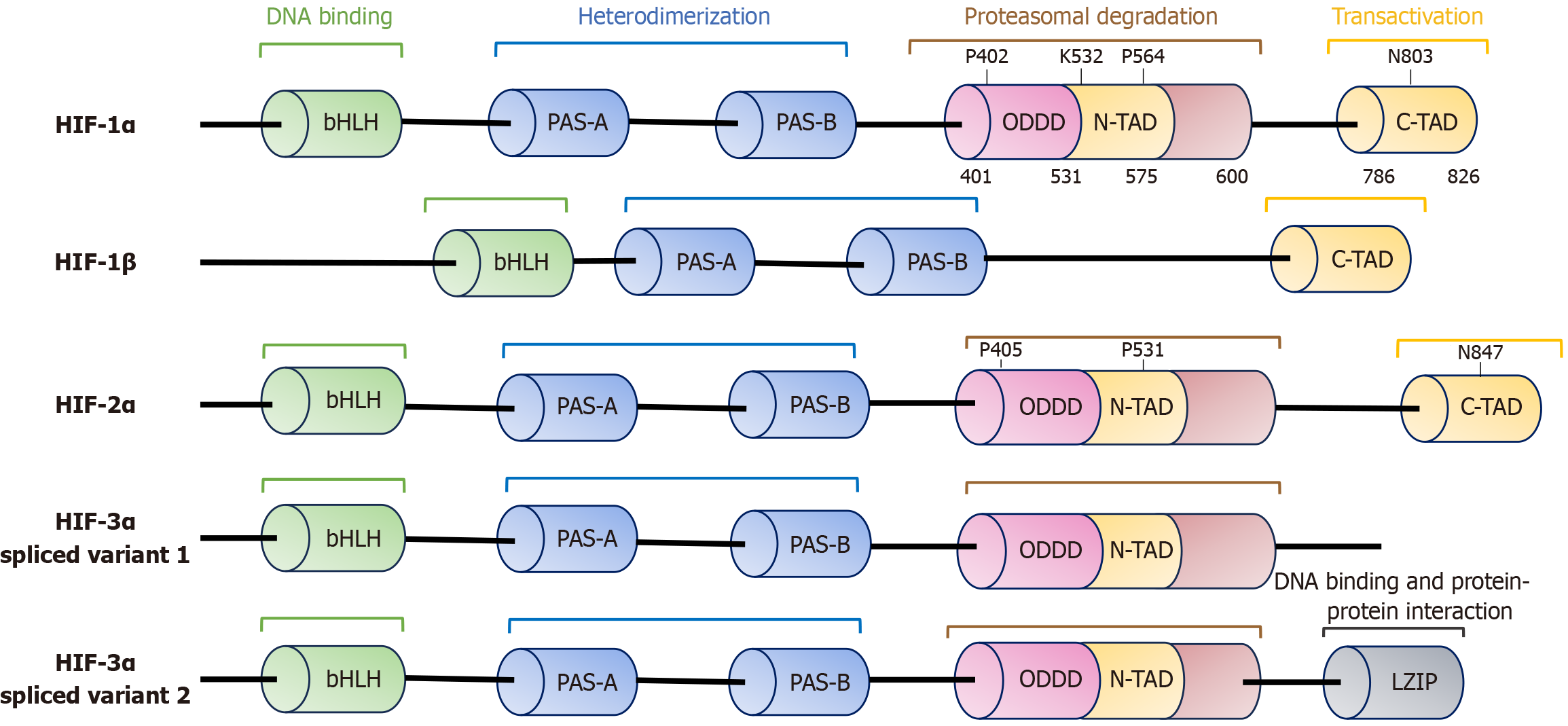
Figure 1 Schematic representation of the functional domains and potential roles of hypoxia inducible factor isoforms: Each column represents a distinct domain, with hydroxylation sites indicated above.
All hypoxia inducible factor (HIF) isoforms belong to the bHLH-PAS family containing a bHLH and two PAS domains (PAS-A and PAS-B) essential for HIF-1α and HIF-1β heterodimerization. Unlike HIF-1β, HIF-1α subunits possess an oxygen-dependent degradation domain (ODDD) that mediates proline hydroxylation and lysine acetylation, leading to proteasomal degradation. The ODDD contains an N-terminal activation domain and a C-terminal transactivation domain that regulate transcriptional activity. Conserved proline residues are present in HIF-1α and HIF-2α. Several HIF-3α splice variants exist, including variant 1, which lacks the C-terminal transcriptional activation domain, and variant 2, which contains a leucine zipper domain involved in DNA binding and protein interactions. HIF: Hypoxia inducible factor; N-TAD: N-terminal activation domain; C-TAD: C-terminal transcriptional activation domain; ODDD: Oxygen-dependent degradation domain; LZIP: Leucine zipper.
- Citation: Bhardwaj S, Pandey S, Ghosh DK, Sharma T, Jain BP. Deciphering the interplay between hypoxia, angiogenesis, and endoplasmic reticulum stress in carcinogenesis: A narrative review. World J Exp Med 2026; 16(1): 115478
- URL: https://www.wjgnet.com/2220-315x/full/v16/i1/115478.htm
- DOI: https://dx.doi.org/10.5493/wjem.v16.i1.115478