
















Copyright: ©Author(s) 2026.
World J Clin Oncol. Jun 24, 2026; 17(6): 120495
Published online Jun 24, 2026. doi: 10.5306/wjco.120495
Published online Jun 24, 2026. doi: 10.5306/wjco.120495
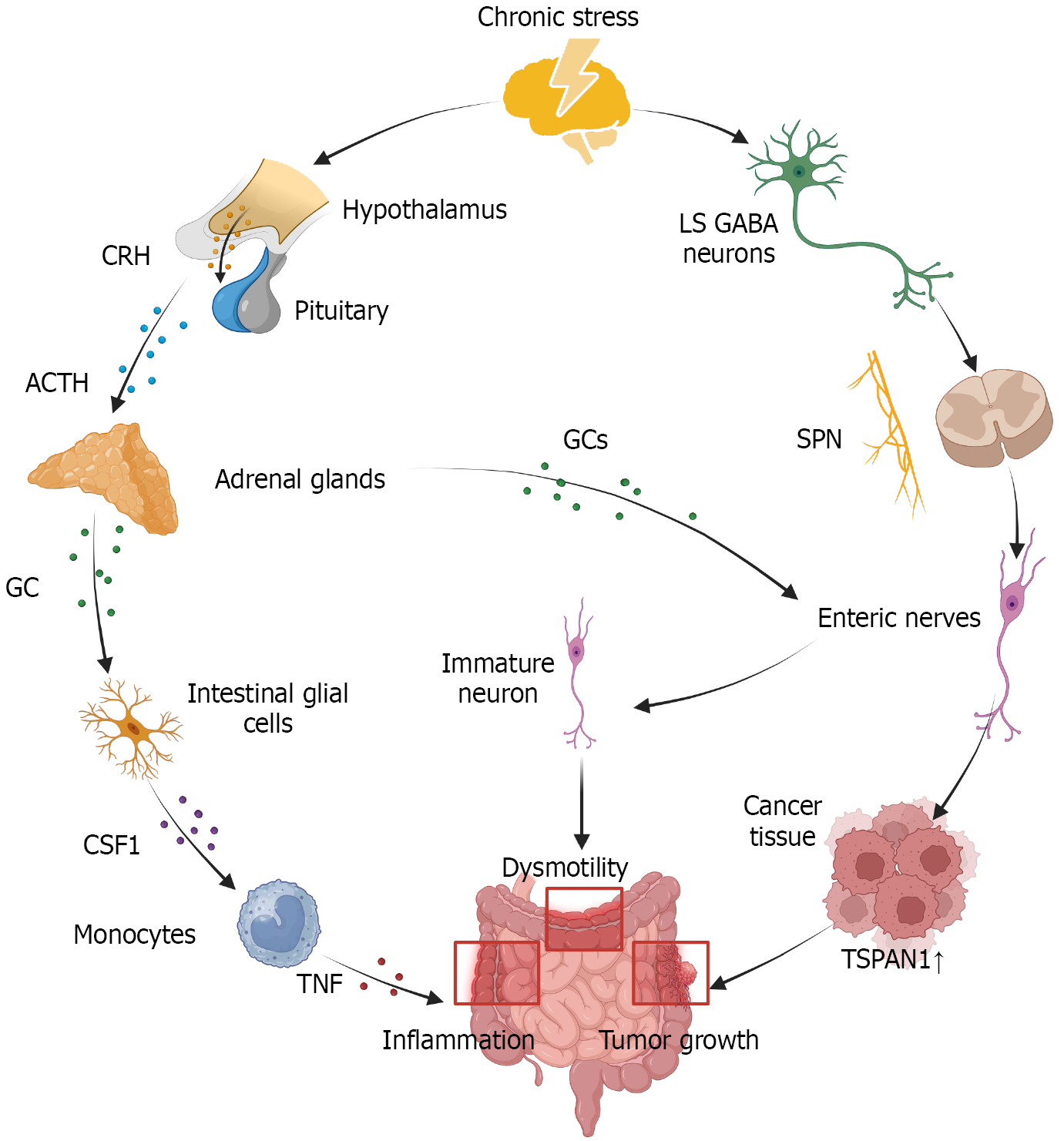
Figure 2 Chronic stress drives intestinal inflammation, dysmotility, and tumor growth through neuroendocrine and neuroenteric pathways.
This schematic integrates findings from studies of stress-associated intestinal inflammation and colorectal cancer progression. In the inflammatory pathway, chronic stress activates the hypothalamic-pituitary-adrenal axis, in which corticotropin-releasing hormone from the hypothalamus stimulates adrenocorticotropic hormone release from the pituitary, leading to glucocorticoid (GC) secretion by the adrenal glands. Sustained GC signaling promotes inflammatory enteric glial responses, inducing colony-stimulating factor 1-dependent monocyte recruitment and tumor necrosis factor-mediated intestinal inflammation. In parallel, GC signaling acts on enteric neurons through a transforming growth factor beta 2-associated program, driving enteric neuronal immaturity, reducing mature cholinergic and nitrergic neurons, lowering ACh availability, and contributing to dysmotility. In the neural-tumor pathway, chronic stress activates gamma-aminobutyric acid (GABA)-ergic neurons in the lateral septum, which signal through a septo-enteric polysynaptic circuit involving the sacral parasympathetic nucleus and tumor-innervating enteric cholinergic neurons. These enteric cholinergic neurons release GABA into the tumor microenvironment, activating epsilon-subunit-containing gamma-aminobutyric acid type A receptors encoded by gamma-aminobutyric acid type A receptor subunit epsilon in colorectal cancer (CRC) cells and promoting tetraspanin 1-associated tumor growth. Together, these pathways illustrate how chronic stress can engage endocrine, immune, enteric neuronal, and brain-gut neural circuits that converge on intestinal inflammation, motility dysfunction, and CRC progression. CRH: Corticotropin-releasing hormone; ACTH: Adrenocorticotropic hormone; CSF1: Colony-stimulating factor 1; TNF: Tumor necrosis factor; LS: Lateral septum; SPN: Sacral parasympathetic nucleus; TSPAN1: Tetraspanin 1; GABA: Gamma-aminobutyric acid; GABRE: Gamma-aminobutyric acid type A receptor subunit epsilon; GCs: Glucocorticoids.
- Citation: Wang SR, Cao TL, Xia ZA, Jiang HZ. Enteric neural-tumor interactions in gastrointestinal malignancies and therapeutic implications. World J Clin Oncol 2026; 17(6): 120495
- URL: https://www.wjgnet.com/2218-4333/full/v17/i6/120495.htm
- DOI: https://dx.doi.org/10.5306/wjco.120495