
















Copyright: ©Author(s) 2026.
World J Clin Oncol. Nov 24, 2026; 17(11): 125917
Published online Nov 24, 2026. doi: 10.5306/wjco.125917
Published online Nov 24, 2026. doi: 10.5306/wjco.125917
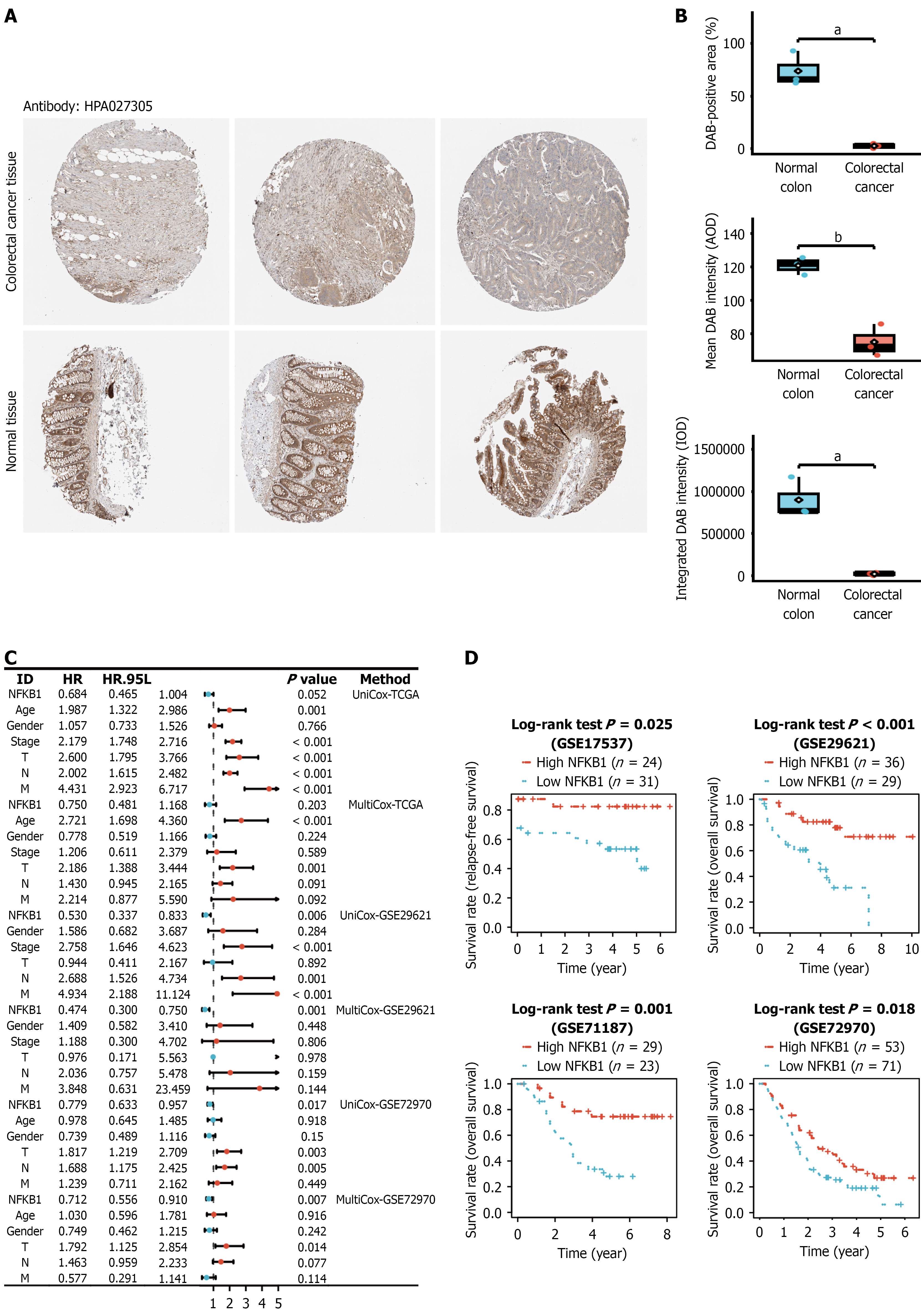
Figure 3 Exploratory Human Protein Atlas staining differences and cohort-specific prognostic associations of NFKB1 expression in colorectal cancer.
A: Representative NFKB1 immunohistochemistry images retrieved from the Human Protein Atlas using antibody HPA027305. Three colorectal cancer specimens and three normal colon specimens from different patients are shown. The corresponding Human Protein Atlas record identifiers, patient characteristics, pathological annotations, staining intensity, staining quantity, staining location, and image names are provided in Supplementary Table 2; B: Exploratory semiquantitative comparisons of the 3,3′-Diaminobenzidine (DAB) positive area percentage, mean DAB optical density, and integrated DAB optical density between normal colon and colorectal cancer specimens. Three nonoverlapping regions of interest were evaluated per image, and their mean was used as the independent patient-level value. Each point represents one patient specimen (n = 3 per group). Comparisons were performed using two-sided Welch’s t-tests; C: Forest plot of univariable and multivariable Cox regression analyses evaluating the prognostic impact of NFKB1 together with clinicopathological variables (e.g., age, sex, stage/T/N/M) in The Cancer Genome Atlas and independent Gene Expression Omnibus validation cohorts; D: Exploratory Kaplan–Meier curves stratified by cohort-specific median NFKB1 expression. Relapse-free survival was analyzed in GSE17537, whereas overall survival was analyzed in GSE29621, GSE71187, and GSE72970. Group sizes and log-rank P values are shown. Median dichotomization was used for visualization and does not represent a clinically validated cutoff. aP < 0.05; bP < 0.01; TCGA: The Cancer Genome Atlas; HR: Hazard ratio. DAB: 3,3′-Diaminobenzidine.
- Citation: Lin X, Lin ZL, Li Y, Huang CD, Chen S, Shi DL, Chen XQ. Spatial macrophage signatures and prognostic relevance of NFKB1 in colorectal cancer. World J Clin Oncol 2026; 17(11): 125917
- URL: https://www.wjgnet.com/2218-4333/full/v17/i11/125917.htm
- DOI: https://dx.doi.org/10.5306/wjco.125917